
A red maze at the village edge
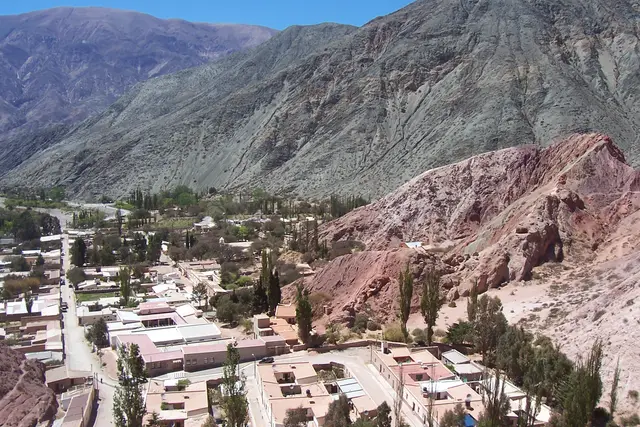
Purmamarca’s adobe houses stop and the earth turns red. That is where Paseo de los Colorados begins. A dirt road leaves the village and curls behind it, through towers, fins and gullies of iron-stained sediment that the wind and rare heavy rains have carved over a very long time.
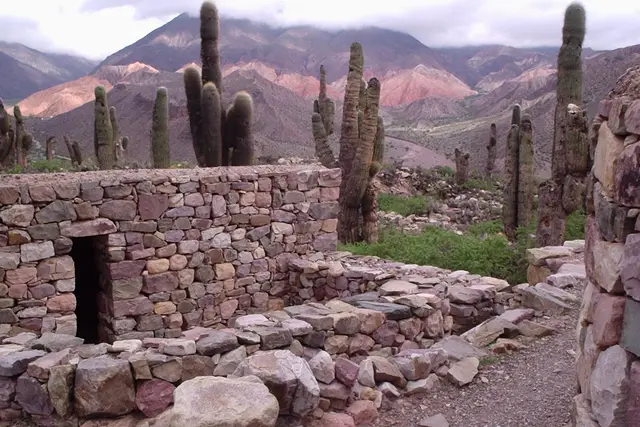
Tall cardón cacti stand on the slopes like fence posts. The track itself is packed earth and gravel, wide enough for a car. On foot, you are close enough to see the layered bands in the rock, from deep oxblood to pale ochre.
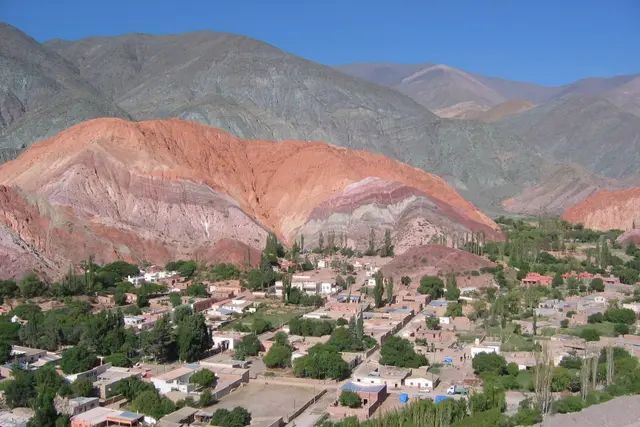
Most visitors photograph the Cerro de los Siete Colores from the plaza and leave. The loop gets far less traffic, so walking it often feels like having the hills to yourself.
Finding the trailhead
Purmamarca is about 65 km north of San Salvador de Jujuy. It sits a few kilometres west of Ruta Nacional 9, on Ruta 52, the road that climbs on to Salinas Grandes and the Paso de Jama into Chile. Buses from Jujuy city stop in the village, and the whole place is small enough to cross on foot in minutes.
From the main plaza, head towards the western edge of town and follow signs for the Paseo de los Colorados. The street turns to dirt and the red walls close in almost straight away. Ask at your lodging which direction they suggest, as both ends of the loop come back into the village.
What the loop looks like
The circuit runs for roughly 3 km. On the outer side it opens to views back over the Quebrada de Humahuaca, a valley listed by UNESCO as a World Heritage cultural landscape in 2003. The inner side is a corridor of eroded formations, some taller than a house, with narrow gullies running off between them.
Look for:
- Crumbling red pinnacles close to the track, best seen in side light
- Cardón cacti, the columnar species used for the beams and doors of Andean churches
- Glimpses of the Cerro de los Siete Colores and its striped slopes
- Rooftops of Purmamarca from above as the loop turns back towards town
Allow 1–1.5 hours at an easy walking pace, more if you stop for every photo. A car does it in minutes. The ground is gentle, but the altitude makes every short rise feel steeper.

Light, season and timing
The path is open 24 hours, but it has no lighting. Plan to be off it before dark. The best colour comes when the sun is low, so early morning and late afternoon are the times to walk, and the midday glare flattens the reds.
The dry months, roughly April to November, are the most reliable. Summer brings the rainy season, when storms can turn the gullies into fast-running mud. Winter days are sunny and clear, but the temperature falls sharply once the sun drops behind the ridge.
On the track: pace, cars and the rock
The loop is shared ground, so a few habits make it easier for everyone.
- Walk the edge. Cars and tour vans use the same track. Keep to one side and expect dust when they pass.
- Stay off the formations. The rock is soft sediment that breaks under a boot. Climbing it speeds up the erosion that made it, and loose pieces fall.
- Go slowly at altitude. Purmamarca sits at about 2,300 metres. If you came up from Jujuy city that morning, walk slower than you want to and drink often.
- Carry everything. There are no shops or taps along the loop. Bring water, a hat and sunscreen, because the sun is strong at this height even when the air feels cool.
- Greet people. Some residents live along the edges of the route. A “buen día” goes a long way in a village this small.
There is no ticket booth or ticket office, so no queue either. Just start walking.
Pairing it with the village
The loop fits easily into half a day in Purmamarca. Afterwards, walk back to the plaza and its artisan stalls, where woven textiles, llama-wool goods and ceramics hang under the trees. On the corner stands the Iglesia de Santa Rosa de Lima, a whitewashed adobe church from the 17th century with a ceiling built from cardón wood.
If you have a car and another morning, Ruta 52 climbs over the Cuesta de Lipán to the white salt flats of Salinas Grandes. To head north instead, Ruta 9 runs up the Quebrada past Tilcara and on to Humahuaca. The Paseo de los Colorados works best early in a stay, before the bigger day trips, while you are still getting used to the altitude.
Frequently asked questions
How long does it take to walk Paseo de los Colorados?
The loop is roughly 3 km and takes about 1–1.5 hours at an easy pace, longer if you stop often for photos. Driving it takes only a few minutes.
What is the best time of day to walk it?
Early morning or late afternoon, when low sun brings out the reds and the heat is easier. The path is listed as open 24 hours but has no lighting, so finish before dark.
How do I get to the start from Purmamarca?
Walk from the main plaza towards the western edge of the village and follow the signs. The street turns to dirt and the red formations start almost immediately. Both ends of the loop lead back into town.
Is it suitable during the rainy season?
The dry months, roughly April to November, are the most reliable. Summer storms can send mud and water through the gullies, so check the weather and ask locally before setting out.
What else is nearby?
In Purmamarca itself you have the plaza artisan market, the 17th-century Iglesia de Santa Rosa de Lima and the Cerro de los Siete Colores. Further away are Salinas Grandes via Ruta 52, and Tilcara and Humahuaca to the north on Ruta 9.
Plan your trip to Purmamarca
Argentina eSIM & staying connected →
Some links above are affiliate links — if you book through them, Wander Atlas earns a small commission at no extra cost to you. It's how we keep every guide free.
Related guides
 attraction
Purmamarca Jujuy: Travel Guide (4.8★)
 attraction
Cerro de los Siete Colores: Purmamarca Travel Guide (4.8★)
 attraction
Pucará de Tilcara: Purmamarca Travel Guide (4.7★)
 attraction