At the foot of the shell
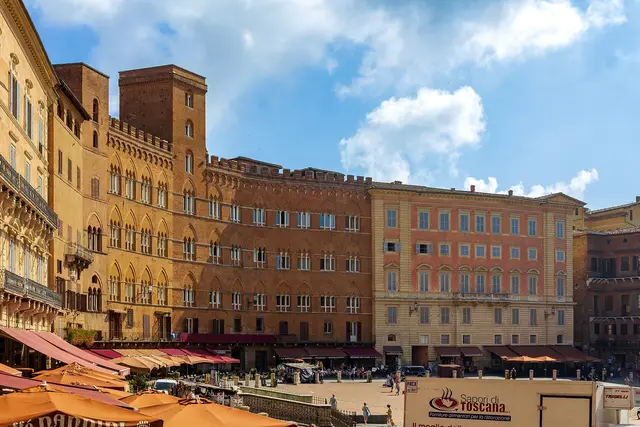
Piazza del Campo slopes downhill. Its fan of red brick is split by nine pale stone lines, one for each member of the Council of Nine who governed Siena when this square was laid out. All nine lines run down to a single building, the Palazzo Pubblico.
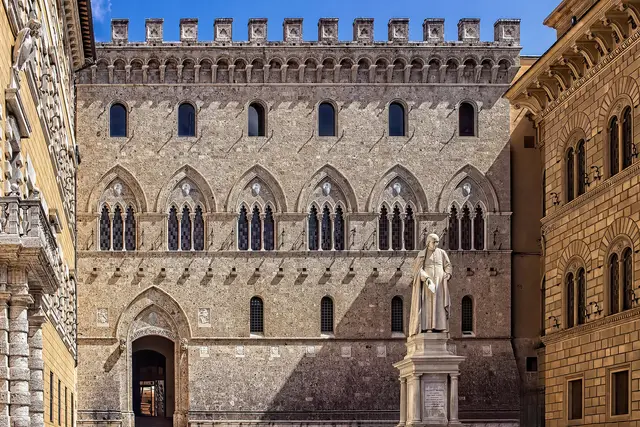
The palazzo went up from the late 1290s. The ground floor is grey travertine and the floors above are brick, set with rows of pointed triple windows. The facade bends very slightly inward to follow the curve of the piazza. Above the windows you’ll see the black-and-white balzana, Siena’s coat of arms, repeated across the stone.
It’s one of the best-known buildings in Tuscany, so expect company. What gets missed is how much is packed inside: a medieval government’s rooms, still painted the way its officials wanted.
Upstairs, the rooms of a republic
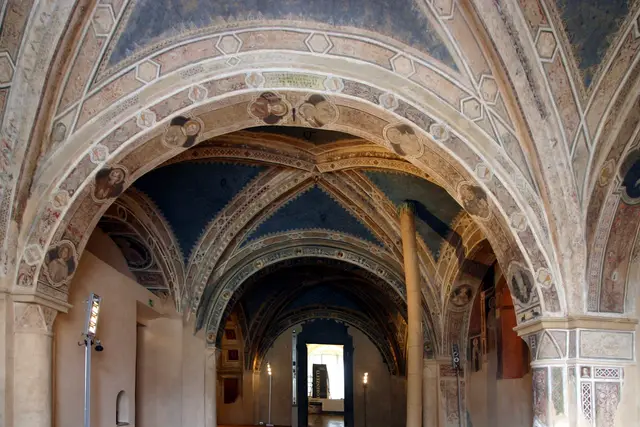
The Museo Civico occupies the upper floors. Most of it is a series of council chambers, so you walk through actual working rooms. They are high, often dim, and covered in fresco from floor to vaulted ceiling.
The Sala del Mappamondo is the big one. Covering one end wall is Simone Martini’s Maestà from 1315: the Virgin enthroned under a painted canopy, with saints crowded around her. Facing it is the famous image of the condottiere Guidoriccio da Fogliano. He rides alone across a bare brown landscape of castles, and both horse and rider are draped in the same patterned cloth.
Look out for these as you move through:
- Sala di Balia, painted with scenes from the life of the Sienese pope Alexander III
- The chapel, with its carved wooden choir stalls and an iron grille
- The loggia at the back, which looks south over the valley toward the countryside
Good and Bad Government, the room to slow down in
Give the Sala dei Nove, also called the Sala della Pace, more time than anything else. Between 1338 and 1339, Ambrogio Lorenzetti covered three walls with the Allegory and Effects of Good and Bad Government. The Nine met beneath these paintings, so the walls were a lecture aimed at the people running the city.
The well-governed city is on the right wall. Builders are at work on rooftops, a ring of dancers fills the street, and a shoe shop is open for trade. Outside the gate, farmers bring goods to market across a carefully painted Sienese landscape.
The bad-government wall is in much worse condition. Even so, you can make out Tyranny with horns and a ruined, soldier-filled countryside. Stand in the middle of the room and turn slowly. The painting only makes full sense once you’ve seen all three walls together.

Up the Torre del Mangia
The tower rises from the palazzo’s left corner and was finished in 1348. It’s a narrow brick shaft topped by a stone crown, and the climb is about 400 steps. Higher up the stairs get tight. Near the top you come out under the bell, with the whole Campo below you.
The name comes from the tower’s first bell-ringer, nicknamed “Mangiaguadagni” (roughly “eat-the-profits”). You’ll find a statue of him in the Cortile del Podestà, the courtyard at the entrance.
At the base of the tower is the Cappella di Piazza, an open stone loggia. The city vowed to build it after the Black Death of 1348.
Getting to Il Campo
The address is Il Campo, 1. You can’t drive to the door, because the historic centre is a limited-traffic zone (ZTL).
- By train: Siena station sits below the walls. Escalators and a short uphill walk take you into the centre. Buses from the station also run to Piazza Gramsci.
- By car: use a car park outside the walls. Parcheggio Santa Caterina near Fontebranda has escalators up into town.
- On foot from the centre: the shops along Via di Città and Banchi di Sotto have narrow passages between them that drop into the Campo. One of the best is the covered lane of Costarella dei Barbieri.
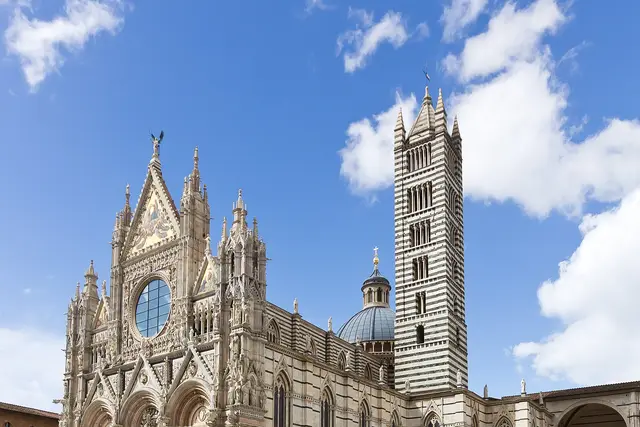
From the Duomo it’s under ten minutes on foot, mostly downhill.
Tickets, slots and the tower line
Tower visits work differently from the rest of the building. Only a small number of people can climb the Torre del Mangia at once, so entry runs in timed groups. Some slots sell out on busy days. Book a slot online or at the ticket desk in the courtyard first, then plan the museum around it.
The museum and the tower have separate tickets, and combined tickets are often sold too. Current options and prices are listed on the official Museo Civico site and at the ticket office, so check them there.
A few more things to know:
- Large bags may have to go into storage before you climb, so pack light.
- The stairs are steep and narrow, which makes the tower a poor choice if you’re uneasy in tight spaces.
- Photography rules can vary by room. If staff ask you to put the camera away, do it.
- Doors currently open at 10am. Opening hours change with the season and on holidays, so check before you go.
A sensible order is the tower first, while your legs are fresh. Then do the frescoes at your own pace and finish in the loggia.
Palio days in the piazza
Twice a year, on 2 July and 16 August, the Campo hosts the Palio. In this bareback horse race, Siena’s contrade (neighbourhoods) race three laps around the square. In the days beforehand, earth is packed over the outer ring of the piazza and wooden stands go up against the buildings.
On race days the palazzo is part of the stage, and visiting it as normal isn’t realistic. The square fills hours before the race. If you’re in town that week, expect changed access and check the museum’s schedule ahead.
On ordinary days, finish the way most visitors do: sit on the sloping brick, where everyone else is sitting too, and look back at the building. From there you’ll see the white marble Fonte Gaia at the top of the square. It’s a copy, and Jacopo della Quercia’s original panels are across town in Santa Maria della Scala. That’s a natural next stop if the frescoes have left you wanting more.
Frequently asked questions
How long should I spend at the Palazzo Pubblico?
Allow about 1.5–2 hours: roughly an hour for the Museo Civico frescoes and 30–45 minutes for the Torre del Mangia climb. If you only have time for the museum, put the Sala dei Nove with Lorenzetti's Good and Bad Government first.
What are the opening hours?
At the moment it opens 10am–6pm. Hours change through the year and on holidays, so check the official Museo Civico site for this month's times.
Do I need to book the Torre del Mangia?
It's a good idea. Only a small group can climb at once, so entry is in timed slots that can sell out. Book online or at the courtyard ticket desk, then fit the museum around your slot.
How hard is the tower climb?
It's about 400 steps up a narrow brick stairway, and it gets tight near the top. It isn't suitable if you have mobility problems or struggle in confined spaces.
What else is nearby?
Everything in the Campo: the Fonte Gaia, the Cappella di Piazza and the cafés around the square. The Duomo and Santa Maria della Scala, which holds Jacopo della Quercia's original Fonte Gaia panels, are under ten minutes' walk uphill.
Plan your trip to Siena
Italy eSIM & staying connected →
Some links above are affiliate links — if you book through them, Wander Atlas earns a small commission at no extra cost to you. It's how we keep every guide free.