Spears in the middle of the traffic
Surabaya built a memorial out of a weapon. Tall concrete shafts rise from a planted island on Jalan Panglima Sudirman, each one cut at a slant like a sharpened bamboo pole. They stand at different heights, bunched together the way spears lean in a rack.
Around the base sit a fountain and flower beds. Beyond those, the traffic of one of the city’s main north-south roads streams past on both sides. You are standing on a small green island in central Surabaya, in Embong Kaliasin, Genteng district, and the spears are what drivers look up at as they pass.
Why bamboo, and why here
Bambu runcing means “sharpened bamboo.” During the fight for independence, many Indonesian fighters had no firearms. They carried bamboo poles cut to a point.
Surabaya holds a special place in that story. The Battle of Surabaya began on 10 November 1945, when local fighters and townspeople took on British-led forces in weeks of street fighting. Indonesia now marks that date as Hari Pahlawan, Heroes’ Day. The city calls itself Kota Pahlawan, the City of Heroes, and this monument is one of several around the centre that keep the memory in public view.
So the spears aren’t abstract sculpture. They stand for the crude tools ordinary people picked up against a modern army, and Surabayans recognise that at once.
Crossing over and walking round
The approach takes more care than the visit. The monument sits in the road corridor, so you will cross traffic to reach it. Use a marked crossing or a gap with traffic lights. Motorbikes filter through every space, so check both ways even when the cars have stopped.
Once you are on the island, the visit is simple:
- Walk the full circuit. The spears line up differently from each side, and the low angle from the south shows their height best.
- Stand back by the fountain for photographs. Close up, you can’t fit the tallest shafts in the frame.
- Look at the cut tips. The slanted ends are the detail that reads as “spear” and not “pillar.”
Twenty to thirty minutes is plenty unless you are setting up careful photographs.

Getting the timing right in Surabaya’s heat
Google currently lists the grounds as open 24 hours. It is an open-air public space, but treat that as this week’s listing and not a promise for every date. Surabaya is hot and humid all year, and the island has little shade at midday.
That makes the time of day matter. Early morning is cooler and the light is softer on the concrete. Late afternoon is the other good window, as the heat eases and the shadows lengthen across the flower beds.
This is a well-known city landmark, so you won’t have it to yourself. Expect other visitors taking photographs, especially at weekends. In the rainy season, roughly November to March, afternoon downpours are common. Go early or carry an umbrella.
Visiting a memorial on a traffic island
There are a few habits to follow at a place like this.
- Treat it as a memorial. Don’t climb the base or the spears, and keep out of the fountain. Locals see this as a tribute to the people who died in 1945.
- Get there by ride-hailing. Most visitors use Grab or Gojek, and both work well in central Surabaya. Set your pickup on Jalan Panglima Sudirman beside the monument so the driver can stop on the right side of the road.
- Don’t plan on parking. There’s no obvious place to leave a car on the island itself. Being dropped off is easier than driving.
- Expect a quick hello. Indonesians are friendly with visitors and may ask for a photo with you. A smile and terima kasih (thank you) goes a long way.
- Mind the date. Around 10 November, the city holds Heroes’ Day ceremonies and events. They are moving to see, but they can change traffic and access across the centre.
Building a heroes’ half-day
Bambu Runcing works best as one stop on a loop through Surabaya’s independence sites. Head north to Tugu Pahlawan, the tall Heroes Monument. The 10 November Museum sits on the same grounds and explains the battle in far more detail than any monument can.
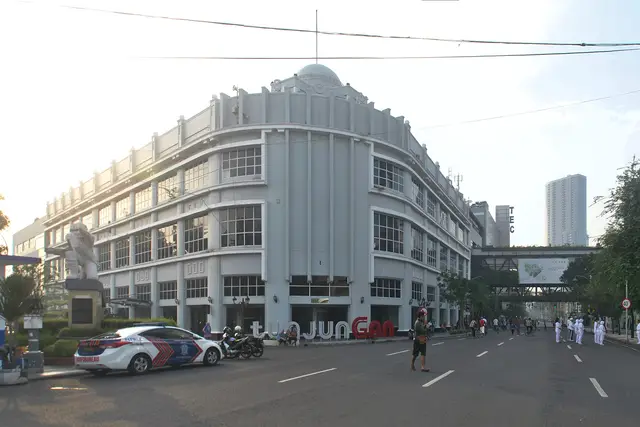
Nearer by, the Monumen Kapal Selam is a retired Soviet-built navy submarine set up as a museum beside the Kalimas river. On the way, Jalan Tunjungan, the old colonial shopping street, is good for a walk and a cold drink. All of these are a short ride apart, so a morning covers the lot before the worst of the heat.
Frequently asked questions
Where exactly is Monumen Bambu Runcing?
It stands on a planted island in the middle of Jalan Panglima Sudirman, in Embong Kaliasin, Genteng district, central Surabaya. Setting your Grab or Gojek pickup on Jalan Panglima Sudirman beside the monument works well.
When is the best time to visit?
Google currently lists the grounds as open 24 hours, but check before you go. Early morning or late afternoon is most comfortable, because the island has little shade in Surabaya's midday heat. Around 10 November (Heroes' Day), commemorations can change traffic and access.
How long should I spend there?
About 20–30 minutes is enough to walk round the spears, see the fountain and take photographs. Allow longer if you combine it with Tugu Pahlawan and the 10 November Museum.
What does the monument represent?
The concrete spears stand for the sharpened bamboo poles (bambu runcing) that Indonesian fighters carried during the independence struggle, including the Battle of Surabaya that began on 10 November 1945.
What else is nearby?
Tugu Pahlawan and the 10 November Museum, the Monumen Kapal Selam submarine museum, and the colonial-era Jalan Tunjungan are all a short ride away and make an easy half-day loop.
Plan your trip to Surabaya
Indonesia eSIM & staying connected →
Some links above are affiliate links — if you book through them, Wander Atlas earns a small commission at no extra cost to you. It's how we keep every guide free.