Farm Cove, the oldest garden in the country
Start with the water. Royal Botanic Garden Sydney wraps the curve of Farm Cove, so the harbour is beside you on most paths. The Opera House sails rise at one end and the bridge sits behind them.
This is where the colony’s first farm was planted in 1788. The garden was founded in 1816, which makes it Australia’s oldest scientific institution. Before any of that, this foreshore was Gadigal land. The Cadi Jam Ora: First Encounters garden tells that story in plants and text.
It is also one of the most-reviewed attractions in the city. Don’t expect solitude after lunch. The rest of this guide is about timing your visit so the lawns feel like yours.
Gates, trains and ferries
You have several ways in. Circular Quay is the easiest: trains, ferries and the L2 and L3 light rail all stop there. From the Quay, walk east past the Opera House forecourt to the Queen Elizabeth II Gate. It takes about ten minutes.
Other entries suit other plans:
- Palace Garden Gate on Macquarie Street, close to St James and Martin Place stations
- Woolloomooloo Gate on the eastern side, near the Art Gallery of New South Wales and The Domain
- Mrs Macquaries Road, the official address, which runs out to the point
The grounds are free to enter. Some exhibitions and guided experiences are ticketed, and current prices are posted on the garden’s official website.
Mrs Macquarie’s Chair before the coaches
This place has its own daily rhythm. The best hour is the first one. Gates open at 7am every day of the week, and the measured quiet window runs from 7am to 9am on weekdays and 7am to 10am on weekends.
Use that window to walk the foreshore path out to Mrs Macquarie’s Chair. It is a bench carved into the sandstone by convicts in 1810 for Elizabeth Macquarie, the governor’s wife. From the point you see the Opera House and Harbour Bridge lined up in one frame.
By weekend lunchtime that view is shared with tour groups and wedding photographers. Early on, it is mostly runners and the harbour ferries pulling out of the Quay. Loop back through the garden beds afterwards, while the lawns are still empty.

Roses, ferns and a dinosaur jungle
The garden spreads across a lot of ground. Pick a few areas rather than trying to see every bed. These are the ones worth finding on the map at the gate:
- The rose garden, formal beds and arbours, at their fullest in spring and early summer
- The fernery, a shaded, damp pocket that is a relief on a hot afternoon
- The Calyx, a curved glasshouse exhibition space with changing plant displays
- Jurassic Jungle, the kids’ area, built around plants with ancient lineages
- The Wollemi pine, a “living fossil” species found in the Blue Mountains region in 1994
- Cadi Jam Ora, the First Encounters garden on Gadigal history and plant use
Allow two to three hours for a relaxed loop that takes in the harbour edge. With children and a picnic, it is easy to fill half a day.
The garden’s other residents
Wildlife is part of the visit here. Australian white ibis stalk the lawns and bins. Sulphur-crested cockatoos screech in the canopy, and Australian water dragons sun themselves on paths and pond edges.
Keep your sandwiches covered. The ibis and cockatoos have learned exactly what a picnic blanket means. Don’t feed them, even when they get close; the garden asks visitors not to.
Bring binoculars if birds are your thing. The mix of open lawn, old trees and water draws more species than you’d expect this close to the CBD.
Picnics, paths and the 5pm gates
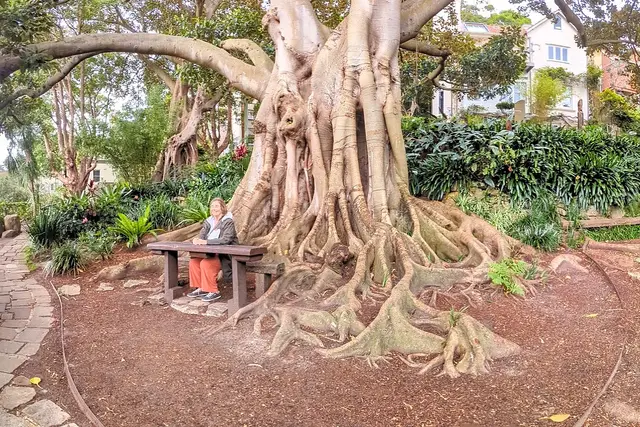
Walking on the grass is welcome here, and Sydneysiders treat the lawns as a backyard. Spread a rug under a fig and you fit right in. People bring takeaway from Circular Quay or Macquarie Street rather than relying on the garden’s own options.
A few habits that make the day smoother:
- Arrive at 7am, especially on weekends. The 12pm to 5pm weekend stretch is the busiest of the week.
- Watch the clock. The listed hours are 7am to 5pm every day, so a sunset picnic means moving to the harbour foreshore outside the gates.
- Carry water and a hat. Sydney sun is strong, and shade between the big trees can be patchy.
- Use the free map at the main gates. The paths curve, and it is easy to come out at the wrong gate.
If you want a sit-down coffee, find it early. Café seats fill fast on weekend afternoons.
Stringing it together with the harbour
The garden sits between some of Sydney’s best-known sights, so plan it as part of a walk. Start at the Opera House and enter through the Queen Elizabeth II Gate. Follow the Farm Cove seawall to Mrs Macquarie’s Chair, then cut back through the beds.
From the Woolloomooloo side, The Domain leads straight to the Art Gallery of New South Wales. Government House sits within the garden’s grounds near the Opera House end, and St Mary’s Cathedral is a short walk up from Palace Garden Gate.
Finish at Circular Quay, where the ferries to Manly and Watsons Bay leave. That way the morning ends on the same water it started beside.
Frequently asked questions
When is the quietest time to visit Royal Botanic Garden Sydney?
The quietest times are 7am to 9am on weekdays and 7am to 10am on weekends. Try not to arrive between 12pm and 5pm on weekends, the busiest stretch of the week.
What are the opening hours?
The listed hours are 7am to 5pm, seven days a week. Check the official website before you go in case hours change for the season or an event.
How do I get to the Royal Botanic Garden by public transport?
Take a train, ferry or the L2/L3 light rail to Circular Quay. From there it is about a ten-minute walk past the Opera House to the Queen Elizabeth II Gate. St James and Martin Place stations are closer to the Palace Garden Gate on Macquarie Street.
How long should I spend there?
Allow two to three hours to see the rose garden, fernery and Calyx and walk out to Mrs Macquarie's Chair. With a picnic or children heading for Jurassic Jungle, plan for half a day.
What is nearby?
The Sydney Opera House and Circular Quay are at the western edge. The Domain and the Art Gallery of New South Wales are on the eastern side, and Mrs Macquarie's Chair is at the tip of the peninsula.
Plan your trip to Sydney
Some links above are affiliate links — if you book through them, Wander Atlas earns a small commission at no extra cost to you. It's how we keep every guide free.