
Two Macaus, one hill apart
From the casino towers of Cotai, Vila da Taipa looks like a smudge of low rooftops at the foot of a slope. Walk in and the scale drops fast. Lanes narrow to a car’s width, and street signs come in blue-and-white Portuguese tiles with Chinese characters underneath.
This was a fishing and fireworks-making village before land reclamation joined Taipa to Coloane. It still sees fewer visitors than Senado Square on the peninsula, especially once you leave the main snack street. The Google listing sits on Rua Governador Tamagnini Barbosa, one of the lanes threading the core.
Rua do Cunha and the side lanes
Most people enter through Rua do Cunha, a pedestrian lane packed with bakeries and snack counters. Shopfronts stack trays of almond cookies and offer samples by the door. What to look for along here:
- Almond cookies and peanut candy from the bakery chains
- Pork chop buns, Macau’s signature sandwich
- Serradura, the Portuguese “sawdust” pudding of cream and crushed biscuit
- Portuguese and Macanese restaurants on the lanes running off the main strip
Step one street sideways and the crowd thins. Largo dos Bombeiros and the alleys around it hold small temples, including the Pak Tai Temple, with incense coils hanging from the roof beams.
Up to the church and the green houses
Climb the stairs at the village’s southern edge to Our Lady of Carmel Church. It’s a cream-coloured Catholic church from the late 19th century, set in a small garden above the old waterfront.
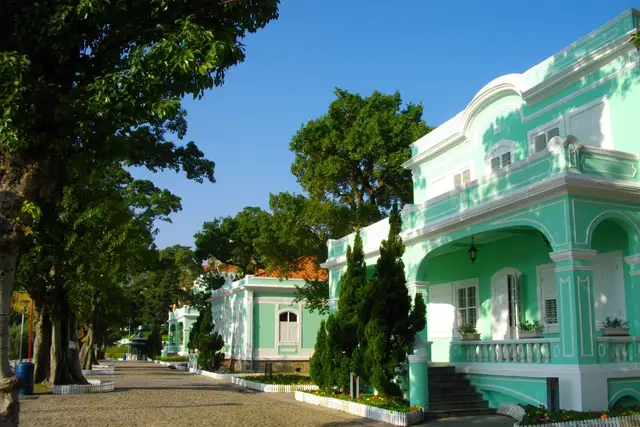
Below it, on Avenida da Praia, stand the Taipa Houses-Museum. These are five mint-green houses built in 1921 for Macanese families, with furnished period rooms inside. The trees in front once lined the shore. Across the former water now is reclaimed land and the Venetian, which gives you the island’s whole history in one view.
From the Venetian it’s roughly a 10 to 15 minute walk. Several public buses stop on the village edge.
Getting the village right
Macau runs on the pataca. Hong Kong dollars are widely accepted at small shops, though your change usually comes back in patacas. Many counters also take Macau Pass cards and mobile wallets, but the smallest stalls may want cash.
Arriving in the morning usually beats the day-trippers coming over from the casinos. After dark the lanes empty out, and the church and museum houses are lit up. Inside temples, keep your voice down. Don’t photograph people praying, and don’t step over the raised door thresholds.
The Taipa Houses-Museum and the shops set their own hours and close days. Check the museum’s official listing before planning around it, and see the menu boards for prices. Learning a few Cantonese words goes further here than Portuguese: m̀h-gōi (thanks) gets used at every counter.
Frequently asked questions
How do I get to Vila da Taipa?
The village sits just north of the Cotai Strip, roughly a 10 to 15 minute walk from the Venetian. Several public buses stop on its edge, and many visitors use the free casino shuttles to Cotai, then walk.
How long should I spend in Taipa Village?
Two to three hours covers Rua do Cunha, the side-lane temples, Our Lady of Carmel Church and the Taipa Houses-Museum. Add time if you're sitting down for a Portuguese or Macanese meal.
Is Vila da Taipa open at night?
The streets are open 24 hours, and the church and green museum houses are lit after dark. Shops, temples and the museum close at their own times, so check those before you go.
What should I eat on Rua do Cunha?
Almond cookies, peanut candy, pork chop buns and serradura pudding are the classics. Sit-down Portuguese and Macanese restaurants are in the lanes off the main strip.
What's nearby?
The Cotai casino resorts, including the Venetian, are directly south across the reclaimed land. Coloane village is a short bus ride further south.
Plan your trip to Taipa
Macau eSIM & staying connected →
Some links above are affiliate links — if you book through them, Wander Atlas earns a small commission at no extra cost to you. It's how we keep every guide free.
Related guides
 attraction
 Taipa Houses: Taipa Village Travel Guide (4.2★)
 attraction
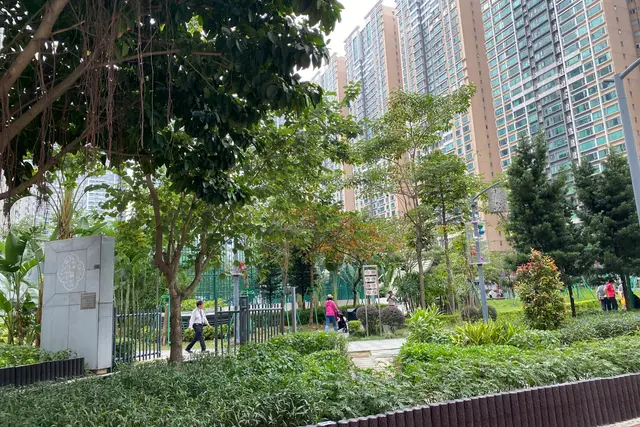
 Taipa Central Park: Taipa Village Travel Guide (4.3★)
 attraction
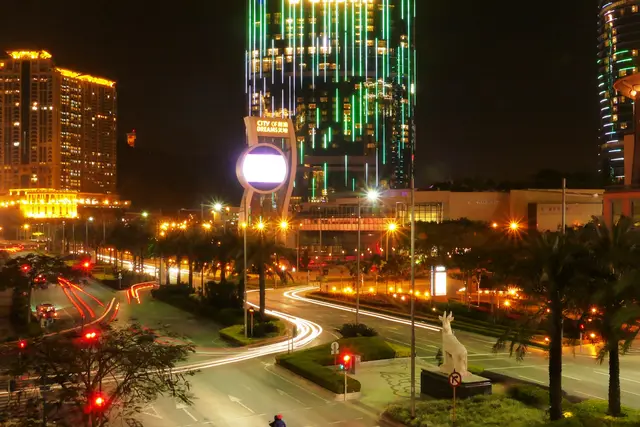
 The Cotai Strip: Travel Guide (4.7★)
 attraction