A palace on the main road
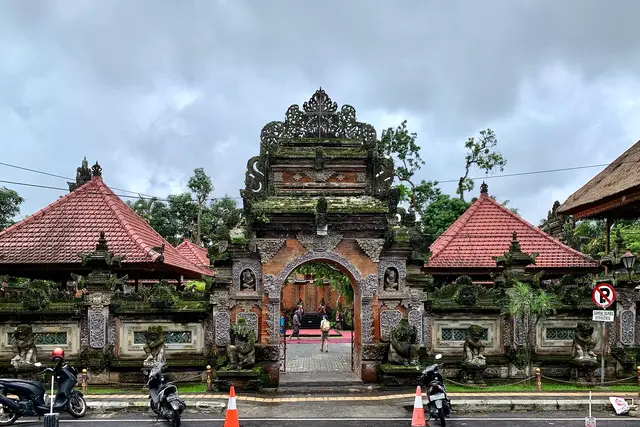
The royal compound faces straight onto Jl. Raya Ubud. Its split gate (candi bentar) is carved grey stone set into red brick, and Ubud Market is just across the street. Scooters and taxis keep passing within a few metres of the entrance.
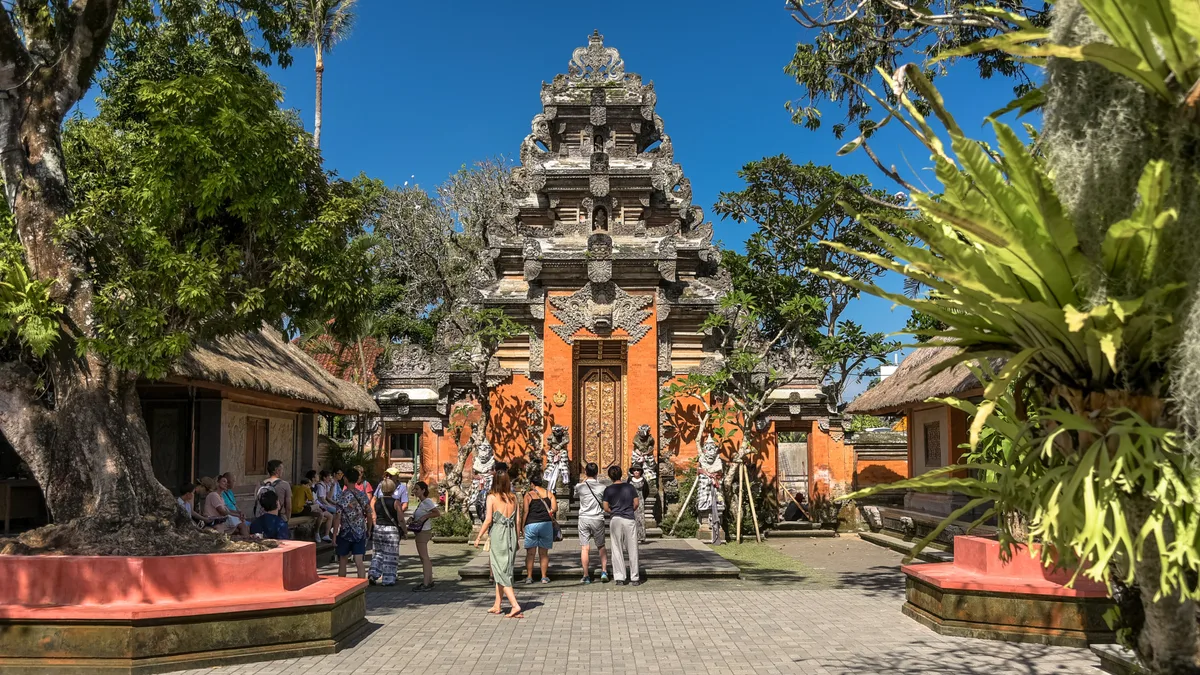
Once you’re through the gate, the noise drops off. Courtyards open one into the next through carved doorways. Open-sided pavilions (bale) stand on raised stone platforms, and guardian figures flank the steps.
This is a working palace. Ubud’s royal family, whose line goes back to rulers in the early 1800s, still lives in the inner quarters. Visitors keep to the outer courts.
What you’re actually looking at
Puri Saren is a lesson in Balinese palace layout. Each court leads to the next through a deliberate sequence of gates. Look for these:
- The carved gateways: the candi bentar at the street and the taller roofed gates inside, covered in floral and demon-face reliefs.
- The pavilions: open bale with ornate painted beams, used for ceremonies and dance.
- Offerings: small woven-leaf trays (canang sari) placed on shrines and steps. Step around them, never over them.
- Gilded doors and stone guardians: the detail is densest around the inner thresholds.
Give the courtyards 30–45 minutes. Most of that time goes on the carving, which rewards slow looking.
Getting in, and evenings at the palace
Respect counts for more here than timing does. Some practical points:
- Dress: cover your shoulders and knees. A sarong and sash are standard in Balinese ceremonial spaces, so carry your own, especially if a ceremony is on.
- Roped-off areas: these are the family’s private quarters. Don’t step past the ropes, and don’t photograph people praying up close.
- Ceremonies: if offerings are being made or a procession is forming, stand to the side and wait. Never walk in front of people at prayer.
- Dance tickets: at night the forecourt becomes a stage for Legong and other traditional dances, with a gamelan orchestra. Tickets are sold near the gate and by sellers along Jl. Raya Ubud. Prices and the night’s programme are posted there, so check on the day.
- Seating: it’s unreserved for dance nights. Arriving well before the start usually gets you a seat with a clear view of the gate, which is the backdrop to every performance.
Daytime and evening hours change, so confirm before you go. You can ask at the entrance or at your guesthouse.
Around Bemo Corner
The palace stands at the junction of Jl. Raya Ubud and Jl. Monkey Forest, the crossroads locals call Bemo Corner. Driving here is slow and parking is scarce, so walk in from your guesthouse or get dropped at the corner.
Easy pairings on foot:
- Ubud Market (Pasar Ubud): directly opposite. It sells craft and textile stalls by day, with produce early in the morning.
- Pura Taman Saraswati: a few minutes west along Jl. Raya Ubud. A temple behind a lotus pond, and another dance venue at night.
- Jl. Monkey Forest: head south past cafés and shops. It ends at the Sacred Monkey Forest Sanctuary.
Here’s one way to plan a day: go to the market in the morning, walk the palace courtyards before lunch, then come back after dark for the dance. That way you see the same gate in two different settings.
Frequently asked questions
Where exactly is Puri Saren Agung Ubud?
It's at Jl. Raya Ubud No.8, in central Ubud, Gianyar. It sits across from Ubud Market, near the junction with Jl. Monkey Forest (Bemo Corner).
How long should I spend at the palace?
Allow 30–45 minutes for the courtyards in daytime. A dance performance takes up a separate evening visit.
What should I wear?
Cover your shoulders and knees. A sarong and sash are customary in Balinese ceremonial spaces, especially during ceremonies.
How do I see a dance performance here?
Buy a ticket near the palace gate or from sellers along Jl. Raya Ubud, where the programme and price are posted. Seating is unreserved, so arrive early for a clear view.
What's nearby?
Ubud Market is directly opposite, and Pura Taman Saraswati is a short walk west. Jl. Monkey Forest runs south to the Sacred Monkey Forest Sanctuary.
Plan your trip to Ubud
Indonesia eSIM & staying connected →
Some links above are affiliate links — if you book through them, Wander Atlas earns a small commission at no extra cost to you. It's how we keep every guide free.