Xingqinggong Park: Xi'an Travel Guide (4.6★)
When to visit China: month-by-month weather, crowds and holidays →
✓ Facts verified via Google Places · Sep 20, 2026
At a glance
How this guide is made
Produced with AI assistance and reviewed against live data sources. Facts such as hours, ratings, and location come from Google Places; images are licensed or public domain. Details can change — please verify before visiting. Editorial policy
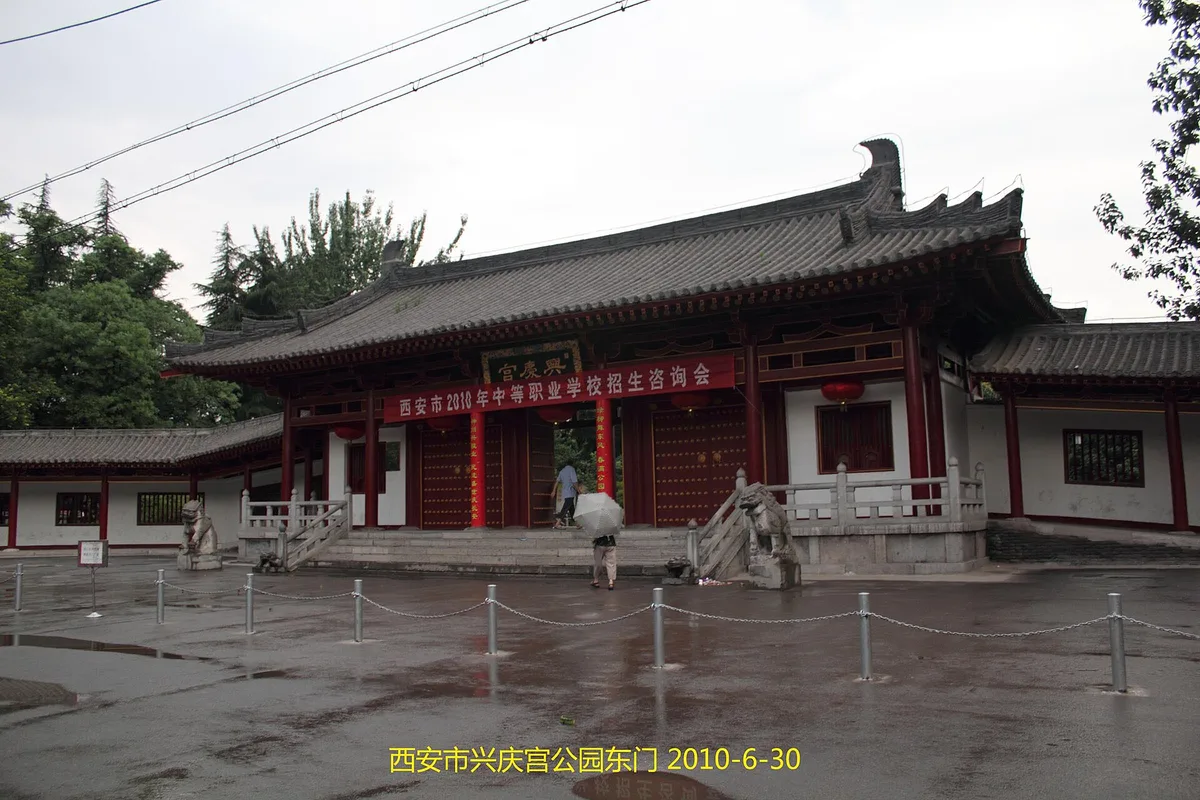
Most visitors to Xi’an spend their whole trip shuttling between the city wall, the Terracotta Warriors and the Muslim Quarter, and never hear the name Xingqinggong. That’s their loss. This park occupies the actual ground where Emperor Xuanzong of the Tang dynasty built his residential palace in the 8th century, and it’s one of the few places in the city where you can stand on genuine Tang-era imperial land without buying a ticket to a museum.
What’s actually here
The palace itself is long gone; what remains is a large public park built around its footprint, centered on a lake ringed by willow trees and pavilions in Tang-revival style.
- Longchi Lake: the park’s centerpiece, with paddle boats available in warmer months
- Peony gardens: planted in reference to Xuanzong’s consort Yang Guifei, who was famously fond of the flower
- Stone pavilions and bridges: reconstructed in a Tang architectural style, not original ruins
- Open lawns and tree-lined paths: used constantly by residents rather than tour groups
Don’t come expecting excavated foundations or an on-site museum. The value here is atmosphere and history-by-association, not artifacts.
The best time to walk in
Spring is the obvious pick, when the peonies bloom in April and cherry blossom trees along the paths flower not long after. That’s also when the park gets its busiest local crowds, though even then it’s nowhere near the density of the Terracotta Warriors site.
Early morning, roughly 7 to 9am, is when the park earns its keep. Groups of retirees practice tai chi and sword forms near the lake, others do ballroom dancing to portable speakers, and the light through the willows is soft rather than the flat glare of midday. Evenings bring a similar but smaller crowd back out after dinner.

Getting there and getting around
The park sits at 55 Xian Ning Xi Lu in Beilin District, close to Xi’an Jiaotong University’s main campus, which makes it a natural stop if you’re already out that way. It’s roughly a 15 to 20 minute taxi ride from the Bell Tower or a similar hop from the Big Wild Goose Pagoda area, so pairing it with either makes for an efficient half-day.
Xi’an’s metro network reaches this part of the city; check current line maps before you go, since new lines have opened in recent years, and confirm the nearest station and exit against a map app on the day. Walking from the university campus side is straightforward and flat.
Budget an hour for a loop around the lake, or two if you want to sit, people-watch, and let the retirees’ morning routines run their course. There’s no need to rush it; the park is compact enough that you won’t get lost, and open enough that you can just follow the path around the water and end up back where you started.
Reading the palace history on site
Xingqinggong was the primary residence of Emperor Xuanzong for much of his reign, and it’s where a good chunk of the court drama around Yang Guifei, one of China’s so-called Four Great Beauties, actually took place. Look for informational signage near the main pavilions; it’s inconsistent in English, so having a basic grasp of the Xuanzong and Yang Guifei story before you arrive makes the walk mean a lot more.
There’s no admission gate charging a separate fee in the way a palace museum would; it functions as a public city park. Confirm current opening hours before visiting, since they’re not listed here, but city parks in Xi’an typically open early and close in the evening.
Blending in with the morning regulars
Nobody polices behavior here, but there’s an unwritten etiquette worth following. Keep to the outer edge of the lawns where tai chi groups practice rather than cutting through the middle of a session. If you want photos of the dancers or the older residents playing cards under the pavilions, ask first or simply keep your distance with a zoom lens rather than pointing a phone directly at them.
Cash isn’t really needed inside the park itself since there’s little to buy beyond maybe a drink from a small vendor cart; mobile payment via Alipay or WeChat Pay is standard everywhere else in the city if you do need to pay for anything nearby. Because it’s still under most tourists’ radar, you’ll get a far more genuine slice of local Xi’an life here on an ordinary Tuesday morning than you will at almost any ticketed site in town.
Frequently asked questions
Where exactly is Xingqinggong Park located?
It's at 55 Xian Ning Xi Lu in Beilin District, Xi'an, near Xi'an Jiaotong University, roughly 15-20 minutes by taxi from the Bell Tower.
Is there an entrance fee?
It operates as a public city park rather than a ticketed historical site, so there's typically no separate admission gate, but confirm current policy before visiting.
How long should I plan to spend there?
An hour covers a full loop around Longchi Lake; two hours lets you sit, watch the morning tai chi groups, and explore the peony gardens without rushing.
What's the best time of year to visit?
Spring, particularly April, when the peony gardens and cherry blossom trees are in bloom, though early mornings year-round are the most atmospheric time of day.
What else is nearby?
The Big Wild Goose Pagoda and the Bell Tower are both within a short taxi ride, making Xingqinggong an easy pairing for a half-day itinerary.
Plan your trip to Xi'an
Some links above are affiliate links — if you book through them, Wander Atlas earns a small commission at no extra cost to you. It's how we keep every guide free.