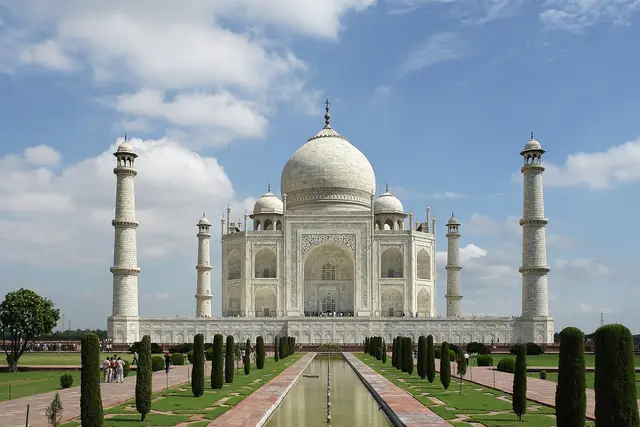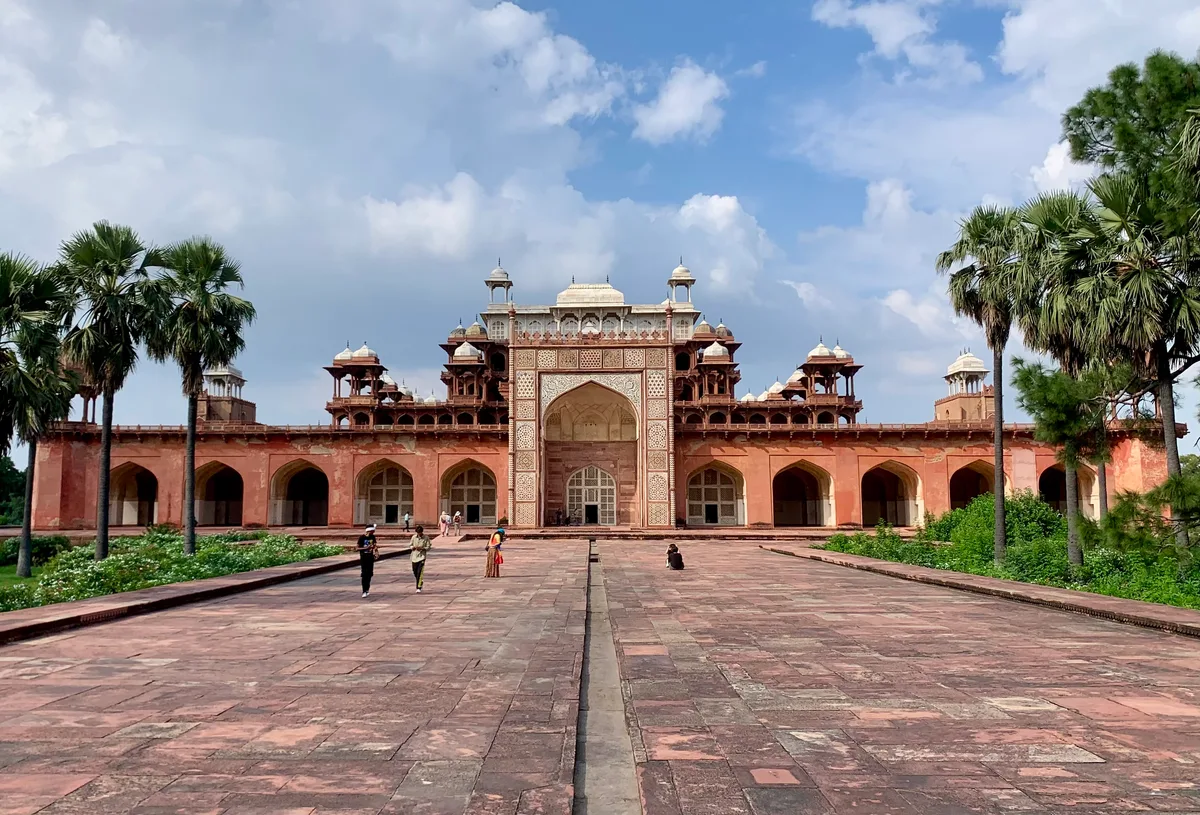
Most visitors to Agra spend their whole trip circling the Taj Mahal and Agra Fort, and never make it out to Sikandra. That’s their loss. The Tomb of Akbar, resting place of the Mughal emperor who built the empire that made those other monuments possible, is quieter, roomier, and in some ways more architecturally curious than either.
Akbar started designing his own mausoleum before he died in 1605, and his son Jahangir finished it around 1613. The result is a strange, layered pyramid of red sandstone terraces topped, unusually for Mughal tombs, with no dome at all. The open-air marble platform at the summit, ringed with delicate screens, holds a symbolic cenotaph under the sky; Akbar’s actual grave lies in a plain crypt below, reached by a sloping corridor.
Walking through the gate
The approach alone tells you this was built for an emperor. You enter through a monumental sandstone gateway inlaid with white marble geometric patterns and four slim minarets, one of the earliest examples of this style in Mughal architecture, later echoed at the Taj.
Beyond it stretches a huge charbagh, the four-quartered Persian garden layout, with deer and langurs often visible on the lawns. The tomb itself sits at the center, a good five-minute walk from the gate along stone paths.
Reading the building itself
The five-tiered structure blends red sandstone on the lower levels with white marble on the top, a material shift you can trace with your eyes as you approach. Each tier is lined with small chattris, the domed kiosks that punctuate Mughal rooflines.
Inside, the entrance hall is decorated with painted stucco ceilings, faded but still legible in places. The descent to the actual burial chamber is narrow and plain by design, a deliberate contrast to the ornament above, and it can feel close and warm with a crowd inside.

When to go and how long to spend
The gate is open 6am to 6pm every day of the week, with no midweek closures to plan around. Crowd patterns here follow a clear rhythm: weekdays are quietest between 7am and 10am, weekends between 7am and 11am.
Try to avoid arriving after 1pm on weekends, when tour groups and family outings both peak and the paths around the tomb get congested. An early visit also means softer light for photos of the sandstone gateway.
Plan on 60 to 90 minutes: enough time to walk the garden paths, climb to the marble terrace, and queue briefly for the crypt without feeling rushed.
Getting there from central Agra
Sikandra sits on the Agra-Mathura road (NH19), roughly 10-13 km from the Taj Mahal area, which usually means a 25-40 minute auto-rickshaw or taxi ride depending on traffic. Most drivers know it simply as “Akbar ka Maqbara.”
There’s no metro line running directly to the site, so a pre-booked taxi, hotel car, or app-based auto is the practical option. Many visitors combine it with Mariam’s Tomb, a smaller Mughal monument a short drive away, on the same outing.
Moving through the site without the crush
Ticket counters and entry lines can bottleneck fast once tour buses arrive, so buying entry early in the day avoids the worst of it. Modest dress is appropriate, as at any mausoleum, and shoes stay on throughout since this isn’t a mosque interior.
Photography is generally allowed in the gardens and on the exterior terraces; check current rules at the crypt, where flash is often restricted. Bring small notes for parking and any optional guide fees, since change can be hard to come by at the gate.
Because this is a well-visited landmark rather than an undiscovered spot, the real trick is timing, not secrecy: come in that early morning window and you’ll often have long stretches of the garden paths to yourself, something that’s much harder to manage at the Taj Mahal a few kilometers away.
Frequently asked questions
Where exactly is the Tomb of Akbar located?
It's in Sikandra, on the northwestern outskirts of Agra, Uttar Pradesh, about 10-13 km from the Taj Mahal and Agra Fort.
What are the opening hours?
The site is open every day of the week from 6:00 AM to 6:00 PM, with no weekly closure.
When is the quietest time to visit?
Weekdays it's calmest between 7am and 10am, and weekends between 7am and 11am. Try to avoid weekend afternoons from 1pm to 6pm, when it's busiest.
How long should I plan to spend there?
Most visitors spend 60 to 90 minutes walking the gardens, climbing to the marble terrace, and visiting the underground crypt.
How do I get there without a car?
There's no direct metro connection, so a taxi, hotel car, or app-based auto-rickshaw from central Agra, roughly 25-40 minutes depending on traffic, is the standard way in.
Is it worth combining with other sites nearby?
Yes, Mariam's Tomb, a smaller Mughal-era mausoleum, sits a short drive away and pairs well with Akbar's Tomb in the same trip.
Plan your trip to Agra
India eSIM & staying connected →
Some links above are affiliate links — if you book through them, Wander Atlas earns a small commission at no extra cost to you. It's how we keep every guide free.