A hill, a hairpin and four days in October
Turn 1 at Circuit of the Americas is a wall of tarmac. From the start line the cars climb a steep slope into a tight left-hander at the crest. Then they plunge downhill into the esses. On race day that hill is covered in fans on the grass. It’s the picture most people have in mind when they think of Austin’s Grand Prix.
The 2026 edition runs October 22-25. It adds a fourth day, Grand PrixView Thursday, before the usual Friday-to-Sunday rhythm of practice, qualifying and the race. For international visitors that extra day matters. It stretches the trip and gives you more time inside the gates.
The circuit itself
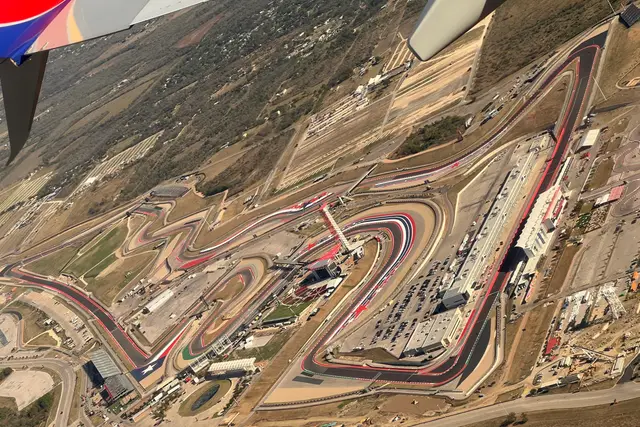
COTA opened in 2012 as the first purpose-built Grand Prix circuit in the United States. Hermann Tilke designed it, and the lap runs anticlockwise over about 5.5 km and 20 corners. Several stretches borrow from famous circuits elsewhere. The fast S-curves after Turn 1 recall Silverstone’s Maggotts and Becketts, and the stadium section at the end of the lap is a tight cluster of slow corners.
Above it all stands the red Observation Tower near Turn 17. It has a glass-floored deck, and its curved red steel supports frame the track below. The amphitheatre beside it hosts the evening concerts that have long been part of race weekend. The lap’s long back straight, ending in a heavy braking zone, is where most of the overtaking happens.
Choosing where to sit
COTA’s layout rewards picking a section for a reason. A few points fans weigh:
- Turn 1 grandstand and hill: the start, the uphill launch and first-lap chaos.
- Turn 12: the braking zone at the end of the back straight, prime overtaking ground.
- Esses (Turns 3-6): fast direction changes, best for watching cars at their limit.
- Main grandstand: pit lane, grid build-up and the podium.
- General admission: grass slopes around the lap, with freedom to roam between corners.
Much of the general admission area is open grass with little shade. Austin in late October is usually warm and sunny during the day, so hats and sunscreen are the norm. The official seating map shows each section’s view. Ticket types and prices are listed on the circuit’s site.
Getting to the far edge of town
The circuit is in Del Valle, southeast of Austin. It’s roughly a half-hour drive from downtown on an ordinary day and close to Austin-Bergstrom International Airport. On race weekend the surrounding roads become the bottleneck. FM 812 and Elroy Road carry most of the traffic, and they’re rural two-lane routes not built for this kind of crowd.
Most visitors avoid driving the whole way. Official shuttle buses from central Austin have long been the main alternative, and rideshare services use a designated drop-off zone. Hotels near the circuit are few. Visitors usually stay downtown, on South Congress or around the airport, then commute each day.
Race weekend, the Austin way
The crowd here is pure Texas: cowboy hats in the grandstands, team shirts everywhere, and a long walk from every gate. These are the habits that make the days easier.
- Paying: cards and contactless are standard at food and merchandise stands, and so is US-style tipping at bars.
- Moving between corners: the walk from the main gate to the back of the circuit takes a long time. General admission fans usually choose one zone per session instead of doing a full lap on foot.
- Leaving: the shuttle and rideshare queues are at their longest just after the chequered flag. Many fans stay for the podium, the track invasion (when it’s allowed) or the evening concert, and let the first wave clear.
- Thursday: with fewer cars on track, the new opening day is the easiest one for exploring the grounds and the tower.
Making a trip of it
Austin turns the race into a city-wide party. Downtown, Sixth Street and Rainey Street fill with fans in team colours every evening. South Congress Avenue is the place for Texas boots and a view of the Capitol. For a quieter hour, Lady Bird Lake has a shaded trail loop. The Congress Avenue Bridge bat colony flies out at dusk while the bats are still in town each autumn.
Barbecue is the city’s main food event. Brisket queues at the best-known pitmasters can start well before lunch, so many visitors visit those on the day before or after the race weekend. Visitors who fly in for the full four days usually budget at least a week in Austin.
Frequently asked questions
When is the 2026 F1 United States Grand Prix?
It runs October 22-25, 2026 at Circuit of the Americas in Austin, Texas. Grand PrixView Thursday opens the weekend, then practice, qualifying and the race follow from Friday to Sunday.
Where is Circuit of the Americas and how do people get there?
COTA is in Del Valle, southeast of Austin, close to Austin-Bergstrom International Airport. Most fans use official shuttles from central Austin or rideshare drop-off zones, because the rural roads around the circuit congest heavily.
Which grandstand or area has the best view?
Turn 1 is best for the start and the steep uphill climb. Turn 12 is the main overtaking spot, the Esses show cars at their limit, and the main grandstand faces the pit lane and podium. General admission lets you move between grassy viewing areas.
Where do visitors usually stay?
Hotels close to the circuit are few, so most visitors stay downtown, on South Congress, or near the airport and travel to the track each day.
What else is there to do in Austin over race weekend?
Sixth Street and Rainey Street for evenings out, South Congress Avenue, the Lady Bird Lake trail, the Congress Avenue Bridge bat flight at dusk, and Central Texas barbecue.
Plan your trip to Austin
United States eSIM & staying connected →
Some links above are affiliate links — if you book through them, Wander Atlas earns a small commission at no extra cost to you. It's how we keep every guide free.
Related guides
 event
event Formula 1 United States Grand Prix: Dates, Tickets & Venue (Austin)
 attraction
 Blanton Museum of Art: Austin Travel Guide (4.7★)
 attraction
 Lady Bird Johnson Wildflower Center: Austin Travel Guide
 hidden gem