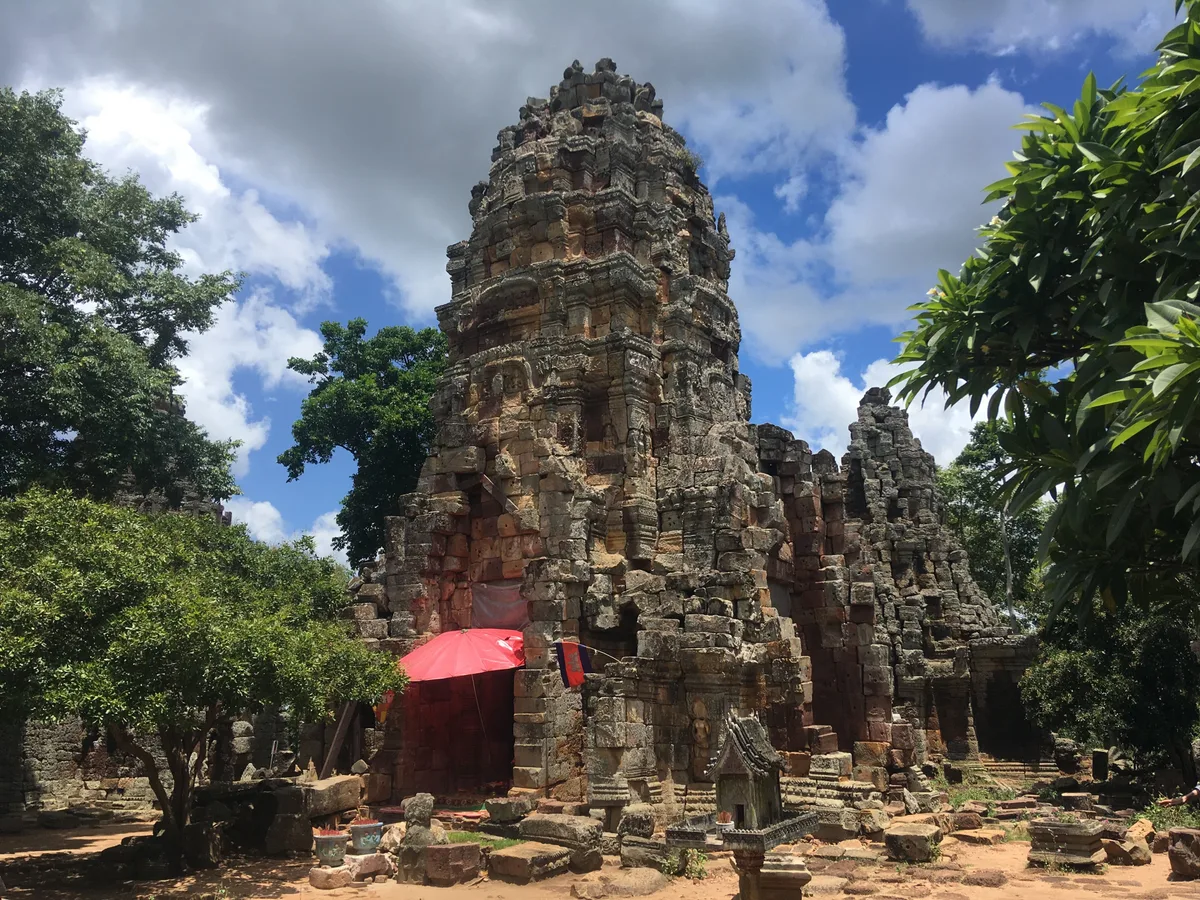
Banan Temple sits on a steep, jungle-covered hill about 25km south of Battambang, and it looks like a smaller, quieter cousin of Angkor Wat left to the elements. Five crumbling sandstone towers crown the summit, their carvings softened by centuries of rain and lichen. Roots snake across fallen lintels. Few other visitors break the silence.
You feel the climb before you see the towers. A long staircase of uneven stone steps cuts straight up the hillside, flanked by frangipani trees and the occasional grazing cow. There’s no shade for most of it, so the heat builds fast once the sun clears the treeline.
Getting there
Most travelers hire a tuk-tuk in Battambang town for a half or full day, often combined with the nearby Phnom Sampov caves or a stop at a rice-paper or fish-paste workshop along the way. The ride takes about 45 minutes on a mix of paved and dirt roads.
Renting a moto works too if you’re comfortable with rougher rural roads. Either way, agree on a price and a return time with your driver before setting off, since there’s little passing traffic to flag down afterward.
Climbing to the summit
The staircase is the main event before you even reach the ruins. Locals sometimes offer a piggyback-style carry up for tired or older visitors, for a negotiated tip, a common, low-key hustle rather than anything to worry about.
Pace yourself, bring water, and pause at the switchback landings. The higher you climb, the more the rice paddies below unfurl into a green-and-gold patchwork stretching toward the horizon.

What you’ll find at the top
The five towers date to the 11th and 12th centuries, built under Khmer kings before Angkor Wat itself was completed. Carved lintels above several doorways still show apsaras and scenes from Hindu mythology, worn but legible.
Unlike Angkor’s restored temples, Banan feels unfinished in its repair, beams prop up leaning stone, and vegetation has reclaimed parts of the structure. It rewards slow looking rather than a quick photo stop.
Bring a flashlight if you want to peer into the darker inner chambers. Give yourself 30–45 minutes at the top before the descent.
When to go
The site is open daily from 6am to 6pm, and mornings are the smart move. Arriving by 7 or 8am means climbing in cooler air and catching softer light on the towers.
Late afternoon, roughly two hours before closing, is the other good window. The heat has eased and the low sun rakes across the carvings. Midday between 11am and 2pm is the toughest stretch: the stone steps radiate heat with no shade.
Rainy season, from May to October, turns the surrounding rice fields a vivid green but can make the steps slick. Dry season, November through February, offers the most reliable footing and clearer valley views.
How to visit like a local
Banan doesn’t get the crowds that swarm Angkor, so there’s rarely a queue at the base of the stairs. That quiet is part of its appeal, treat it as a place to linger rather than tick off quickly.
Bring small riel or dollar bills; informal vendors near the base sell water and snacks, and cash is how everything here gets paid. Dress modestly, covering shoulders and knees, since this remains an active spiritual site for some visitors even amid the ruins.
- Wear real shoes, not sandals. The steps are uneven and occasionally loose
- Carry more water than you think you’ll need
- Skip the midday sun if you can shift your schedule
- Tip modestly if someone helps carry a bag or a child up the stairs
- Combine the trip with Phnom Sampov to make the drive worthwhile
The most common mistake is treating this as a quick 20-minute stop. Rushing the staircase in the heat, then rushing back down, skips the actual reward: standing quietly among towers older than Angkor Wat, with nobody else in sight and a green valley spread out below.
Frequently asked questions
How do I get to Banan Temple from Battambang?
Hire a tuk-tuk in Battambang town for around 45 minutes each way; most drivers offer a half-day rate that includes waiting time and a stop at Phnom Sampov.
How many steps are there to climb?
358 stone steps lead up the hillside to the towers, with no shade for most of the climb, so pace yourself and bring water.
What are the opening hours?
Banan Temple is open daily from 6am to 6pm, including weekends.
When is the best time to visit to avoid heat and crowds?
Go early morning (by 7-8am) or about two hours before closing in the late afternoon; midday between 11am and 2pm is the hottest, least comfortable window.
Is Banan Temple worth combining with other stops?
Yes — it's commonly paired with the Phnom Sampov caves and killing caves on the same half-day trip from Battambang.
Plan your trip to Battambang
Cambodia eSIM & staying connected →
Some links above are affiliate links — if you book through them, Wander Atlas earns a small commission at no extra cost to you. It's how we keep every guide free.
Related guides
 attraction
 Bamboo Train: Battambang Travel Guide (4.0★)
 attraction
 Pub Street: Siem Reap Travel Guide (4.4★)
 attraction
 Royal Independence Gardens: Siem Reap Travel Guide (4.4★)
 attraction