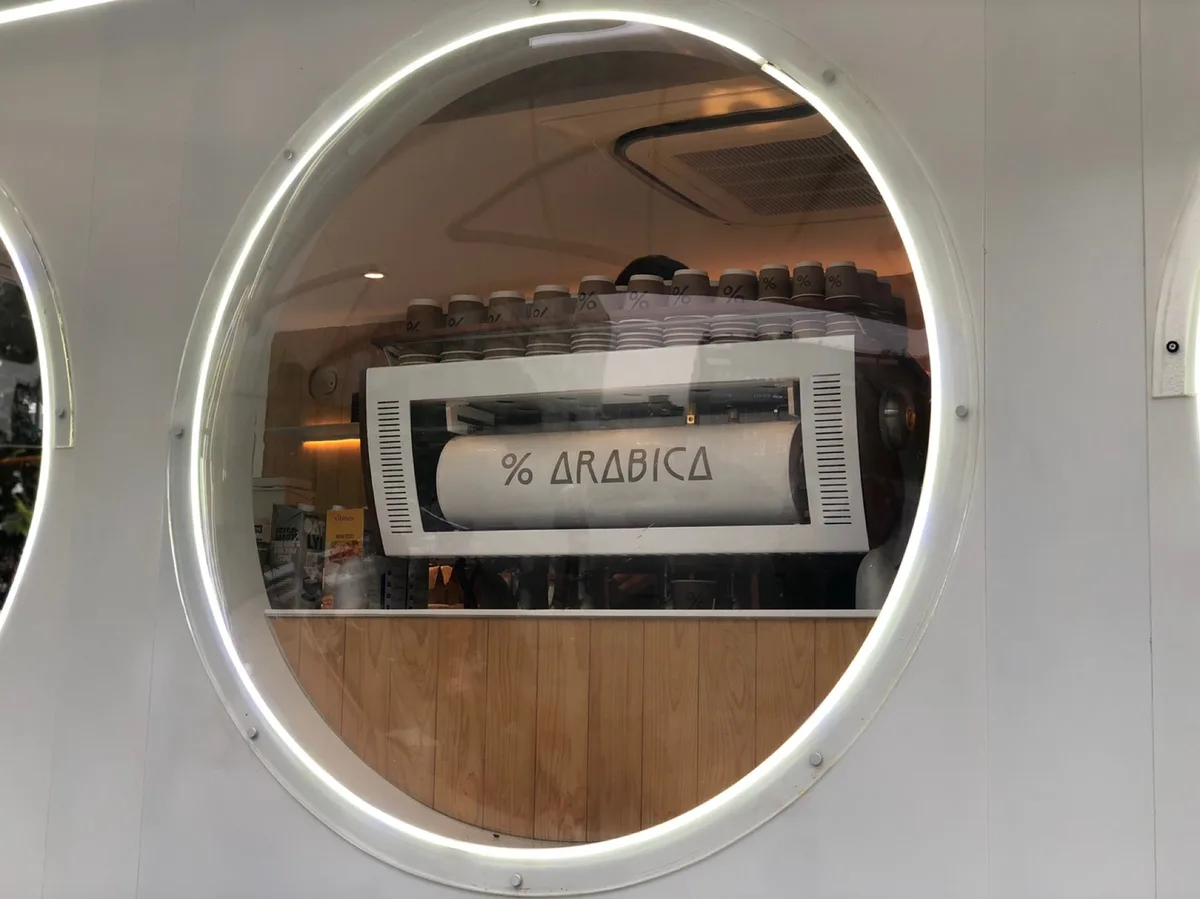
Don’t expect a big menu or an elaborate food program; % Arabica worldwide keeps things tight: espresso, lattes, little else. Seating is minimal, too. The draw here is less about variety and more about the fifteen minutes you spend holding a cup in that courtyard, watching light move across old brick.
You smell the neighborhood before you see the cafe: coal-warmed brick, dust off the hutong lanes, the faint incense drift from White Stupa Temple’s courtyard a few minutes’ walk away. Then you turn a corner and the gray brick gives way to a clean white ”%” logo, glass, and pale wood, % Arabica’s signature look, dropped almost jarringly into one of Beijing’s oldest surviving neighborhoods.
Why this location matters
% Arabica started in Kyoto and built its identity on a single visual promise: white walls, exposed espresso machines, “See The World Through Coffee” stenciled somewhere in view. The Baitasi branch takes that formula and folds it into a genuinely old structure instead of a shopping mall or airport terminal, which is where you usually find this brand.
A French design team led the renovation. They kept the original timber framework overhead and the gray brick masonry on the walls, then opened up a courtyard at the center, so you’re drinking espresso under exposed beams that may be a century old, with sky instead of a ceiling above the seating.
The Baitasi hutong context
Baitasi, literally “White Stupa Temple”, is one of Beijing’s older residential hutong districts, centered on a Yuan-dynasty white dagoba that’s still an active temple site. In the last several years, the area has quietly become a small showcase for adaptive reuse: courtyard homes and old shopfronts converted into design studios, independent bookstores, and cafes like this one, rather than torn down for redevelopment.
That makes % Arabica less a standalone destination and more one stop on a walk. You can pair it with:
- White Stupa Temple itself, right nearby
- Nearby hutong lanes for wandering and courtyard-architecture spotting
- Other small independent design shops and cafes that have moved into the district
What to expect inside
Don’t expect a big menu or an elaborate food program; % Arabica worldwide keeps things tight: espresso, lattes, little else. Seating is minimal, too. The draw here is less about variety and more about the fifteen minutes you spend holding a cup in that courtyard, watching light move across old brick.
Seating is limited, as it tends to be at every % Arabica location. On a clear afternoon the open-air courtyard fills fast with people as interested in the architecture as the coffee.
When to go
Early morning on a weekday is your best window, before tour groups exploring the temple filter through the lanes. Weekend afternoons bring both coffee regulars and photographers drawn to the courtyard’s clean lines against rough brick, so the wait for a seat stretches longest then.
Because this is a trending, relatively recent opening, opening hours and any reservation policy can shift. Confirm both on the brand’s official channels or a maps app before you make the trip out.
How to visit like a local
Treat it as a coffee break inside a hutong walk, not a sit-down cafe visit. Order at the counter. That’s standard for the brand everywhere in the world, cash or mobile pay (WeChat Pay or Alipay) both work fine in Beijing generally, so bring one loaded on your phone if you can.
- Skip the counter photo everyone takes and instead find a courtyard corner where the old timber frame is visible overhead
- Come on foot from the temple rather than by car, hutong lanes are narrow and not built for parking
- Don’t expect to camp out with a laptop; turnover is part of the culture at these small locations
- If the courtyard’s full, walk the lane a few extra minutes rather than waiting, several other cafes have opened nearby
The mistake most visitors make is treating it purely as an Instagram stop and rushing back out. Slow down for ten minutes instead. The building’s history, old brick and beams repurposed rather than replaced, is the actual reason this branch is worth the detour, more than the espresso itself.
Frequently asked questions
Where exactly is % Arabica Baitasi Store located?
It's in the Baitasi hutong district of Beijing, near the White Stupa Temple (Baita Si), a short walk through the surrounding lanes from the temple entrance.
What makes this % Arabica branch different from others?
It occupies a renovated hutong structure with a French-designed open-air courtyard that preserves the original wooden framework and gray brick masonry, unlike the brand's typical mall or airport locations.
What's the best time to visit to avoid crowds?
Aim for early morning on a weekday. Weekend afternoons draw both coffee drinkers and photographers, so seating in the courtyard fills up fastest then.
Should I check opening hours before going?
Yes — this is a recently opened, trending spot, so hours and any reservation requirements can change. Check the brand's official page or a maps app shortly before your visit.
What else can I see nearby?
Combine it with a visit to White Stupa Temple itself, plus a wander through the surrounding hutong lanes, which host several other independent design shops and cafes.
Plan your trip to Beijing
China eSIM & staying connected →
Some links above are affiliate links — if you book through them, Wander Atlas earns a small commission at no extra cost to you. It's how we keep every guide free.