A hill that named a district
Berlin is mostly flat, so even a modest hill matters. The Kreuzberg rises about 66 metres above sea level. That’s enough to make it the high point of the inner city’s southern edge, and the borough took its name from it.
The name comes from the iron cross at the very top. Viktoria Park wraps the slope in winding paths, lawns and stands of old trees. The park was laid out in the late 19th century around a monument that had stood on the bare hill for decades already.
Most visitors come for three things:
- The National Monument on the summit, with its viewing terrace
- The waterfall, which tumbles down the north slope towards Kreuzbergstraße
- The lawns, which fill with picnickers, readers and sunbathers in warm months
The iron spire on the summit
The paths all climb to one point. At the top stands Karl Friedrich Schinkel’s National Monument for the Wars of Liberation, unveiled in 1821. It’s a Gothic-style spire cast in iron, which was a bold material for a public monument back then.
Walk around its base and you’ll find twelve niches. Each holds an allegorical figure for a battle against Napoleon’s armies. One of them is Katzbach, the same name as the street in the park’s address. Several Kreuzberg street names follow the same theme, so once you notice it you’ll spot it all over the neighbourhood.
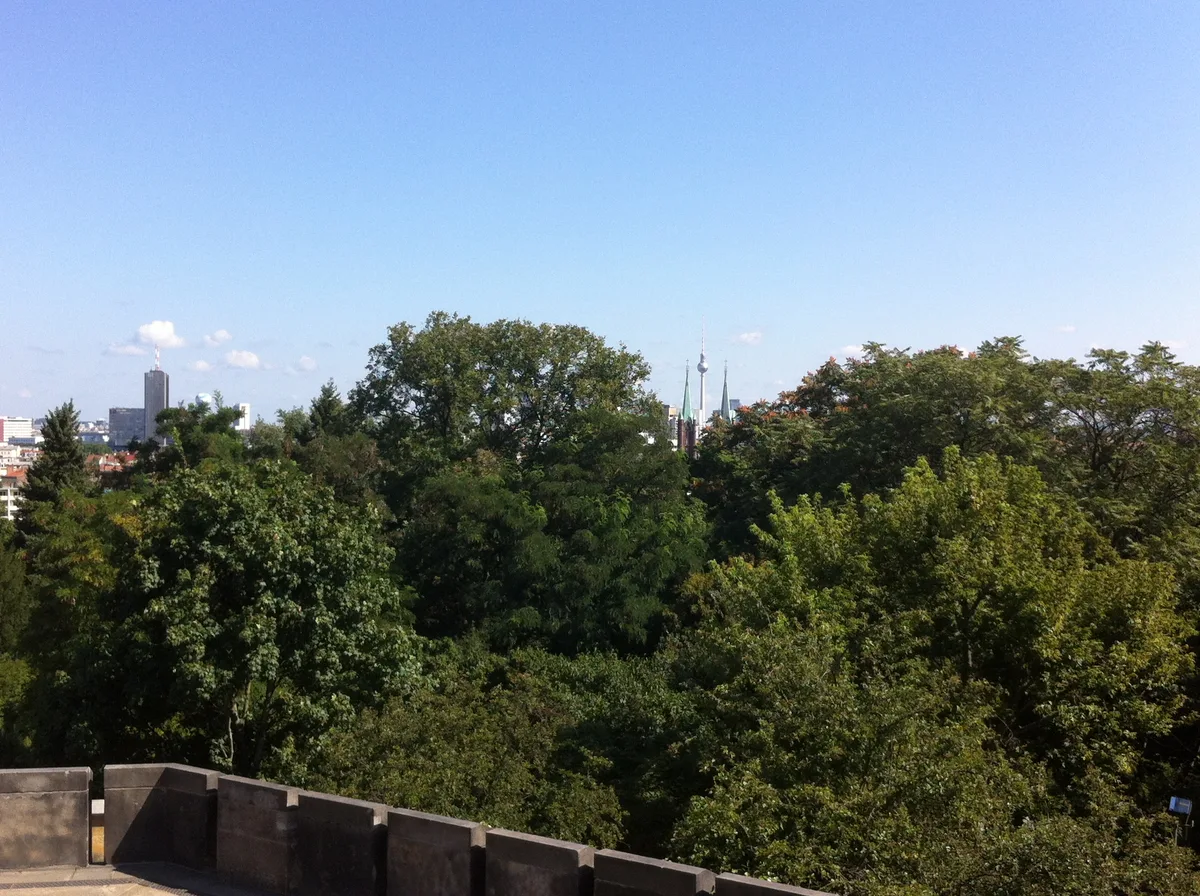
The terrace in front of the monument faces north. From the low wall the view runs straight down Großbeerenstraße towards the centre, with the Fernsehturm on the skyline. People line that wall at golden hour, so get there early if you want a spot at the front.
Following the cascade downhill
The waterfall is the park’s showpiece, and it’s artificial. Water is pumped up the hill and released over rocks designed to look like a mountain stream. The idea was a scrap of Silesian mountain scenery in the middle of the city.
It runs in the warmer months and is switched off in winter. Outside the main season you may find a dry, mossy rock channel instead of a cascade. If the water matters to you, plan a visit between late spring and early autumn.
The best way to see it is from the bottom. Start at the pool on Kreuzbergstraße and climb the stepped path beside the falls. You’ll stay close to the water all the way up to the summit. On the southern slope there’s also a small vineyard, which is unusual to find inside a Berlin park.
The 7am window
Viktoria Park is one of the most-visited green spaces in Kreuzberg. Google currently lists it as open 24 hours, but the hours you choose make a big difference.
BestTime’s forecast of typical foot traffic puts the calmest stretch at 7am–8am on weekdays and 7am–9am on weekends. At those hours the summit terrace is mostly joggers and dog walkers, and you can photograph the monument without anyone in the frame.
Weekends from 12pm to 9pm are the busiest. On a sunny Saturday that means a full summit wall, crowded lawns and a slow climb up the waterfall steps. Go in the morning, or come on a weekday evening.
After dark the paths are poorly lit in places. Daylight or dusk is the practical choice.
Lawn manners and the bottle ritual
Berliners treat this hill like a shared back garden, and a few unwritten rules come with it.
- Drinking outdoors is legal. A beer from a nearby Späti (corner shop) on the grass is completely normal.
- Leave empty deposit bottles beside the bin, not inside it. Bottle collectors check the bins for Pfand (deposit) bottles, and setting them on the ground next to the bin saves them a search.
- Check the signs before lighting a grill. Berlin only allows barbecues in designated areas, so don’t assume any lawn is fair game.
- Keep the waterfall steps clear. They’re narrow, and people sitting on them block a busy route.
- Watch for dogs. Many are off the lead on the upper paths, so walk your own dog with care.
In winter, if there’s enough snow, the slopes turn into one of the inner city’s go-to sledging hills. Children often bring sledges straight from home.
Getting to the Kreuzberg hill
The park has entrances on several sides, so choose one based on how you’re arriving.
- U6 or U7 to Mehringdamm: a short walk west through the Bergmannkiez. This is the easiest route if you want to eat before or after.
- U6 to Platz der Luftbrücke: the closest stop to the summit side, near Tempelhof’s old airport building.
- S-Bahn to Yorckstraße: walk south down Großbeerenstraße and the monument stays in view the whole way. It’s a good way to see the axis the summit view looks back along.
For the full experience, enter at the waterfall pool on Kreuzbergstraße and walk uphill. Leave from the summit side towards Methfesselstraße or Dudenstraße.
Off the hill: Bergmannkiez and Tempelhofer Feld
The streets east of the park are some of the most pleasant in Kreuzberg. Bergmannstraße has cafés, second-hand shops and bookshops in late 19th-century apartment blocks. A few minutes on, the Marheineke Markthalle covers the food-hall side of a visit.
Chamissoplatz is close by. It’s a cobbled square lined with intact old tenements, and it’s often used as a film location for historic Berlin.
If you still want more space, keep heading south past Platz der Luftbrücke to Tempelhofer Feld. The former airfield is a huge flat expanse, the opposite of the hill you’ve just climbed. Seeing both in one afternoon gives you two very different sides of Berlin’s open space within a short walk.
Frequently asked questions
When is the quietest time to visit Viktoria Park?
BestTime's typical-traffic forecast puts the calmest periods at 7am–8am on weekdays and 7am–9am on weekends. Try not to come between 12pm and 9pm on weekends, when the summit terrace and lawns are at their busiest.
Is the Viktoria Park waterfall running all year?
No. The cascade is artificial and pumped, so it runs in the warmer months and is turned off in winter. For the best chance of seeing water, visit between late spring and early autumn.
How do I get to Viktoria Park by public transport?
Take the U6 or U7 to Mehringdamm and walk west through the Bergmannkiez, or the U6 to Platz der Luftbrücke for the summit side. From the S-Bahn, get off at Yorckstraße and walk south along Großbeerenstraße.
How long should I spend at Viktoria Park?
One to two hours is enough to climb the waterfall path, see the Schinkel monument and take in the view from the summit terrace. Add time if you want to picnic or continue on to Bergmannstraße or Tempelhofer Feld.
What is the monument on top of the hill?
It's Karl Friedrich Schinkel's cast-iron National Monument for the Wars of Liberation, unveiled in 1821. It has twelve niches with allegorical figures for battles against Napoleon, and the iron cross at the top gave the Kreuzberg district its name.
Plan your trip to Berlin
Germany eSIM & staying connected →
Some links above are affiliate links — if you book through them, Wander Atlas earns a small commission at no extra cost to you. It's how we keep every guide free.