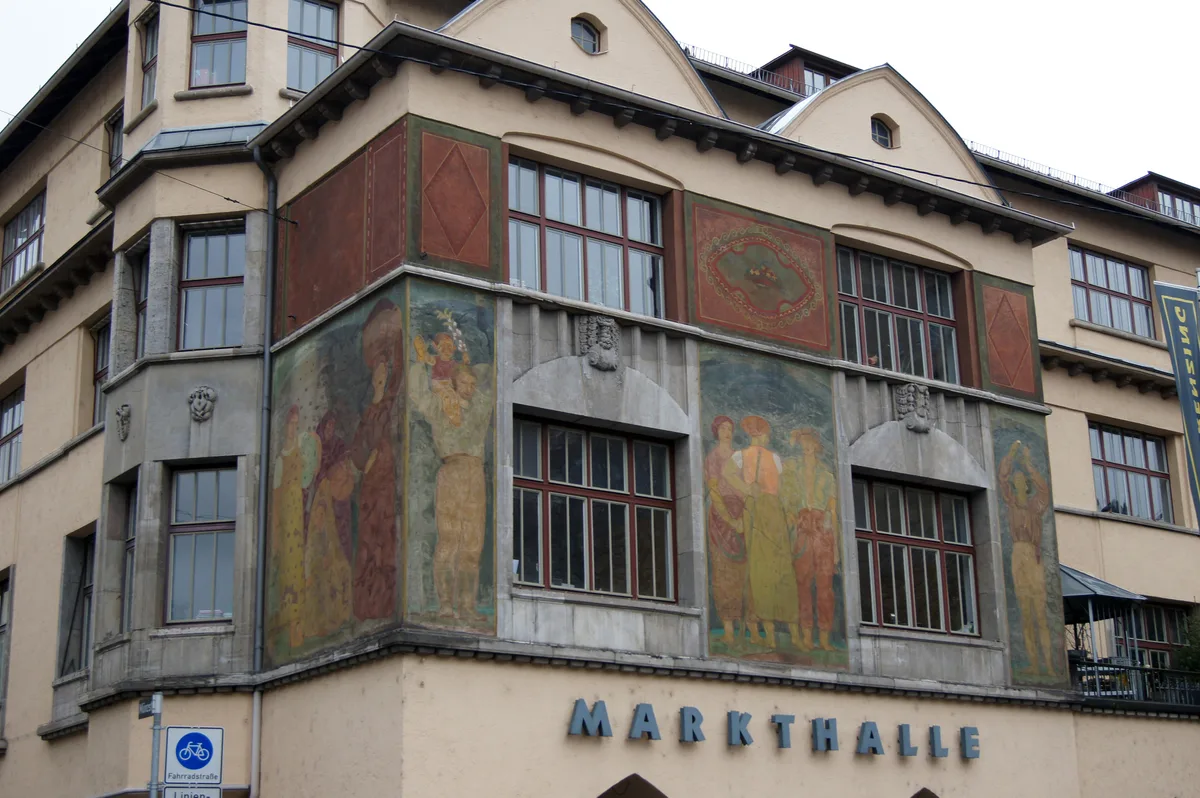
Under the Jugendstil roof
Look up before you look at the food. Markthalle Stuttgart dates from the early 1900s, and the art nouveau (Jugendstil) building is half the reason it is so well reviewed. It opened in 1914 as the city’s covered market, and it still does that job.
The floor is one long, high hall lined with stalls. A gallery runs above it, so you can see the counters, the aisles and the shoppers from overhead. It is one of the most-reviewed places in central Stuttgart. Plan for crowds, not quiet.
Working the stalls
The counters are where the hall makes its living. Expect cheese, cured and fresh meat, and a spread of international food alongside the regional produce. It works as a place to shop and as a place to graze.
What to look for as you walk:
- Cheese counters, where you can ask for a small piece to try before you commit
- Butchers and charcuterie, good for picnic supplies if you’re heading to the Schlossgarten
- International stalls, for snacks and ingredients from well beyond Swabia
- Swabian staples such as Maultaschen and Spätzle, if a counter has them that day
For a browse, a coffee and something to eat, allow 45 minutes to an hour. If you’re also shopping and going upstairs, allow longer.
Ordering by the hundred grams
The market works like a German neighbourhood shop, just with more counters. Here is how to fit in:
- Don’t help yourself. Produce and deli items are served across the counter. Point, or ask, rather than picking things up.
- Order by weight. People ask for “hundert Gramm” (100g) or “zweihundert Gramm”. Saying “Ich hätte gern…” (“I’d like…”) is polite and enough.
- Wait your turn. There’s often no ticket system. Watch who was there before you, and expect the vendor to ask “Wer ist dran?” (“Who’s next?”).
- Carry cash and a card. Card acceptance varies from stall to stall, and small purchases are often paid in cash.
- Bring a bag. A tote or backpack is normal kit for German market shopping.
Prices are posted at each counter, so check the sign or ask before you order a large piece of cheese or meat.

Beating the Saturday crush
Saturday is when the hall fills up. The busiest weekend window is 9am to 5pm, which is almost the whole Saturday opening. Arrive after 9am and you’ll be squeezing through the aisles behind shopping bags and prams.
The fix is simple. On Saturday the doors currently open at 7am, so you get about two hours before the main rush. A weekday visit is the other option: the hall currently opens 7:30am–6:30pm Monday to Friday. Saturday closes earlier, at 5pm, and Sunday is closed. Hours can change around public holidays, so check before a special trip.
Finding Dorotheenstraße 4
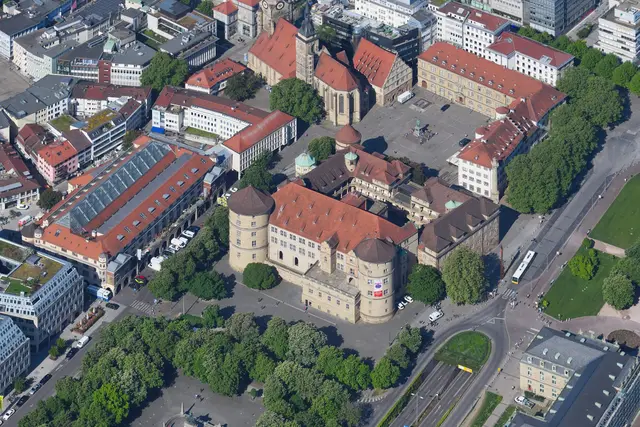
The hall sits in the compact old core of the city centre. Most visitors just walk there. From Stuttgart Hauptbahnhof, walk down Königstraße, the long pedestrian shopping street, and cut across toward Schillerplatz. It takes roughly 15 minutes on foot.
By Stadtbahn, the Charlottenplatz and Rathaus stops are each a few minutes’ walk away. Charlottenplatz is the bigger interchange, served by most city-centre lines. Driving in is more trouble than it’s worth. There are multi-storey car parks nearby, but central streets are slow, and public transport puts you much closer to the door.
The blocks around the hall
Several of Stuttgart’s main sights are within about five minutes, so the market fits into a morning in the old town without any detour.
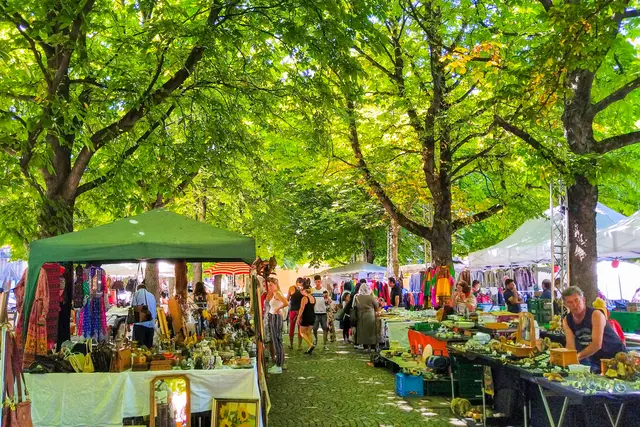
- Schillerplatz, the square with the Schiller statue. It hosts an open-air market on several mornings a week, which pairs well with the hall.
- Stiftskirche, the twin-towered collegiate church overlooking Schillerplatz
- Altes Schloss, the Renaissance castle courtyard, which houses the Landesmuseum Württemberg
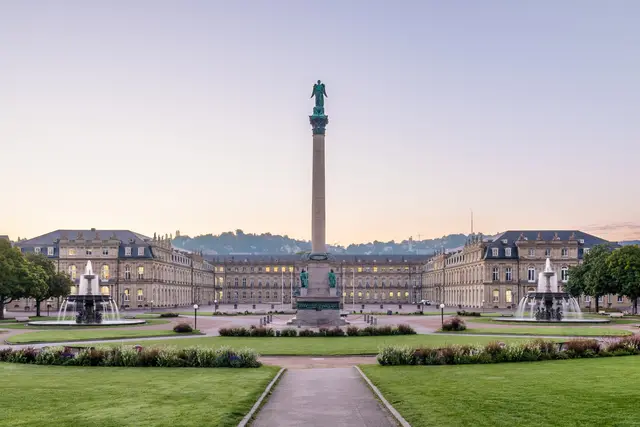
- Schlossplatz and the Neues Schloss, a short walk north
- Marktplatz and the Rathaus, just south
A route that works: start in the hall, buy cheese and bread, then walk to the Schlossgarten beyond Schlossplatz to eat outside.
Frequently asked questions
When is the quietest time to visit Markthalle Stuttgart?
Skip Saturday between 9am and 5pm, when the hall is at its busiest. Your best options are a weekday visit or arriving soon after the 7am Saturday opening, before 9am.
What are the opening hours, and is it open on Sunday?
At the moment it opens 7:30am–6:30pm Monday to Friday and 7am–5pm on Saturday. It is closed on Sunday. Hours can change around public holidays, so check before you go.
How do I get to Markthalle Stuttgart?
It's at Dorotheenstraße 4 in the city centre, near Schillerplatz. You can walk there from the Hauptbahnhof along Königstraße in about 15 minutes. You can also take the Stadtbahn to Charlottenplatz or Rathaus and walk a few minutes.
How long should I spend there?
For a browse and a snack, allow 45 minutes to an hour. Allow more if you're shopping for picnic supplies or going up to the upper gallery.
What is nearby?
Within a few minutes' walk you'll find Schillerplatz and its open-air market, the Stiftskirche, the Altes Schloss with the Landesmuseum Württemberg, Schlossplatz and Marktplatz.
Plan your trip to Stuttgart
Germany eSIM & staying connected →
Some links above are affiliate links — if you book through them, Wander Atlas earns a small commission at no extra cost to you. It's how we keep every guide free.