Bukhara is a city of fired brick. After sunset, floodlights pick out the madrasa portals and the tile panels on the domes, and the lanes between them go a warm orange. The Bukhara Night Race sends runners into that city after dark. Its date is set for November 2026, and it offers four distances: half marathon, 10K, 5K and 2K.
This guide covers what the race is, where it happens and how a trip around it usually works. Start times, the exact route and the registration process come from the race organiser, and none of those details are reproduced here.
Four distances, one old city
The distances run from serious to casual. The half marathon is 21.1 km. The 10K suits most regular runners. The 5K and 2K are the ones that pull in families, first-timers and people who mostly came to see Bukhara.
With a 2K on the programme, the event works for groups with mixed fitness. One person can run the half while the rest of the group does the short course and then waits at the finish.
The summary describes the race as running “through the historic city.” Bukhara’s historic centre is a UNESCO World Heritage Site and is compact by any standard. Most of its major monuments are within walking distance of each other. Which streets the course actually uses is for the organiser to say.
Running a city of brick after dark
The old town looks very different at night than in the daytime tourist hours. These are the landmarks in the historic core:
- Poi Kalyan ensemble: the Kalyan Minaret dates from 1127 and stands roughly 46 metres tall, between the Kalyan Mosque and the Mir-i-Arab Madrasa. Its banded brickwork shows clearly under lights.
- Lyabi-Hauz: a stone-edged pool from the 16th and 17th centuries, ringed by old mulberry trees and teahouse platforms, with the Nadir Divan-Begi Madrasa on one side.
- The trading domes: brick-domed bazaars such as Toqi Zargaron (the jewellers’ dome) built over old crossroads.
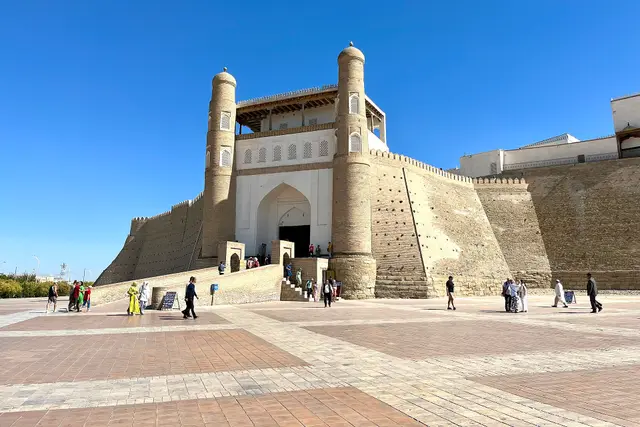
- The Ark: the walled fortress of the former emirs, with a long sloping ramp up to its gate.
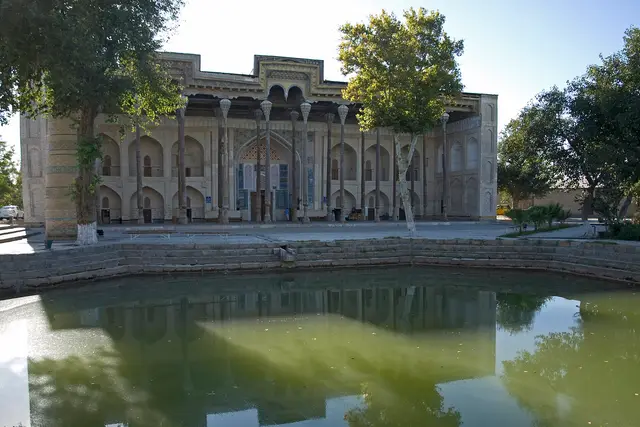
- Bolo Hauz Mosque and the Samanid Mausoleum: both a short distance west of the Ark, the mausoleum being one of the oldest buildings in Central Asia.
Underfoot, much of the old town is paving stone and old brick rather than smooth asphalt. Runners used to city marathons usually notice the change. Shoes with some cushioning cope best.
November nights in the Kyzylkum
Bukhara sits on the edge of the Kyzylkum desert, and in November the desert climate decides what you wear. Days are often mild and dry. Once the sun goes down, the temperature drops fast, and nights are usually in single digits Celsius. Frost is possible late in the month.
That works in a runner’s favour, since nobody is fighting summer heat. Waiting at the start and cooling down afterwards are the cold parts. Runners usually bring:
- a throwaway layer or old jacket for the start area
- light gloves and a thin hat for the slower distances
- a warm layer packed for the finish
- a headlamp or reflective item for the walk back through unlit side lanes
Dry desert air also dries you out faster than you notice, so most runners hydrate well during the day before a night start.
Reaching Bukhara
Most international visitors fly into Tashkent and continue overland or on a domestic flight. The Afrosiyob high-speed train connects Tashkent and Samarkand with Bukhara, and the Samarkand-to-Bukhara leg is short enough to fit into the same day as sightseeing.
Bukhara’s railway station is in Kagan, a separate town south-east of the old city. Taxis and ride-hailing cars cover the transfer. Bukhara International Airport is closer to the centre and has domestic and some international flights.
Inside the old town, walking is the default. The lanes around Lyabi-Hauz and the trading domes are narrow and largely pedestrianised, and guesthouses there put you within walking distance of most of the historic core.
Settling in around race day
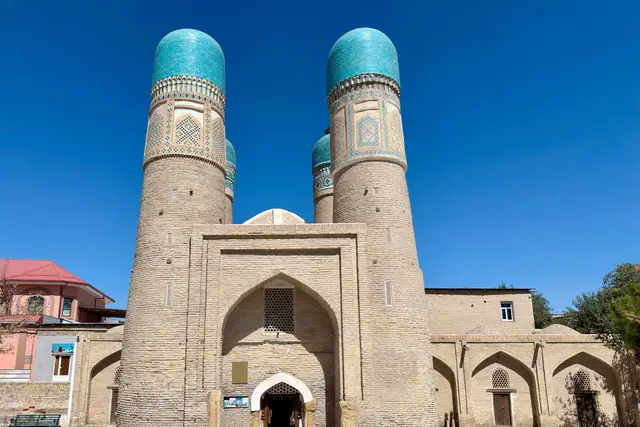
Visitors usually build the race into a stay of two to three days in Bukhara. One day covers the Poi Kalyan, the Ark and the trading domes at a walk. A second day reaches the Samanid Mausoleum, Chor Minor with its four turquoise-capped towers, and the Sitorai Mohi-Hosa summer palace on the city’s northern edge.
Plenty of runners sightsee the day after the race rather than before, because a full day on stone paving tires your legs before a night start. The compact centre makes it easy to keep race-day walking light.
Eating, paying and greeting in Bukhara
Uzbek food runs on its own clock, and it doesn’t always suit a night race. Plov, the national rice dish cooked in huge cauldrons, is traditionally a midday meal. Many plov houses sell out and close by mid-afternoon, so runners after a carb-heavy plate tend to eat it at lunch.
In the evening the grills take over. Shashlik skewers, round loaves of non bread from tandoor ovens and pots of green tea are the usual post-race meal around the old town.
A few habits help in shops, taxis and chaikhanas:
- Cash in som is still the default for small purchases, taxis and market stalls. Cards are accepted more widely in hotels and larger restaurants.
- Tipping is modest and not obligatory. Some restaurants add a service charge to the bill.
- Greetings: “Assalomu alaykum” is the standard hello. A hand placed briefly on the chest is a common, polite gesture to go with it.
- Tea etiquette: the host pours small amounts into a piyola bowl and refills it often. A half-full bowl is hospitality, not stinginess.
- Active mosques and madrasas: covered shoulders and knees are expected. That’s worth remembering if you sightsee in running kit.
Where the details live
The race organiser is the source for anything time-sensitive: the exact November date, the start and finish point, start times for each distance, and registration terms. This guide doesn’t list prices, start times or a route, because none of those were available to us.
The things that don’t change are also the most useful ones for planning. The race takes place in November 2026, in a cold-night desert climate, with four distances to choose from. The setting is a walkable old town of brick monuments, and it is worth a few extra days whatever your finishing time.
Frequently asked questions
When is the Bukhara Night Race?
Its date is announced as November 2026. The race organiser is the source for the exact day and the start times of each distance.
What distances does the Bukhara Night Race offer?
Four: a half marathon (21.1 km), a 10K, a 5K and a 2K. That range makes it suitable for serious runners, beginners and families.
How cold is Bukhara at night in November?
Days are often mild and dry, but desert nights drop sharply, usually into single digits Celsius, and frost is possible late in the month. Runners typically bring a throwaway layer for the start and a warm layer for the finish.
How do I get to Bukhara for the race?
Most visitors fly into Tashkent and take the Afrosiyob high-speed train to Bukhara, often stopping in Samarkand on the way. The station is in Kagan, a taxi ride from the old town. Bukhara International Airport is closer to the centre.
How long should I stay in Bukhara around the race?
Two to three days is typical. That gives you time to see the Poi Kalyan, the Ark, Lyabi-Hauz and the trading domes, plus the Samanid Mausoleum and Chor Minor, without heavy walking on race day.
Plan your trip to Bukhara
Uzbekistan eSIM & staying connected →
Some links above are affiliate links — if you book through them, Wander Atlas earns a small commission at no extra cost to you. It's how we keep every guide free.