Stand at the corner where Rue des Marchands meets Rue Mercière and tip your head back. Above you is a corner oriel, a turret-like bay jutting from the first floor. Over it runs a wooden gallery, and every stretch of plaster between the timbers is painted. Maison Pfister has stood on this corner since 1537, making it one of the oldest houses in Colmar’s old town. It is also one of the most photographed.
It also happens to sit on an ordinary shopping street. That is the charm, and it is the reason people walk straight past it.
A hatter’s house from 1537
The house was built for Ludwig Scherer, a hatter from Besançon who got rich enough to commission the most ambitious townhouse on the street. It dates from the early Alsatian Renaissance. You can see that in the way the stone ground floor gives way to timber and paint above. A merchant was advertising his success to everyone heading for the market.
The name came much later. The Pfister family owned the house from the nineteenth century onward, and their name stuck. Today it is listed as a historical landmark.
Reading the painted façade
The murals are the reason to stop. Take them in section by section rather than all at once.
- The painted panels: biblical scenes and allegorical figures fill the spaces between the windows, in muted reds, ochres and greens.
- The emperors: a row of figures from the Holy Roman Empire runs across the façade, a reminder that Colmar was an imperial free city when the house went up.
- The corner oriel: this polygonal bay on the first floor turns the corner. It gives the house its unusual silhouette from both streets.
- The wooden gallery: the carved timber balcony on the upper floor is the detail most people remember. Look at the turned balusters.
- The stair turret: round to the courtyard side and you’ll find an octagonal tower holding the staircase.
Step back across the street for the full elevation, then walk right up under the oriel to see the brushwork. Both views are worth having.
Getting to Rue des Marchands
The old centre of Colmar is largely pedestrian. You’ll reach Maison Pfister on foot whichever way you arrive.
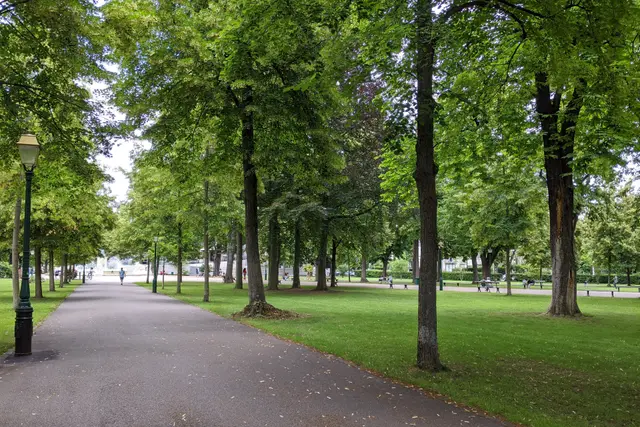
From Colmar railway station, the walk is roughly 15 to 20 minutes. Head northeast through the Champ de Mars park toward the Collégiale Saint-Martin, whose tiled roof you can use as a landmark. The house is a short stroll from the church square. If you’re driving, use one of the car parks on the edge of the old town and walk in rather than trying to get into the historic core.
The address is 11 Rue des Marchands, 68000 Colmar.

Looking up without blocking the street
Rue des Marchands is narrow and still works as a shopping street, so where you stand matters.
- Photograph from the corner, not the middle of the lane. Delivery vans and bikes use it, and the pavement is thin.
- Say “bonjour” when you enter the shop. The ground floor trades as a shop, and in France you greet staff on the way in and say “au revoir” on the way out. Walking in silently reads as rude.
- Remember it’s a working building. There is no museum interior to tour. The shop’s listed hours are 10am to 7pm, every day of the week, and the façade is visible from the street at any time.
- Cards are widely accepted in Colmar shops. For small purchases, carrying a few euros in cash is still sensible.
Timing is where you can win. Weekdays are quiet right through the day, from 10am to 7pm. Weekends are a different story. Between 12pm and 5pm, tour groups working the old-town circuit stack up at the corner, and a clean photo becomes hard to get. Arrive before noon on Saturday or Sunday, or after 5pm, and you’ll mostly share the view with shoppers.
Timing it with the seasons
Colmar changes character through the year. The house looks different in each season.
From late November through December, the Christmas markets fill the old town. The squares around Saint-Martin and the Koïfhus are lit up and very crowded, and the painted façade glows under the street lights. If that’s your trip, stick to weekday mornings for the house itself.
Spring and early autumn are gentler. The low sun reaches the murals and the colours read clearly. Summer brings the longest days and the most visitors. It also means evening light after 5pm, when the weekend crowd has thinned.
A walk outward from the corner
Maison Pfister makes a good first stop on an old-town loop. Most of Colmar’s landmarks are within ten minutes’ walk.
- Musée Bartholdi, a few doors along at 30 Rue des Marchands, is the birthplace of Auguste Bartholdi, sculptor of the Statue of Liberty.
- Collégiale Saint-Martin, the Gothic church with the patterned roof, is just around the corner.
- The Koïfhus, the old customs house, has glazed roof tiles and sits on the square of the same name.
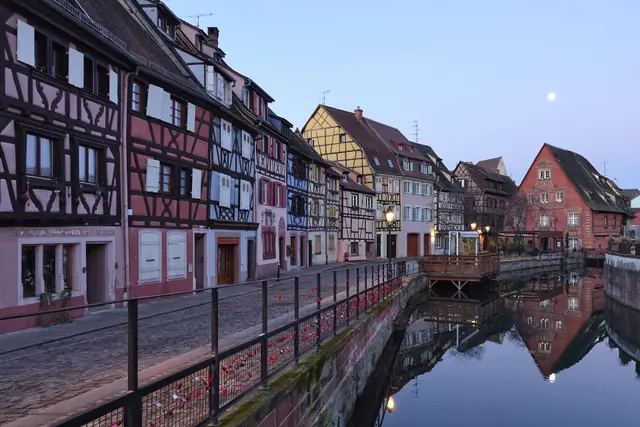
- Quartier des Tanneurs and Petite Venise lie south of here, with half-timbered houses along the Lauch river.
- Maison des Têtes, on Rue des Têtes, has a façade covered in more than a hundred carved faces. It pairs well with Pfister if you like decorated Renaissance buildings.
- Musée Unterlinden, home to the Isenheim Altarpiece, is a longer walk north and deserves a couple of hours of its own.
Give the house itself 15 to 20 minutes. Allow half a day if you’re carrying on through the old town to Petite Venise.
Frequently asked questions
When is the quietest time to visit Maison Pfister?
Weekdays are quiet right through the listed hours, from 10am to 7pm. On weekends, avoid 12pm to 5pm, when it gets busiest. Before noon or after 5pm on Saturday and Sunday is much calmer.
Can you go inside Maison Pfister?
It isn't a museum. The ground floor trades as a shop, with listed hours of 10am to 7pm every day. The painted façade, the wooden gallery and the corner oriel are what people come for, and you can see them all from the street at any time.
How do I get to Maison Pfister from Colmar station?
Walk roughly 15 to 20 minutes northeast through the Champ de Mars toward the Collégiale Saint-Martin. The house is at 11 Rue des Marchands, at the corner with Rue Mercière, a short walk from the church.
How long should I spend there?
Give it 15 to 20 minutes to read the murals from across the street and from up close. Then carry on to the Musée Bartholdi, the Koïfhus and Petite Venise, which are all within easy walking distance.
Is it worth seeing during the Christmas markets?
Yes. The old town is lit up from late November through December. It's also at its most crowded then, so come on a weekday morning to get a clear view of the façade.
Plan your trip to Colmar
Some links above are affiliate links — if you book through them, Wander Atlas earns a small commission at no extra cost to you. It's how we keep every guide free.