A roof you read like a quilt
Look up before you do anything else. The Koifhus, Colmar’s old customs house, wears a steep roof of glazed tiles in a diamond pattern of green, ochre, red and black. It dates from 1480, making it the oldest public building in the city. Merchants once brought their goods here to be weighed and taxed before they could be sold.
The square around it is small and paved, and half-timbered houses in painted plaster close it in on every side. You can take the whole thing in at a glance. That tight scale is the reason to come. Petite Venise gets most of the day-trippers, while this square is still a place you can stand in and look around.
The Koifhus and the fountain
The customs house has two faces. On the ground floor, arcades open onto the street where carts were once unloaded. Upstairs is the hall where delegates of the Décapole met. This was the league of ten free imperial cities of Alsace, and Colmar was one of them.
Walk around the building rather than just photographing its front. The passage beneath it leads through towards Grand’Rue. From that side the roof pattern and the wooden gallery show up at a different angle.
In the middle of the square is the Schwendi Fountain, made by Frédéric Auguste Bartholdi, Colmar’s own sculptor. He is the man behind the Statue of Liberty. The bronze shows Lazare de Schwendi, a 16th-century military commander, holding up a vine cutting. Local legend says he brought Tokay vines back from Hungary, which ties this square to the wine of the Alsace hills on the horizon.
Getting there on foot
Colmar’s old centre is compact and mostly pedestrianised, so walk. Here is how the square connects to everything nearby:
- From Gare de Colmar: roughly a 20-minute walk east via Avenue de la République and the Champ de Mars.
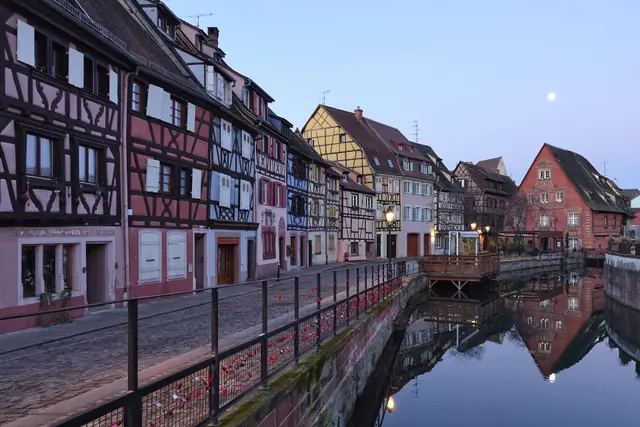
- From Petite Venise and Quai de la Poissonnerie: a few minutes north along the canal-side lanes.
- From Maison Pfister and Rue des Marchands: head south down Grand’Rue and the Koifhus comes into view.
- By car: use one of the central car parks, such as Parking Rapp or Parking Lacarre, then walk in. Don’t try to drive into the old town lanes.

When the square is at its best
The square has no gate and no ticket. It is open around the clock, so you choose the light. In early morning the tiled roof glows and the terraces are still being set out. After dark the fountain and the half-timbering are lit. Arriving outside the middle of the day usually means you miss the walking tours that move from Petite Venise through to the Collégiale Saint-Martin.
From late November through December the square hosts one of Colmar’s Christmas markets. Wooden chalets ring the fountain and the Koifhus becomes a backdrop of lights. It is the busiest the square ever gets. If you want to see it decorated but not packed, go on a weekday morning.
Using the square the Alsatian way
This square is for pausing, so do what the terraces invite you to do. Some practical habits help:
- Say “Bonjour” first when you walk into any shop or café around the square. Skipping it reads as rude in France.
- Order an Alsatian white rather than a generic glass. Riesling, Pinot Gris and Gewurztraminer come from the vineyards Schwendi’s statue celebrates.
- Tipping is light. Service is included in French bills, so leaving a little change or rounding up is plenty.
- Cards are widely taken, though small market stalls in December may prefer cash.
- At the Christmas market, hot wine comes in a souvenir mug that carries a deposit. Return it to any stall to get the deposit back, or keep it.
The Koifhus hall is used for exhibitions and events rather than as a permanent museum. Check the Colmar tourist office before planning a visit inside.
Pairing it with the rest of Colmar
The square works best as one stop on a loop. Start at the Musée Bartholdi on Rue des Marchands to see more of the sculptor’s work, then walk down to the fountain. From there, carry on south to the Quai de la Poissonnerie and Petite Venise.
Alternatively, head north past Maison Pfister to the Collégiale Saint-Martin, whose own patterned roof echoes the Koifhus. The Unterlinden Museum and the Isenheim Altarpiece are a short walk beyond. The whole circuit takes a relaxed half-day, and this square is where it makes most sense to stop and sit down.
Frequently asked questions
Is Place de l'Ancienne Douane open all the time?
Yes. It is a public square, open 24 hours every day, and there is no entry ticket. The Koifhus hall upstairs is only open for exhibitions and events, so check with the Colmar tourist office before planning a visit inside.
How long should I spend there?
Give it 20 to 40 minutes to walk around the Koifhus, look at the Schwendi Fountain and take photos. Stay longer if you sit at a café terrace. Most people fit it into a half-day walking loop of the old town.
How do I get there from Colmar train station?
Walk east via Avenue de la République and the Champ de Mars, which takes roughly 20 minutes. If you are driving, park at a central car park such as Parking Rapp or Parking Lacarre and walk in.
Is there a Christmas market on the square?
Yes. From late November through December the square hosts one of Colmar's Christmas markets, with wooden chalets around the fountain. Weekday mornings are the easiest time to see it.
What is nearby?
Petite Venise and the Quai de la Poissonnerie are a few minutes south. Maison Pfister, the Musée Bartholdi on Rue des Marchands and the Collégiale Saint-Martin are all a short walk north.
Plan your trip to Colmar
Some links above are affiliate links — if you book through them, Wander Atlas earns a small commission at no extra cost to you. It's how we keep every guide free.