Why go
Colmar’s half-timbered lanes are gorgeous but tight, and by mid-morning they’re shoulder to shoulder with visitors. Parc du Champ de Mars is the release valve: a broad, tree-canopied park just outside the historic core where the pace slows and the sightlines open up.
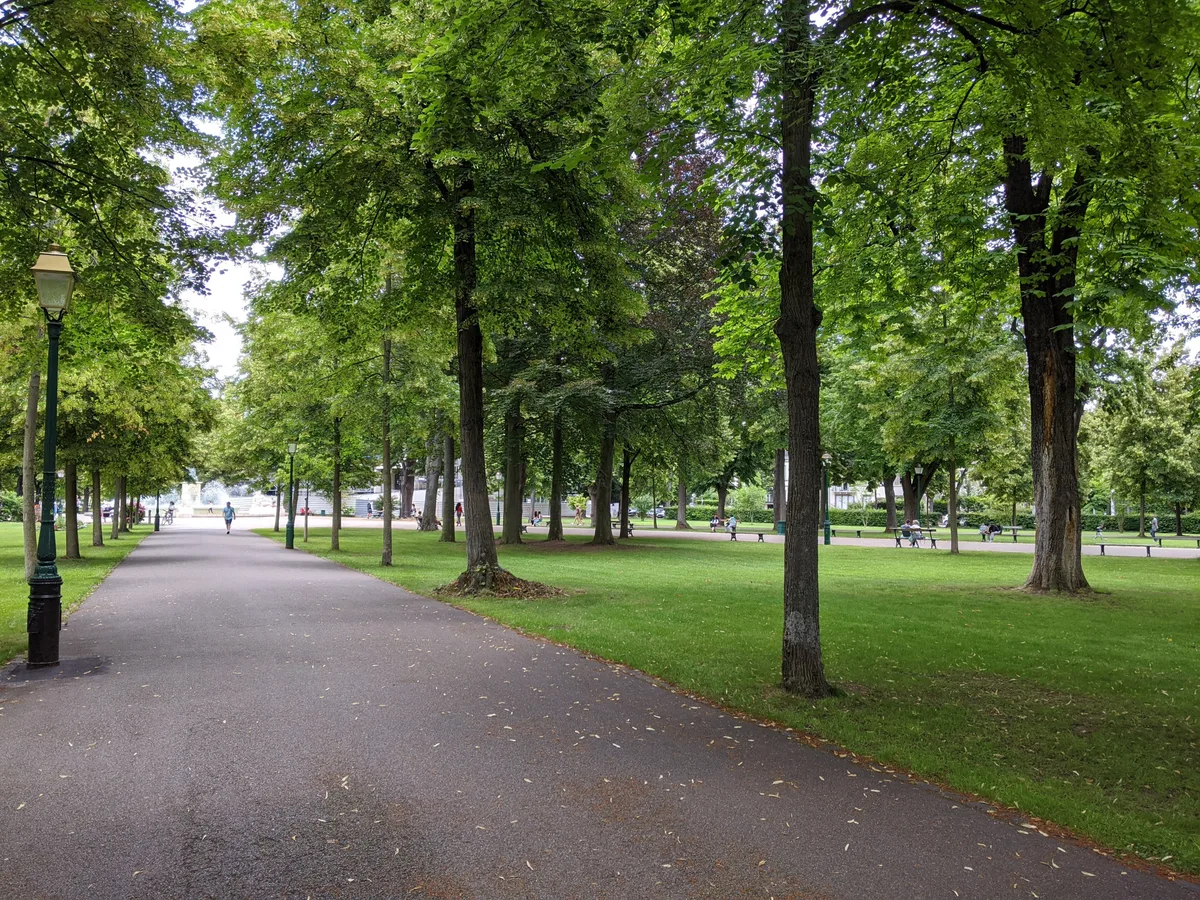
You come here not for a single monument but for the whole picture, gravel paths under plane trees, a central fountain throwing up a fine mist in summer, and stone statues of notable Frenchmen standing sentinel along the walkways.
Getting there
The park sits on Avenue de la République, on the eastern edge of central Colmar, an easy 10–15 minute walk from the Old Town or the Koifhus. If you’re coming from the train station, it’s roughly the same distance the other direction, making it a natural stop on a loop through town.
There’s no gate and no closing time, it’s open 24 hours every day, so it works equally well as a morning warm-up before the shops open or a place to unwind after dinner.
What to see and do
The layout rewards unhurried wandering rather than a checklist, but a few things anchor a visit:
- The central fountain, ringed by benches and usually the park’s focal point for photos
- Statues of prominent French historical figures dotted along the main paths
- A children’s playground, useful if you’re traveling with young kids and need a break from cobblestones
- Mature tree cover that makes the park noticeably cooler than the streets on hot Alsace summer afternoons
None of it demands much time, 30 to 45 minutes covers the loop, but the shade and the quiet make it easy to linger longer than planned.
When to go
This is a genuinely popular park, not a quiet backstreet find, and it shows during the day. Weekends tend to be the busiest, with families, joggers, and groups settling in for hours at a time.
For a calmer visit, aim for early morning, on weekdays and weekends alike. Arrive then and you’ll often have the fountain and main paths largely to yourself.
Spring and summer bring the fullest tree canopy and the liveliest atmosphere; autumn scatters the paths with leaves and thins the crowds noticeably, which suits anyone who prefers a slower walk over a social one.
How to visit like a local
Treat the early morning slot as the park’s best-kept practical secret, even if the park itself isn’t one. Locals walking dogs or heading to work tend to pass through before 8am, when the light through the trees is softest and the benches are empty.
There’s no entry fee and nothing to book. It’s a public park, so you simply walk in. Don’t expect food vendors or facilities beyond the playground; this isn’t a destination with amenities, it’s a place to decompress between the sights everyone else is queuing for.
The most common visitor mistake is treating it as a quick photo-stop squeezed between Petite Venise and the Old Town at midday, then wondering why it feels crowded and unremarkable. Give it the quiet hour instead, or swing through at dusk when the day-trippers have thinned out and the statues catch the last light.
If you’re cycling or walking a wider loop of Colmar, the park makes a natural rest point roughly midway between the station and the tourist center, so factor it in as a pause rather than a separate outing.
Frequently asked questions
How do I get to Parc du Champ de Mars from central Colmar?
It's about a 10–15 minute walk east of the Old Town along Avenue de la République — no bus or ticket needed.
What are the opening hours?
The park is open 24 hours every day, so there's no specific opening or closing time to plan around.
When is it quietest?
Weekday mornings between 7am and 8am are calmest; on weekends the quiet window runs 7am to 9am. Avoid weekend afternoons from noon to 9pm, when it's busiest.
How much time should I spend there?
30 to 45 minutes covers the main paths, fountain and statues; add extra time if you're visiting with kids for the playground.
Is there an entry fee?
No, it's a free, open public park with no ticket or reservation required.
Plan your trip to Colmar
Some links above are affiliate links — if you book through them, Wander Atlas earns a small commission at no extra cost to you. It's how we keep every guide free.