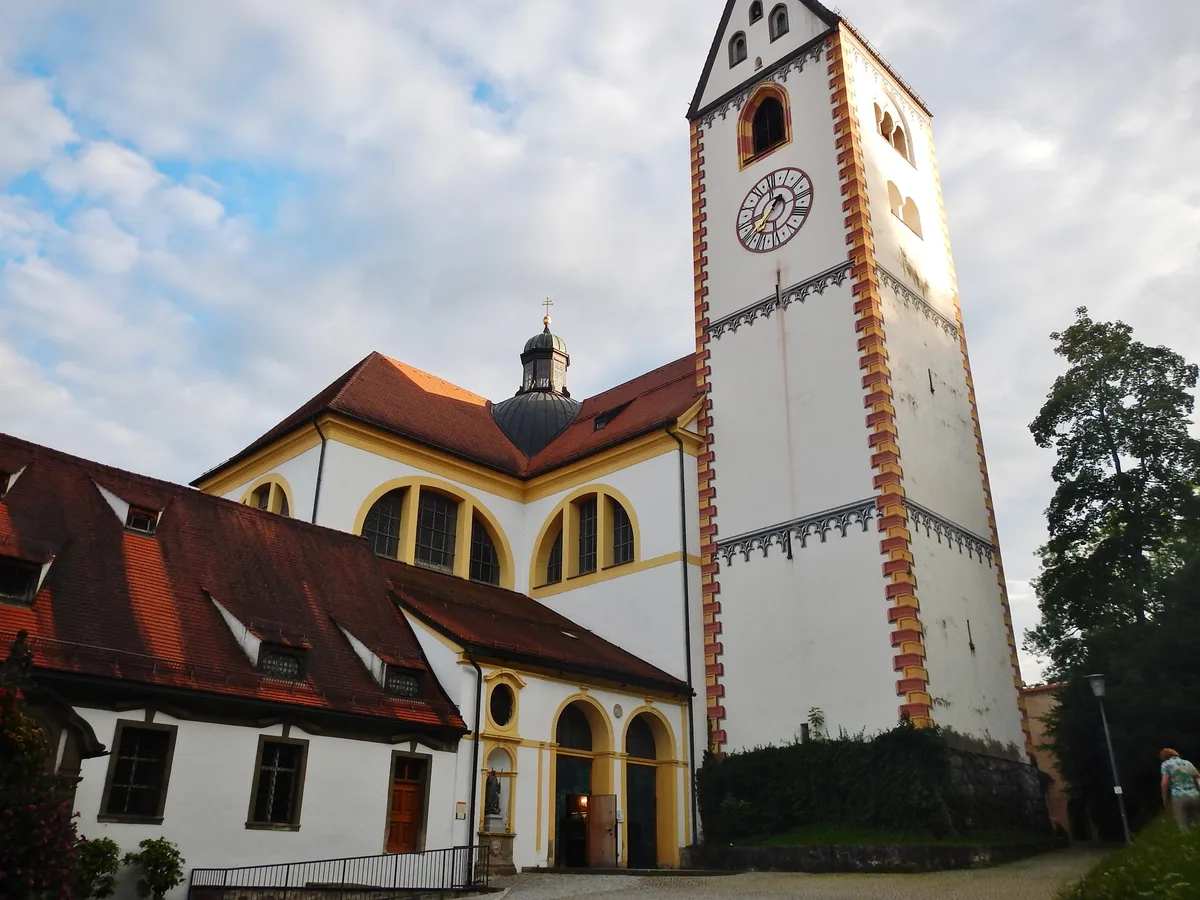
A pale baroque wing sits above the Lech, with the twin-domed bulk of the Basilica of St. Mang pressed up against it. Most visitors walk straight past on their way to the Neuschwanstein buses. That is good news for you. Inside the old monastery, Füssen keeps the museum that explains why this small Allgäu town once supplied lutes to half of Europe.
A monastery built on a saint’s cell
St. Mang is the local form of Magnus. He was the missionary monk who settled on this spot above the river in the 8th century. A Benedictine community grew around his memory, and the monastery dates back to the 9th century. For roughly a thousand years it was the town’s spiritual and economic anchor.
What you see today is mostly an early 18th-century baroque rebuild. It was laid out by Johann Jakob Herkomer, an architect from the Füssen area. The abbey was secularised in the early 1800s. Part of the complex now serves as Füssen’s town hall, and the grandest rooms became the Museum der Stadt Füssen.
Rooms to slow down in
The museum follows the monastery’s own floor plan. You move through the abbots’ state rooms more or less the way a visiting dignitary would have. Expect stucco ceilings, painted walls and corridors with views down into the cloister.
Highlights to look for:
- The lute and violin collection. Füssen was a centre of European lute making from the 16th century onward. Its workshops sent instruments and craftsmen to Venice, Padua and Lyon, and the cases here trace that trade.
- The Fürstensaal. The prince’s hall is the baroque showpiece, built for receiving important guests.
- The library. A galleried baroque room where the monks kept their books.
- St. Anne’s Chapel (Annakapelle). It holds the Füssener Totentanz, a Dance of Death painted in the early 1600s. Skeletons lead people of every rank, from pope to peasant, off the stage.
The Dance of Death rewards a few minutes of real attention. Each panel carries a short rhymed verse in old German. Even without translating it, the steady parade of skeletons making their point across every rank of society gets through.

Getting to Lechhalde 3
The address is Lechhalde 3, on the lower edge of the old town where the street drops toward the river. Füssen station is the end of the regional line from Munich. Most connections change at Buchloe, and the trip takes about two hours.
From the station, walk through the pedestrianised Reichenstraße toward the Hohes Schloss. Then bear downhill toward the basilica. It takes about 10–15 minutes on foot. If you’re driving, use one of the public car parks around the old town edge. The lanes near the monastery are narrow and partly pedestrian-only.
Fitting it around the castles
The opening hours are simple: 10am to 5pm, Tuesday through Sunday. Mondays it is closed, which catches out people who plan a “museum day” to rest after the castles. Swap your days if you need to.
The monastery works well as the other half of a Neuschwanstein day. The castles of Schwangau sit about four kilometres east. A late-morning castle tour followed by an early-afternoon bus back still leaves you time here before 5pm. Arriving after about 4pm is a squeeze, because the rooms are spread out.
Moving through a working church complex
The museum is quiet, but the basilica next door is a functioning parish church. Behave as you would at any Bavarian church:
- Check for services before entering the basilica. Mass and weddings take priority. During a service, stay at the back or come back later.
- Look for the crypt. Under the basilica’s choir sits the crypt of St. Magnus, with frescoes from around the year 1000, among the oldest in Bavaria. Access can depend on the church’s schedule.
- Keep voices low in the chapels, especially in St. Anne’s, which is small and echoes.
- Ask before photographing, and look for posted signs. Rules on photography and flash can differ between the museum rooms and the church.
Admission is paid at the museum entrance, where current prices are posted. Some joint tickets with the Hohes Schloss galleries have been offered in the past, so ask at the desk whether one is available before you pay twice.
Before and after
Leave the monastery by the river side and you’re at the Lech, which runs a striking green below the walls. A short walk upstream brings you to the Lechfall. There the river spills over a weir into a narrow gorge, and a footbridge crosses above it.
Back uphill, the Hohes Schloss looks down over the old town. It was the residence of the prince-bishops of Augsburg and is known for its painted illusionistic windows. The monastery, the castle and the old town lanes between them fill an unhurried half day without a single tour bus.
Frequently asked questions
What are the opening hours of Benediktinerkloster St. Mang?
It opens Tuesday to Sunday, 10am to 5pm, and is closed on Mondays. Arrive by about 3pm to see the museum rooms without rushing.
How long should I spend at the St. Mang monastery?
Plan on 1.5–2 hours for the museum: the lute collection, the Fürstensaal, the library and the Dance of Death in St. Anne's Chapel. Allow extra time if you also want to look around the basilica next door.
How do I get there from Füssen train station?
Walk through the old town along Reichenstraße, then head downhill toward the basilica and Lechhalde 3. It takes about 10–15 minutes on foot.
Can I combine it with Neuschwanstein in one day?
Yes. The castles are about four kilometres away in Schwangau. A morning castle visit followed by an afternoon at the monastery works, as long as it isn't a Monday.
What else is nearby?
The Hohes Schloss is just uphill. The Lech riverbank and the Lechfall gorge are a short walk away from the monastery's river side.
Plan your trip to Füssen
Germany eSIM & staying connected →
Some links above are affiliate links — if you book through them, Wander Atlas earns a small commission at no extra cost to you. It's how we keep every guide free.
Related guides
 attraction
 Hohes Schloss: Füssen Travel Guide (4.5★)
 attraction
 Walderlebniszentrum Ziegelwies: Füssen Travel Guide (4.7★)
 attraction
 Hohenschwangau Castle: Füssen Travel Guide (4.6★)
 restaurant