
A town the castle crowds walk past
Most people come to Füssen for somewhere else. Neuschwanstein and Hohenschwangau sit about four kilometres east, and the coaches and castle buses treat the town as a car park with a railway station. That leaves the old town quieter than its looks would suggest.
The Altstadt is small enough to cross in ten minutes. It’s a knot of pastel-plastered houses with steep roofs, wrought-iron shop signs and stone gateways. Above it stands a late-Gothic castle, and below it the Lech runs green and fast toward its gorge. Füssen is also the southern end of the Romantic Road, the old route that starts up in Würzburg.
Reichenstraße and the lanes off it
Start on Reichenstraße, the pedestrianised spine of the old town. It’s paved in cobbles and lined with gabled house fronts. The street climbs gently toward the castle hill, with the Alps showing at the end of the side streets.
The ground floors are bakeries, cafés, outdoor-gear shops and souvenir shops. The upper floors still carry painted window surrounds and the odd mural. Take the narrow passages that branch off to either side. They lead to small squares, back courtyards and stretches of the old town wall, and they empty out quickly once you leave the main street.
What to look up at as you walk:
- The guild-style hanging signs over the shop doors
- Bay windows and oriels stuck onto the upper storeys
- Painted façades on the churches near the river
- Glimpses of the Hohes Schloss tower over the rooftops
The castle that paints its own windows
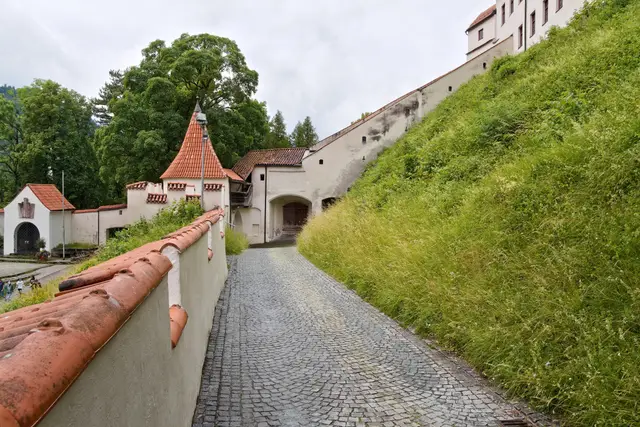
The Hohes Schloss crowns the hill at the top of the old town. It was the summer residence of the Prince-Bishops of Augsburg. Walk into the inner courtyard and you’ll notice something odd straight away.
Many of the windows, oriels and stone frames on the courtyard walls aren’t there. They’re trompe-l’oeil paintings from around 1500, done so precisely that you have to stand close before the illusion breaks. It’s one of the best-known examples of illusionistic façade painting in Germany, and many day-trippers never see it.
Inside, the castle holds a branch of the Bavarian State Painting Collections and the town’s own art gallery, with late-Gothic and Renaissance works. Museum hours change through the year, so check the official Füssen site for this month’s times before you climb up.

Lutes, violins and a Dance of Death
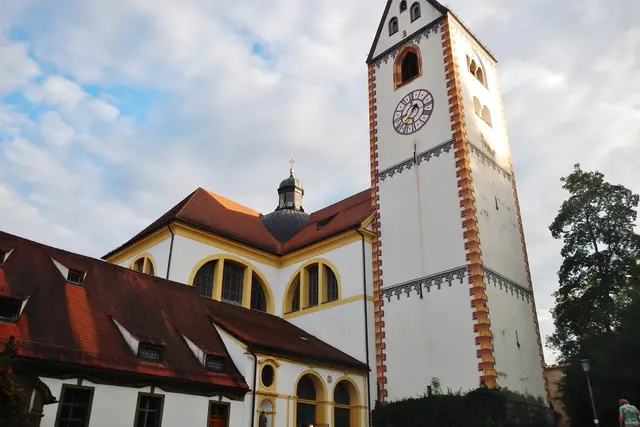
Below the castle sits the former Benedictine Abbey of St. Mang. It was rebuilt in Baroque style in the early 18th century. Its abbey church and the cloister buildings now house the Museum der Stadt Füssen.
The museum covers something most visitors don’t know about the town. Füssen was one of the cradles of European lute-making, and later of violin-making. Its workshops supplied instruments to courts across the continent. The collection of historic stringed instruments tells that story better than any plaque in the street.
Don’t skip the St. Anna Chapel. Its early 17th-century Totentanz, the Dance of Death, shows skeletons leading people of every rank away, from emperor to beggar. It’s macabre, finely painted and much more memorable than another gilded altar. Opening times here also vary by season, so confirm them on the official site.
Down to the Lech
The river is the old town’s other edge. From the abbey, walk downhill to the riverside, where the Franciscan monastery stands above the water. The Heilig-Geist-Spitalkirche’s painted façade faces the street along the bank.
Follow the Lech upstream for roughly a kilometre and you reach the Lechfall. Here the river drops over a series of weirs into a narrow limestone gorge. The König-Max-Steg footbridge crosses right over the churning water, and it’s the best view in town that doesn’t involve a ticket. Paths from here go on into the woods and toward the lakes south of town.
Arriving by rail and from the castles
Füssen station is the end of the regional line from Munich. The trip takes about two hours, sometimes with a change at Buchloe. The station is at the edge of the old town, so you can walk to Reichenstraße within a few minutes of getting off the train.
The regional buses to Hohenschwangau, the village below Neuschwanstein, also leave from the station. That makes the Altstadt an easy add-on either side of a castle visit. If you’re driving, the town’s signed car parks ring the old centre. The core is pedestrianised, so leave the car outside and walk in.
Timing your stroll around the castle buses
The old town’s rhythm follows the castle traffic. Day-trippers tend to head straight from the train to the Hohenschwangau buses in the morning, then come back through town in the late afternoon to catch trains home. So the early morning and the evening, after the last coaches have left, are when Reichenstraße feels most like a town rather than a transit point.
A few practical habits that help here:
- Stay the night if you can. The Altstadt’s best hours come after the day visitors have gone, and an overnight stay also gets you to the castles before the first train arrives.
- Carry some euros. Cards are accepted widely, but small bakeries and cafés in Bavaria sometimes still prefer cash.
- Tipping is light. In cafés and restaurants, round the bill up or add about ten percent, and say the total out loud when you hand over the money instead of leaving coins on the table.
- Mind Sunday. Most shops in Germany close on Sundays, though cafés and museums often open. Plan your shopping for another day.
- Churches are working churches. Keep your voice down in St. Mang and the riverside churches, and step back if a service is on.
A greeting helps. “Grüß Gott” is the standard hello in this part of Bavaria, and saying it as you walk into a small shop gets a warmer welcome than a plain “hello”.
Frequently asked questions
How do I get to Füssen Altstadt from the train station?
Walk. Füssen station is at the edge of the old town, and Reichenstraße, the main pedestrian street, is a few minutes away on foot. Trains from Munich take about two hours, sometimes with a change at Buchloe.
How long should I spend in Füssen's old town?
Half a day covers the Altstadt properly: Reichenstraße and its side lanes, the Hohes Schloss courtyard and galleries, St. Mang Abbey's museum, and a walk to the Lechfall. If you skip the museums, an hour or two works as a stop before or after Neuschwanstein.
What's the best time of day to explore the Altstadt?
Go early in the morning or in the evening. Many day visitors pass through on their way to and from the castle buses, so the lanes are calmest before they arrive and after they leave. Staying overnight gives you both.
Is the old town close to Neuschwanstein?
Yes. Neuschwanstein and Hohenschwangau are about four kilometres east, and regional buses to Hohenschwangau leave from Füssen station. The two fit easily into one day.
What is there to see besides shops?
See the trompe-l'oeil painted windows in the Hohes Schloss courtyard, the Füssen town museum in St. Mang Abbey with its historic lutes and violins, the Dance of Death paintings in the St. Anna Chapel, and the Lechfall gorge with the König-Max-Steg footbridge. Museum hours vary by season, so check the official site.
Plan your trip to Füssen
Germany eSIM & staying connected →
Some links above are affiliate links — if you book through them, Wander Atlas earns a small commission at no extra cost to you. It's how we keep every guide free.
Related guides
 hidden gem
 Neuschwanstein Castle: Füssen Travel Guide (4.6★)
 restaurant
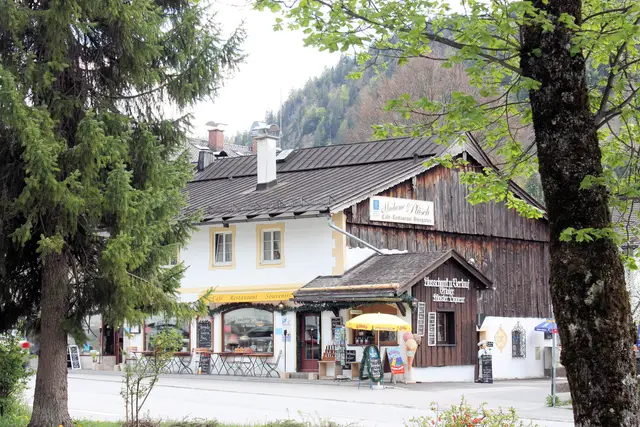
 Restaurant Madame Plüsch: Where to Eat in Füssen (4.6★)
 attraction
 Benediktinerkloster St. Mang: Füssen Travel Guide (4.6★)
 attraction