Where the city stops and the plateau starts
Giza does not fade out gently. Apartment blocks, satellite dishes and traffic on Pyramids Road (Shari’ al-Haram) run right up to a wall of tan limestone. Above that wall stand the oldest of the ancient Seven Wonders and the only one still standing.
The plateau is bedrock. The pyramids were built from blocks cut out of it, so the ground under your feet and the stone above you are one material. Sand collects in the hollows, and the wind carries it across the paths.
This is the most visited ancient site in Egypt, with well over 100,000 reviews on Google, and it lives up to the attention. Plan on half a day. Give it longer if you want to go inside a pyramid and walk out to the cemeteries.
Three pyramids, walked in order
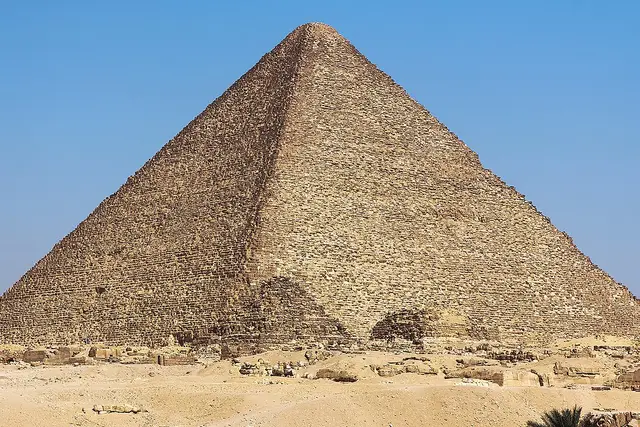
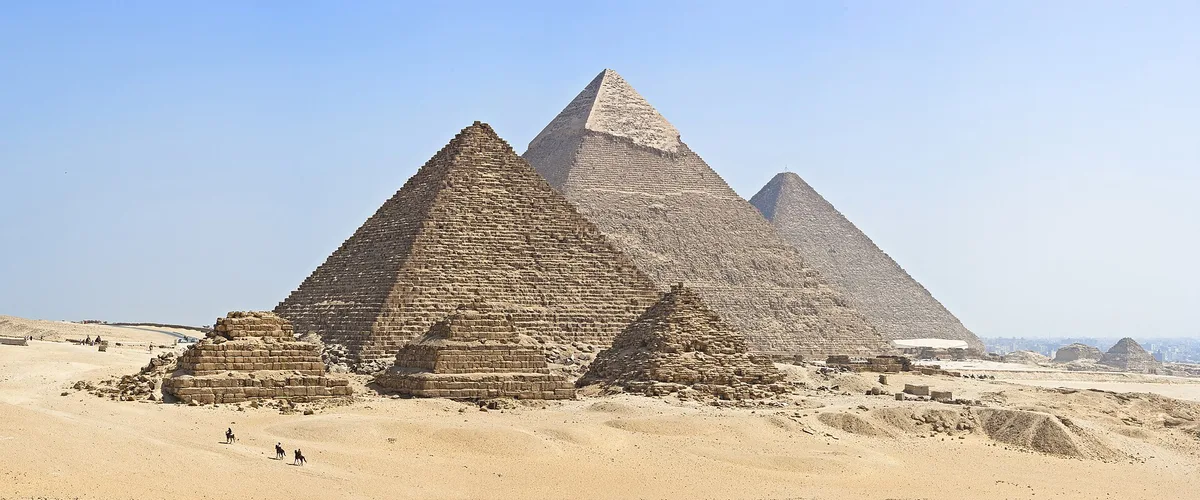
The three main pyramids sit roughly on a diagonal line, from largest to smallest.
- Khufu (the Great Pyramid): the oldest and largest, built around 2560 BC. At ground level, each block on its stepped face comes up to about your chest.
- Khafre: it looks taller because it stands on higher ground. Near its tip it still keeps a cap of the smooth limestone casing that once covered all three.
- Menkaure: the smallest, with granite blocks still visible around its lower courses.
Around Khufu are the small queens’ pyramids. Rows of mastaba tombs belonging to officials spread out to the east and west, laid out like streets. Most visitors walk straight past them, and that alone makes them worth the detour.
Crawling into Khufu
You can enter the Great Pyramid. It needs its own ticket, separate from site entry. Check the official ticket office or the Egyptian antiquities site for the current options, because interior access is sometimes rotated between the pyramids.
The route is physical. A low, narrow passage climbs steeply, and you go up it bent nearly double. Then the Grand Gallery opens out: a tall corbelled shaft with walls that step inwards as they rise. It ends in the King’s Chamber, a plain room lined with red granite that holds an empty, lidless sarcophagus.
The chamber has no paintings or inscriptions. The air is warm and still. If you are claustrophobic or have bad knees, skip it and spend the time on the plateau.

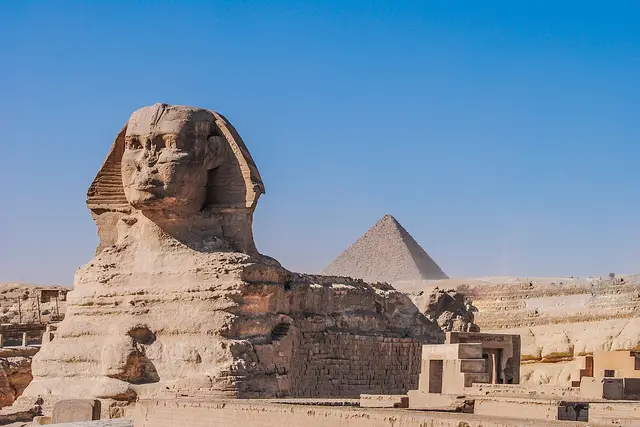
The Sphinx, seen from the Valley Temple
The Great Sphinx was carved straight out of the bedrock at the bottom of the plateau, facing east towards the Nile. You don’t just walk up to it. You come at it through the Valley Temple of Khafre.
That temple is built from huge blocks of pink granite, fitted without mortar, over a pale alabaster floor. A causeway leads you out to a terrace beside the Sphinx’s flank. Its body shows clear layers in the rock, because some bands of stone weathered faster than others.
The terrace gets crowded quickly, and most people take the same head-on photo. Walk to the edge of the enclosure and you can line the Sphinx up against Khafre’s pyramid behind it. That is the angle that shows how the whole complex was planned as one.
Beating the 10am wave
Arriving early matters more here than almost anywhere in Cairo. The site currently opens at 8am every day and closes at 4pm. Hours at Egyptian antiquities sites shift through the year, so check the official site for this month’s times.
Crowd forecasts show the quietest time is 8am–9am on weekdays. At weekends the calm lasts a little longer, from 8am to 10am. Try not to arrive between 10am and 2pm at the weekend. That is when tour coaches fill the car parks and the Sphinx terrace gets packed.
Early mornings bring other advantages too:
- Light: the low sun hits the eastern faces of the pyramids and the Sphinx’s face.
- Heat: the open plateau has almost no shade by midday, especially from May to September.
- Queues: if you want the interior ticket, buying it early helps.
Handling camels, horses and offers of help
Around the gates and the viewpoints, men offer camel rides, horse-and-cart trips, photos and “guiding”. Some are licensed. Some say an area is “closed” so they can lead you somewhere else. Stay calm and polite.
- Agree everything up front. Settle the full price, the route and how long it lasts before you get on any animal. Then confirm it again.
- A firm “la, shukran” (no, thank you) while you keep walking works better than a debate.
- Carry small Egyptian pound notes for tips (baksheesh) to toilet attendants or anyone who really helps you.
- Bring a card as well as cash. Ticket offices at major Egyptian sites have moved towards card payment.
- Don’t climb the pyramids. It is forbidden and guards enforce it.
Hiring a licensed Egyptologist through a reputable agency or your hotel removes most of the hassle. They can also explain the mastabas that most visitors pass without knowing what they are.
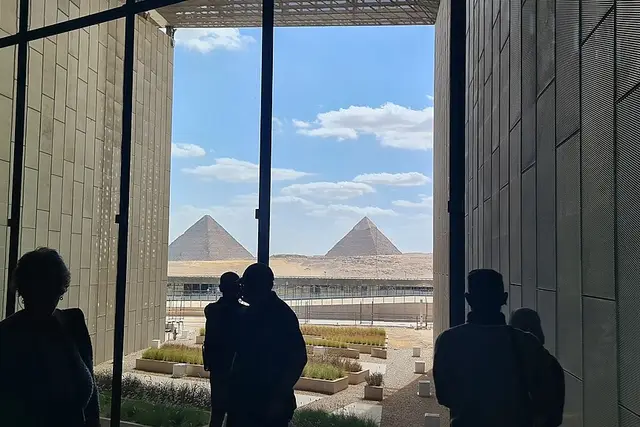
The panoramic viewpoint on the desert ridge southwest of the pyramids is where you can photograph all three in a row. It is a long, exposed walk there, so many people go by car or carriage. Bring water and a hat whichever way you go.
Getting to Al Haram
The site is at the western edge of Greater Cairo, at the end of Pyramids Road. The Cairo Metro doesn’t reach it. You can ride Line 2 to Giza station, but you will still need a taxi or ride-hail car for the last stretch.
For most visitors, the simplest option is a ride-hailing app from central Cairo or Zamalek. Traffic decides how long it takes, and leaving early enough to arrive right at the 8am opening makes sense. The plateau has more than one entrance, so check which gate your driver is heading to.
In the evenings, there is a long-running sound and light show beside the Sphinx. It has its own schedule and tickets, so check them before you go.
Frequently asked questions
When is the quietest time to visit Giza Necropolis?
Crowd forecasts show 8am–9am is quietest on weekdays and 8am–10am at weekends. Try not to arrive between 10am and 2pm at the weekend, when it usually peaks.
What are the opening hours?
At the moment it opens 8am–4pm every day. Hours at Egyptian antiquities sites change with the season, so check the official site for this month's times.
How long should I spend at the pyramids?
Allow at least half a day. That covers the three pyramids, the Sphinx and the Valley Temple, plus the panoramic viewpoint. Add time if you want to go inside a pyramid or explore the mastaba cemeteries.
Can I go inside the Great Pyramid?
Yes, with a separate ticket from site entry. Expect a steep, low passage you climb bent over, then the Grand Gallery and the granite King's Chamber. Check at the ticket office which interiors are open.
How do I get to Giza Necropolis from central Cairo?
The simplest way is a taxi or ride-hailing car along Pyramids Road to Al Haram. The metro doesn't reach the site: Line 2 to Giza station still leaves you a car ride from the gates.
Plan your trip to Giza
Egypt eSIM & staying connected →
Some links above are affiliate links — if you book through them, Wander Atlas earns a small commission at no extra cost to you. It's how we keep every guide free.