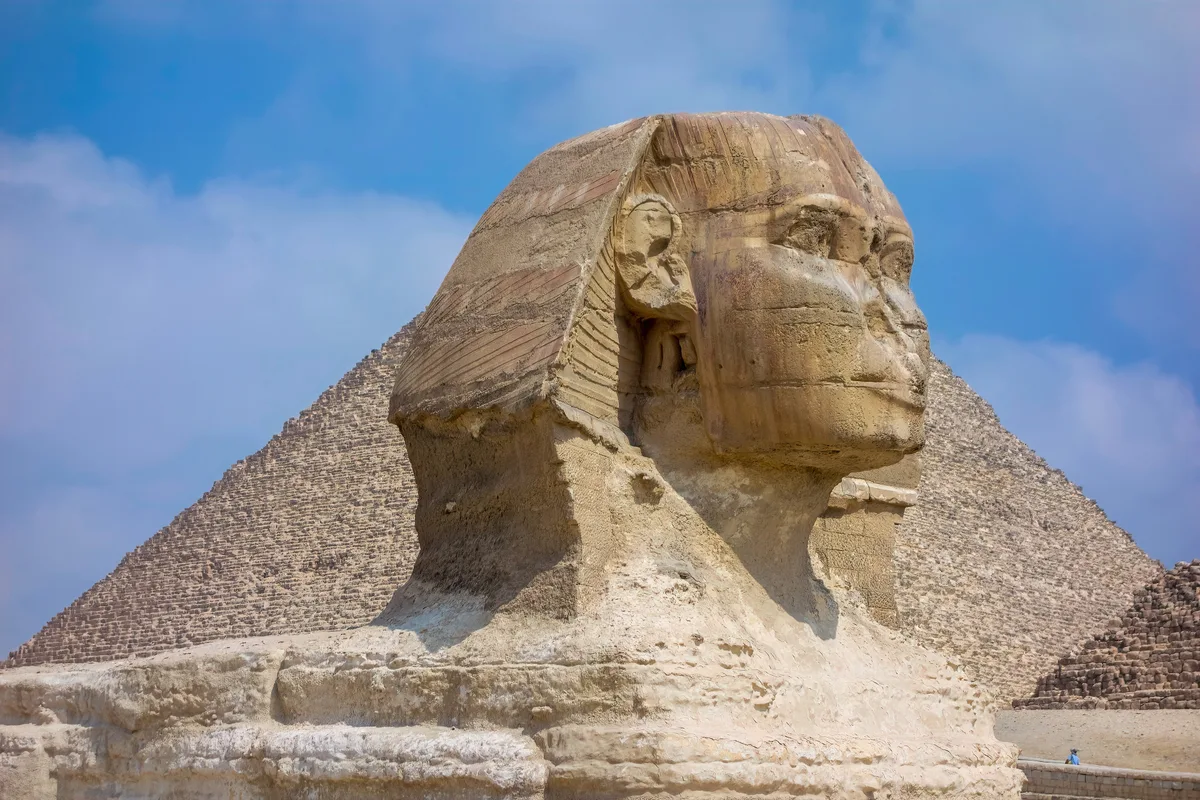
A course laid out around Khufu
This course crosses ground that has held a building site for 4,500 years. The Giza Plateau is a raised shelf of limestone at the edge of the Western Desert. The stone for the Great Pyramid of Khufu was quarried from this same rock, and you run across it with the pyramid in view.
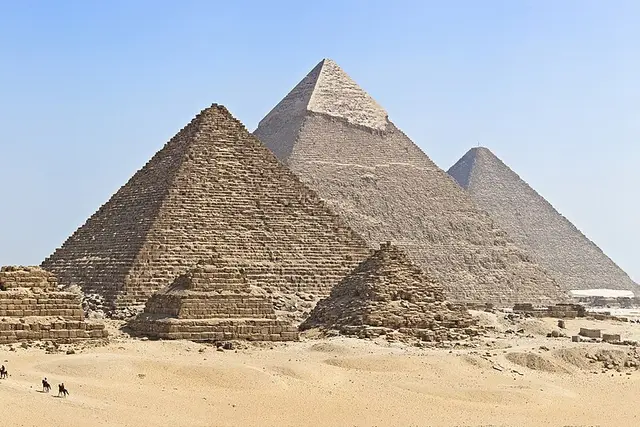
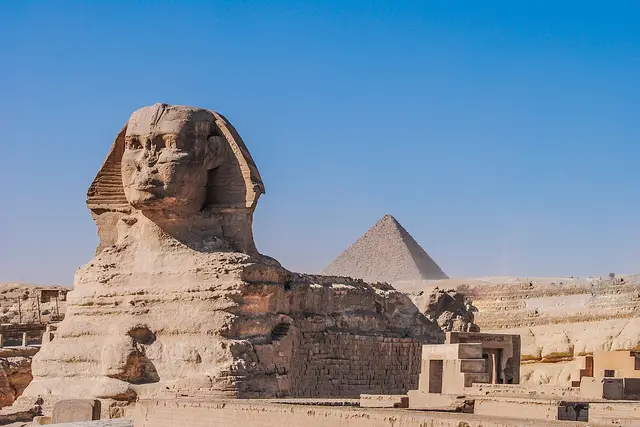
Three pyramids stand in a rough diagonal line: Khufu, Khafre and the smaller Menkaure. Each has satellite pyramids and the low ruins of mastaba tombs around it. Below them, facing east toward the Nile valley, the Great Sphinx crouches in its quarried hollow.
Few road races anywhere put this much ancient architecture beside the route. For many runners it is the whole reason to come to Egypt in December.
Dates and distances for 2026
The eighth edition runs over two days inside the Giza Pyramids complex:
- Friday 11 December 2026: the 5K
- Saturday 12 December 2026: the 10K and the half marathon (21.1km)
Splitting the shortest distance onto its own day keeps Saturday’s field to the longer races. It also lets a household arrive together and run on separate mornings. One person can do the 5K on Friday and another the half on Saturday.
The organiser publishes start times, registration, ticket links and bib collection details on the race’s official site. Marakez is the title sponsor, which is why its name sits in front of the event’s name.
Friday and Saturday: running on Egypt’s weekend
The race dates follow Egypt’s calendar rather than a European one. Here the weekend is Friday and Saturday, so both race days fall on days off for most Cairenes. Friday is also the main day of congregational prayer, and the midday prayer shapes the rhythm of the city.
In practice, Friday mornings in Greater Cairo tend to be the quietest of the week on the roads. That matters on the drive out to Giza, where weekday traffic on the Pyramids Road can be slow. Saturday traffic usually builds faster as the day goes on, so a morning start suits the longer distances.
Getting to the plateau on race morning
The Giza Pyramids complex sits on the western edge of Greater Cairo, about 15km from Tahrir Square. No metro line runs to the plateau. Giza station on Cairo Metro Line 2 is the nearest stop, and it is still several kilometres from the pyramids.
Most runners come by car. Uber and Careem both operate across Cairo and Giza, and hotels arrange drivers. The main approaches are:
- Pyramids Road (Shari’ al-Haram): the long avenue from central Giza, ending near the Mena House hotel at the plateau’s northern side
- Nazlet el-Samman: the village below the Sphinx on the eastern side, packed with guesthouses with pyramid views
Cairo International Airport is on the far side of the city, so the transfer takes a long time in traffic. Visitors racing on Saturday usually stay in Giza itself rather than in Downtown or Zamalek. That way race morning starts with a short drive.
December on the desert edge
December is one of the coolest months in Giza, which is why the race is held then. Mornings in the desert are cool and often fresh. Days are mild and sunny, and the low winter sun throws long shadows across the plateau. Rain is rare.
The desert still dries you out, and there is very little shade on the plateau. Runners commonly pack:
- a light layer for the wait before the start, taken off before the gun
- sunglasses and a cap, since the sun reflects off pale stone and sand
- sunscreen, even in winter
- a buff or thin scarf, useful if the wind lifts dust
- shoes they have already worn on mixed surfaces, because the plateau’s paths are not a city road
The plateau is not flat. It rises and falls around the pyramid bases and the cemetery fields. Runners targeting a fast time usually treat this as a scenery race rather than a record attempt.
Race weekend etiquette on the Giza Plateau
The plateau works to its own customs, and race weekend doesn’t change them. Knowing a few of them keeps things smooth.
Camels, horses and touts. Camel and horse handlers, souvenir sellers and self-appointed guides work the plateau. A smiling, firm “la, shukran” (“no, thank you”) while you keep walking is the accepted way to decline. Stopping to chat is usually taken as interest.
Cash and tipping. Hotels and larger restaurants take cards. Drivers, toilet attendants and small vendors expect cash in Egyptian pounds, and small notes are hard to come by. Tipping, called baksheesh, is part of daily life. People round up for drivers and leave a little for anyone who helps.
Climbing and touching. Climbing the pyramids is forbidden, and that rule applies to runners in finisher medals too. Photos from the paths and viewpoints are fine.
Dress off the course. Running kit is normal on the course. In Nazlet el-Samman and around Cairo afterwards, both men and women usually cover their shoulders and knees, out of courtesy.
After the finish: the rest of Giza
Many runners stay on the plateau after the race and see it at walking pace. The usual circuit:
- The Great Sphinx and the Valley Temple of Khafre, on the eastern edge, built from huge granite and limestone blocks
- The Panoramic Point, a rise to the south-west where all three main pyramids line up in one frame
- The interior of the Great Pyramid, reached by a steep, cramped ascending passage that is hard work on race-tired legs
Beyond the plateau, the Grand Egyptian Museum stands a couple of kilometres to the north-east. It holds the Tutankhamun collection and a large share of Egypt’s pharaonic statuary, and it fills a full day on its own.
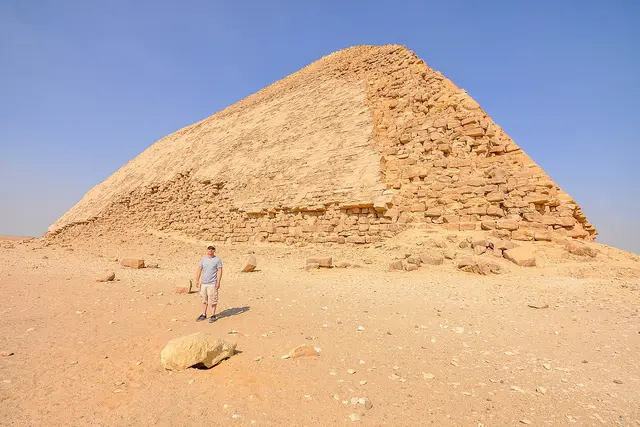
South of Giza, Saqqara, with the Step Pyramid of Djoser, and Dahshur, with the Bent and Red Pyramids, are a half-day trip by car. Visitors with an extra day often pair them, because the older pyramids show how the builders worked up to Khufu.
For food, Giza and central Cairo serve the standard Egyptian refuelling dishes. Koshari is a bowl of rice, lentils, pasta and chickpeas under tomato sauce and fried onions. Ful medames is stewed fava beans eaten with flatbread. Both are cheap and filling, and you’ll find them everywhere.
Frequently asked questions
When is the Marakez Pyramids Half Marathon 2026?
The eighth edition takes place on Friday 11 December 2026 (5K) and Saturday 12 December 2026 (10K and half marathon). Start times and registration details are on the race's official site.
Where is the race held?
Inside the Giza Pyramids complex on the Giza Plateau, on the western edge of Greater Cairo, around the pyramids of Khufu, Khafre and Menkaure and the Great Sphinx.
How do runners get to the start?
Usually by car: Uber, Careem or a hotel driver. No metro reaches the plateau; Giza station on Line 2 is several kilometres away. Saturday runners often stay in Giza or Nazlet el-Samman to keep race-morning travel short.
What is the weather like in December?
December is one of Giza's coolest months, with cool, fresh mornings, mild sunny days and rare rain. There is little shade on the plateau, so sun protection matters even in winter.
What else can I see nearby after the race?
The Sphinx, the Valley Temple of Khafre and the Panoramic Point on the plateau itself, the Grand Egyptian Museum a couple of kilometres away, and the pyramids of Saqqara and Dahshur as a half-day trip south.
Plan your trip to Giza
Egypt eSIM & staying connected →
Some links above are affiliate links — if you book through them, Wander Atlas earns a small commission at no extra cost to you. It's how we keep every guide free.
Related guides
 event
Shakira Las Mujeres Ya No Lloran World Tour - Pyramids of Giza: Dates, Tickets & Venue (Giza)
 hidden gem
Bent Pyramid of Cairo: Giza Travel Guide (4.8★)
 attraction
Giza Necropolis: Travel Guide (4.6★)
 attraction