A ship made of brick
Chilehaus doesn’t look like any office block you’ve seen. It’s ten storeys of dark, heavily fired clinker brick, built between 1922 and 1924 to designs by Fritz Höger. The whole block narrows to a sharp eastern point, and from the right angle that point reads as a liner’s bow pushing into the street.
The client was Henry B. Sloman, a Hamburg shipping merchant who made his fortune trading Chilean saltpetre. That’s where the name comes from. He wanted a statement building for the port city’s trading houses, and he got one of the best-known works of Brick Expressionism in Europe.
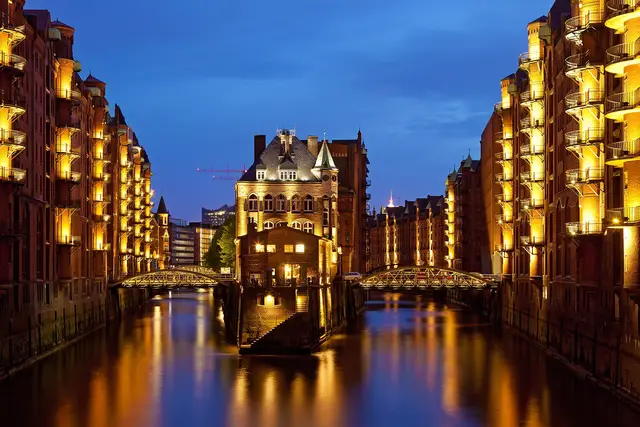
It’s not a secret. Since 2015 it has been inscribed on the UNESCO World Heritage List, together with the Speicherstadt warehouse district across the canal. This is one of Hamburg’s most photographed façades.
Standing at the prow
Go to the bow first. The sharp tip sits where Pumpen meets Burchardstraße. Stand back across the junction and look up: the brick lines run toward a single vertical edge, and the upper floors step back like a ship’s decks.
Then walk the south side along Pumpen. That façade is not flat. It bends in a long, gentle wave that follows the street, so the rows of windows seem to ripple as you move. The effect works best if you keep walking rather than stopping for one photo.
Look closely at the brick itself. Höger used millions of clinker bricks that vary in colour from purple-brown to near black, and he set some of them proud of the wall to build up pattern and texture. Most visitors miss this:
- the vertical piers that make the building look taller than it is
- the ceramic and brick ornament near the entrances
- the stepped balconies and setbacks on the top floors
Through the Fischertwiete arches
The street Fischertwiete runs straight through the building under tall arches. The listed address, Fischertwiete 2A, is in this passage. Walking through gives you a sense of how big the block is: the structure spans a public street and wraps around inner courtyards.
The courtyards show the same brick as the outside, but enclosed, with the walls rising on all sides. On the ground floor you’ll find shops, cafés and restaurants. The upper floors are still working offices.

Visiting a working office building
The building’s inside was not made for tourists, and the people who work there notice who behaves well:
- Stick to the public areas. The arcades, the passage and the courtyards are fine to wander. Upper-floor corridors belong to tenants, so don’t go up the stairs to look around.
- Keep doorways clear. Office workers come and go through the entrances on weekday mornings and at lunch. Step aside for your photos.
- Shops keep their own hours. Google lists Chilehaus as open 24 hours at the moment, but that means the exterior and passage. The ground-floor businesses set their own schedules, so check those separately.
- Pay as you would elsewhere in Hamburg. Cards are widely taken, though some smaller cafés still prefer cash. Rounding up the bill is the normal way to tip.
- Use the German name. Locals say “Chilehaus” with a German “ch”, roughly “CHEE-leh-house”. Ask for the Kontorhausviertel if you need directions.
When the street goes quiet
Foot-traffic data gives a clear pattern. On weekdays the quietest window is 10pm to 11pm, when the offices are empty. On weekends it’s calm from 7am to 1pm and again from 6pm to 11pm.
For photos, an early weekend morning is the best choice. You get the bow and the Pumpen curve with few people in the frame, and the light is soft on the brick. Avoid weekday office hours if you want empty arcades.
Late evening has its own appeal. The dark brick looks almost black under the streetlights, and the outline of the bow gets sharper. Since the exterior is always open, you can walk past after dinner.
Getting to the Kontorhausviertel
The closest stop is Meßberg on the U1. Leave the station and you’re a couple of minutes’ walk from the building. Steinstraße, also on the U1, is a similar distance from the northern side.
From Hamburg Hauptbahnhof it’s an easy walk of about 10–15 minutes south through the Altstadt. The route is flat and passes St. Jacobi church. Allow 30–45 minutes for the outside, the passage and the courtyards. Add more time if you stop to eat on the ground floor.
The rest of the block
Chilehaus is one of a group of 1920s and 1930s trading houses, and the others are within a few minutes’ walk:
- Sprinkenhof, a huge brick block just north, with a diamond-pattern façade
- Messberghof, across the square at Meßberg, another dark-brick Kontorhaus
- Speicherstadt, the red-brick warehouse district on the canals immediately south
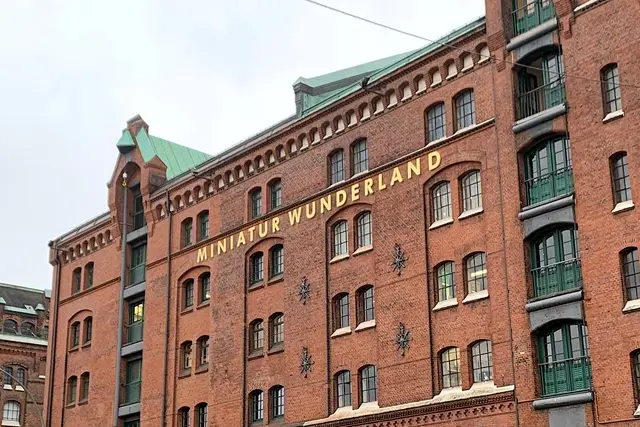
- Miniatur Wunderland, the model railway museum inside the Speicherstadt
- St. Jacobi and St. Petri, two of the city’s main churches, toward the Mönckebergstraße shopping street
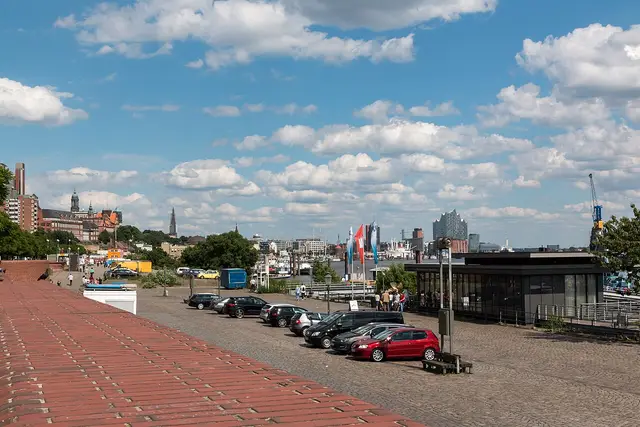
A good half-day route starts at the Chilehaus bow, goes through the Kontorhaus district, then crosses into the Speicherstadt. You end on the waterfront at HafenCity, with the Elbphilharmonie in view. It follows the story of Hamburg as a trading port, from the merchants’ offices to the warehouses where their goods were stored.
Frequently asked questions
When is the quietest time to visit Chilehaus?
On weekdays it's calmest between 10pm and 11pm. On weekends it's quietest from 7am to 1pm and from 6pm to 11pm. Early weekend mornings are best for photos with few people in them.
Which U-Bahn station is closest to Chilehaus?
Meßberg on the U1 is the closest, a couple of minutes on foot. Steinstraße, also on the U1, is nearly as close. From Hamburg Hauptbahnhof it's an easy walk of about 10–15 minutes.
Can you go inside Chilehaus?
Yes, you can walk the public areas: the Fischertwiete passage, the arcades and the inner courtyards, plus the ground-floor shops and restaurants. The upper floors are private offices, and the shops keep their own hours.
How long should I spend at Chilehaus?
Allow 30–45 minutes for the bow, the curved Pumpen façade and the courtyards. If you add the rest of the Kontorhausviertel and the Speicherstadt next door, it easily fills half a day.
What is there to see near Chilehaus?
Next to it are Sprinkenhof and Messberghof, two more 1920s brick office blocks. The Speicherstadt warehouse district and Miniatur Wunderland are just south across the canal. St. Jacobi church is on the walk to the main station.
Plan your trip to Hamburg
Germany eSIM & staying connected →
Some links above are affiliate links — if you book through them, Wander Atlas earns a small commission at no extra cost to you. It's how we keep every guide free.