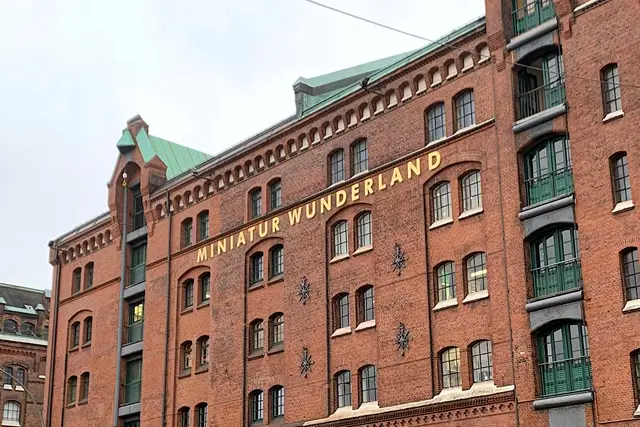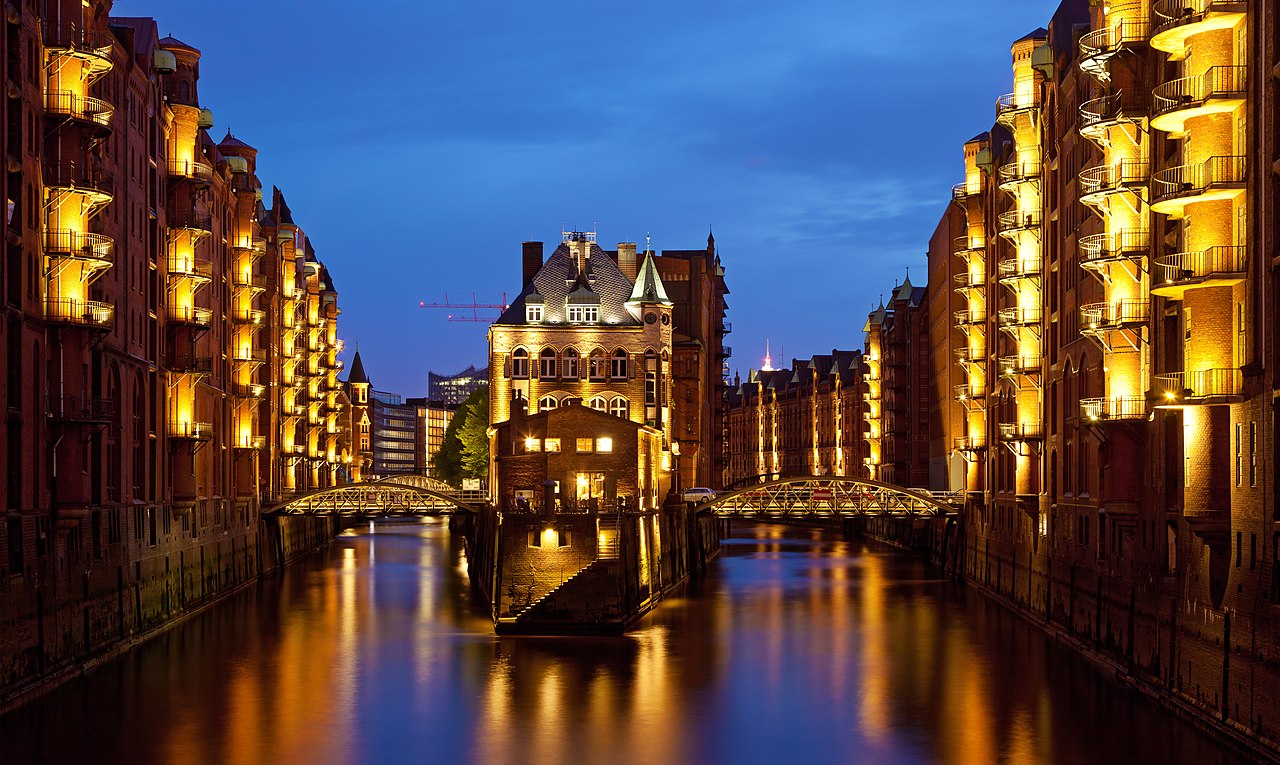
Narrow canals called fleets cut between rows of warehouses seven or eight storeys tall. The red brick drops straight into the water, and green copper turrets stand along the roofline. Iron footbridges join one block to the next, and on the canal side the old loading doors are stacked one above the other up each facade. Under the gables you can still see the winch beams that hauled sacks of coffee up from the barges.
This is Speicherstadt. It runs for over a kilometre along the Elbe’s edge, and it was never built for people to live in. It isn’t a secret: it is one of Hamburg’s best-known sights and a UNESCO World Heritage Site. But because it is a working district of streets and bridges, you can arrive at any hour and find the bricks and water to yourself somewhere.
Reading the Warehouses
Start by looking down. The whole district stands on oak and timber piles driven into the riverbed, so these heavy brick blocks rest on wood sunk deep in Elbe mud. Construction began in 1883, when Hamburg joined the German customs union and needed a free port where goods could be stored duty-free. Building carried on in phases into the twentieth century.
The price of that ambition was paid by the people who lived here. Their old residential quarter on the Kehrwieder and Wandrahm islands was cleared, and many thousands of residents were moved out. What replaced it was warehousing in the neo-Gothic style: pointed gables, glazed-brick bands and small towers.
The goods stored here make good clues as you walk:
- Coffee, tea and cocoa, the trades the district was built for
- Spices and tobacco, kept in climate-steady upper floors
- Oriental carpets, a trade that still has a quiet presence here
In 2015 UNESCO listed Speicherstadt together with the neighbouring Kontorhausviertel and its ship-prow Chilehaus. Cross Willy-Brandt-Straße from the eastern end and you can see the two together. The warehouses stored the goods, and the office blocks across the road ran the business.
The Wasserschloss and the Poggenmühlen Bridge
Every postcard of Speicherstadt seems to show the same building. That’s the Wasserschloss, a narrow turreted brick block on a point of land where two fleets meet. It once housed the workshops and staff of the hydraulic winch engineers who kept the cranes running.
The classic angle is from the Poggenmühlen-Brücke at the eastern end of the district, a short walk from the Alter Wandrahm address. From there the Wasserschloss sits between two canals, with warehouse facades on either side. Expect other photographers on the bridge, and keep to the edge, because cyclists and delivery bikes use it as a through route.
Then walk west along Alter Wandrahm, Kehrwieder and the Brook streets. Cross every bridge you pass, because each one frames a different stretch of canal.
The Tide Runs the Boat Tour
The Elbe is tidal here, and Speicherstadt’s water rises and falls with it. That matters more than any timetable if you want to see the district from water level. The small open harbour launches called Barkassen, which leave from Landungsbrücken, can only slip under the low bridges and into the fleets when the water level allows.
At low tide those boats may skip the canals entirely and stay out on the main harbour. If the warehouse fleets are the point of your trip, ask the operator before you board whether today’s departure goes through the Speicherstadt. Pick a sailing that fits the tide. Most operators post their tide-dependent routes at the pier or online.
The same tide occasionally works against the district. In strong storm surges, the lower streets here are among the first in Hamburg to flood, which is why many ground floors were built for goods and not for people.
After Dark in the Brick
Speicherstadt is open around the clock, and night is when it looks most different. A lighting scheme picks out the gables, bridges and turrets in warm light, and the canals double everything in their reflections. The museum crowds have gone by then, and the quiet makes the scale of the brick walls easier to feel.
Pair an evening walk with the Elbphilharmonie at the western edge, whose wave-shaped glass top sits above an old brick warehouse base. The walk from the Wasserschloss to the concert hall takes you through the whole district and over into HafenCity’s newer waterfront.
What’s Behind the Doors
Many of the warehouses now hold attractions, and a few of them reward an hour inside:
- Miniatur Wunderland, the huge model railway on Kehrwieder, which books timed tickets and fills up early
- Speicherstadtmuseum, inside a real warehouse, on the coffee, tea and carpet trades
- Deutsches Zollmuseum, on customs history, fitting for a former free port
- Spicy’s Gewürzmuseum, a spice museum that leans into the district’s trading past
- Hamburg Dungeon, the theatrical one, if you’re travelling with teenagers
- Internationales Maritimes Museum, in a historic warehouse just over the line in HafenCity
Opening times and admission differ from venue to venue, so check each one’s official site before you go.
Moving Through a Working District
Speicherstadt still has offices, trading firms and deliveries, so treat it as a neighbourhood rather than a theme park. A few habits make the visit smoother:
- Say “Moin” when you greet people. Hamburgers use it at any hour, not just in the morning.
- Keep bridge railings and doorways clear while you take photos. Vans and cargo bikes really do need the space.
- Book Miniatur Wunderland online in advance; walk-up visitors often face long waits.
- Carry a card and some euros, as smaller counters and kiosks around the harbour don’t always take cards.
To get in, take the U1 to Meßberg for the eastern end and the Wasserschloss, or the U3 to Baumwall for the Elbphilharmonie end. Überseequartier (U4) drops you on the HafenCity side. One HVV ticket covers U-Bahn and S-Bahn, and the HVV harbour ferries from Landungsbrücken are covered too. The red StadtRAD bike-share docks dotted around the area work well for hopping between the two ends.
Arriving early in the morning usually beats the tour groups to the Poggenmühlen bridge. A late evening walk avoids them altogether.
Frequently asked questions
How do I get to Speicherstadt by public transport?
For the eastern end and the Wasserschloss view, take the U1 to Meßberg. For the Elbphilharmonie end, take the U3 to Baumwall. Überseequartier (U4) is on the HafenCity side. All three are short walks into the district.
Is Speicherstadt open at night?
Yes. It is a public district of streets and bridges, open 24 hours every day. The facades and bridges are lit after dark, so an evening walk is well worth doing. The museums inside keep their own hours.
How long should I spend in Speicherstadt?
Allow about two hours to walk the bridges and canals from the Wasserschloss to the Elbphilharmonie. Make it a half day if you add Miniatur Wunderland or another museum, or a Barkasse harbour tour.
Do harbour boat tours go through the Speicherstadt canals?
Only when the tide allows. The small Barkassen launches from Landungsbrücken need enough water to pass under the low bridges into the fleets. Ask the operator before you board whether your sailing goes through the Speicherstadt.
What is near Speicherstadt?
The Elbphilharmonie and HafenCity are on its western and southern edges. The UNESCO-listed Kontorhausviertel and Chilehaus are just across Willy-Brandt-Straße, and the Landungsbrücken piers are a short walk or U3 ride west.
Plan your trip to Hamburg
Some links above are affiliate links — if you book through them, Wander Atlas earns a small commission at no extra cost to you. It's how we keep every guide free.