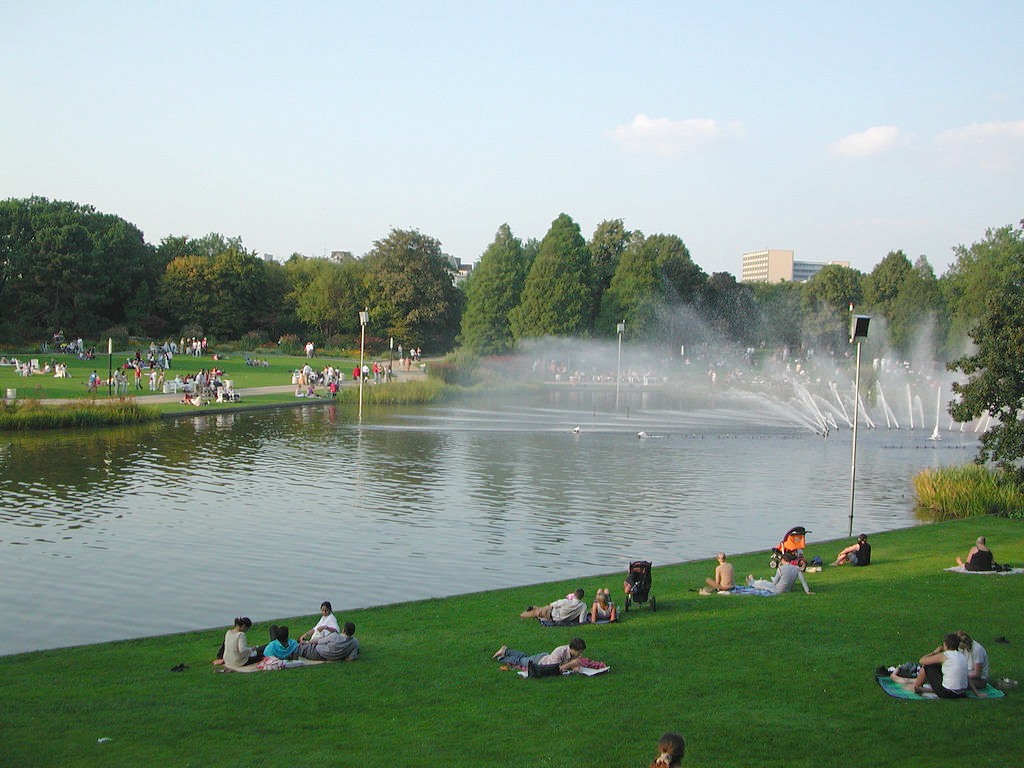
Planten un Blomen is Low German for “plants and flowers”. It’s a fair description of a park that takes up a long strip of Hamburg’s old city ramparts. Lawns run between flower beds, ponds and greenhouses, and the Heinrich-Hertz-Turm, the city’s TV tower, rises above the western edge. It’s one of the most-reviewed green spaces in Germany, and on a warm afternoon it shows.
A park built on the old walls
The ground here used to be fortifications. The ditches and banks of Hamburg’s 17th-century defences were later turned into gardens, and the park took its present shape through the International Garden Exhibitions held here in 1953, 1963 and 1973. That’s why it feels less like one park than several joined together.
From Dammtor in the east, the paths lead you past the glasshouses of the Old Botanical Garden. Further west you reach the Parksee lake, the Japanese Garden and a run of themed beds. The whole site is long and narrow, so allow time if you want to walk it end to end.
What to find inside
Choose two or three areas instead of trying to tick off everything. These are the highlights:
- Japanese Garden: stone lanterns, raked gravel, a stream and a wooden tea house. Tea ceremonies are held here in the warmer months, and the dates are posted on the park’s official site.
- Tropical greenhouses: near the Dammtor end, filled with palms, cacti and subtropical plants. Handy on a grey Hamburg day.
- Rose garden: formal beds of many varieties, at their best from late spring into summer.
- Parksee: the central lake with stepped seating along its edge, where the evening fountain shows take place.
- Music pavilion: free open-air concerts across the summer season.
- Playgrounds and water play: large and well used by local families.

After dark at the Parksee
Summer evenings are the park’s best-known draw. Between late spring and early autumn, the fountains in the Parksee rise and fall to recorded music while coloured lights play on the water. These water-light concerts start once it’s dark, so the start time moves earlier as the season goes on. Check the current schedule before you plan your evening.
The terraced seating around the lake fills well before the show begins. Bring a jacket, because Hamburg evenings turn cool even in July. The park stays open until 11pm every day, which leaves time to walk out slowly afterwards.
In winter the mood changes. An outdoor ice rink usually runs on the Wallanlagen side, and the greenhouses become the warmest place in the park.
Getting in from three sides
The park has several entrances, and the best one depends on what you want to see first.
- Dammtor station (S-Bahn and regional trains): the closest stop to the greenhouses and the eastern entrance on St. Petersburger Straße.
- Stephansplatz (U1): a short walk to the Dammtor side and the Old Botanical Garden.
- Messehallen (U2): comes out by the western end, close to the TV tower, the Japanese Garden and the Parksee.
Arriving at Dammtor and leaving from Messehallen, or the other way round, saves you from walking back. The Alster lakes and the Rathaus are within walking distance of the Dammtor end, so you can easily combine them in a day.
Moving through the park like Hamburgers do
Entry is free, so there’s no ticket to buy and no queue at the gate. On sunny weekends the real competition is for space on the lawns and for seats by the Parksee. You’ll get better spots in the morning, soon after the 7am opening, than in the afternoon, when families and office workers arrive.
Some habits make a visit easier:
- Read the boards at the gates. Each entrance displays the park rules, including where bikes have to be pushed. Follow them; park staff do enforce them.
- Keep quiet in the Japanese Garden. The tea house is for contemplation, so stay on the paths and off the gravel.
- Picnic on the lawns, not in the flower beds. Locals spread a blanket on the open grass and take their rubbish home.
- Carry a card and some euros. The cafés and kiosks vary in what they take, and seasonal stands are often simpler.
A little German helps. “Wasserlichtkonzert” is the word to search for when you look up show times.
How long to give it
A loop of the greenhouses, the Japanese Garden and the Parksee takes about two hours at a relaxed pace. Add a concert, a tea ceremony or an evening fountain show and it becomes a half day or a full evening. May to September is when the beds are fullest and the events calendar is busiest. The greenhouses make an off-season visit worthwhile too.
Frequently asked questions
What are the opening hours of Planten un Blomen?
The park is open every day from 7am to 11pm, with the same hours seven days a week. Individual attractions inside, such as the greenhouses and the tea house, keep their own schedules, so check those separately.
What is the nearest station to Planten un Blomen?
Dammtor station (S-Bahn and regional trains) is closest to the eastern entrance and the greenhouses. Stephansplatz (U1) is nearby too. For the Japanese Garden and the Parksee, Messehallen (U2) on the western side is the most convenient.
When can I see the water-light concerts?
They run nightly on the Parksee from late spring to early autumn and begin after dark, so the start time shifts across the season. The current schedule is on the park's official website. Arrive early to get a seat on the terraces.
How long should I spend at Planten un Blomen?
Give it about two hours for the greenhouses, the Japanese Garden and the lake. Allow a half day or a whole evening if you add a summer concert, a tea ceremony or the fountain show.
What is near Planten un Blomen?
The Heinrich-Hertz-Turm and the Messe halls border the western side. From the Dammtor end you can walk to the Alster lakes and Hamburg's Rathaus.
Plan your trip to Hamburg
Germany eSIM & staying connected →
Some links above are affiliate links — if you book through them, Wander Atlas earns a small commission at no extra cost to you. It's how we keep every guide free.