For about five centuries, Jeju was governed from this walled compound. The island’s moksa, the governor sent from the mainland, held court here, received orders and passed judgement. What you walk through today is a reconstruction. It was built after archaeologists dug the site back out of the modern city and matched it against the original plans.
The result is a quiet grid of tiled roofs, stone walls and swept courtyards. Downtown Jeju City keeps moving just beyond the outer gate.
A seat of power, dug back out of the ground
The compound’s roots go back to the 14th century. Most of what it represents belongs to the Joseon dynasty, when Jeju was a far-off posting on the empire’s southern edge. The buildings were largely demolished during the Japanese colonial period, and the site disappeared under later construction.
Excavations in the 1990s uncovered foundation stones and building footprints. The reconstruction, completed in the early 2000s, follows those traces and the surviving historical records. That is why the layout feels exact rather than guessed. Each hall sits where its predecessor stood.
The site is designated a national Historic Site. That explains the careful restoration and the interpretive panels, which appear in English as well as Korean.
Getting to Gwandeok-ro
The address is 13 Gwandeok-ro 7-gil, in the old centre of Jeju City. This is the original town, not the newer Shin Jeju district near the airport. Jeju has no subway, so you have three options:
- Walking: Dongmun Market is roughly ten minutes east on foot. Jungang-ro’s underground shopping arcade is about the same distance.
- Bus: many city routes stop at the Gwandeokjeong stop on the main road, right in front of the square.
- Taxi: from Jeju International Airport it is a short ride. Show the driver “제주목 관아” (Jeju-mok Gwana).
Parking in the old town is tight. If you are driving a rental car, use a public lot nearby and walk the last stretch.
Gwandeokjeong, the pavilion at the gate
Before you reach the ticket booth, you pass Gwandeokjeong. This open-sided pavilion stands on the square in front of the compound. It was built in the 15th century as a training hall for soldiers and is counted among the oldest surviving buildings on Jeju. It is also a designated national Treasure.
Look up at the underside of the roof. The deep eaves rest on heavy wooden brackets, and the painted dancheong patterns in green, red and blue are easy to study from ground level. Traditional stone dol hareubang figures, Jeju’s grandfather statues, have long stood guard here too.
The pavilion is free to look at from the square. Many visitors treat it as the prologue to the compound behind.
Inside the walls
You enter through the outer gate and then the two-storey gate tower, Jinhaeru. The compound opens into a series of courtyards, and each one sits a little further from the street noise than the last.
The halls are single-storey timber buildings on raised stone platforms, with curved tiled roofs. Some have their doors open so you can see the wooden floors and paper-screen windows. Others hold small exhibits and mannequin tableaux of the governor’s work. There is also a model of how the whole compound once looked.
Buildings worth finding:
- Hongwhagak: the governor’s main office, the hall at the political centre of the compound.
- Yeonhuigak: a pavilion used for receptions and banquets.
- Mangyeongru: a two-storey pavilion toward the rear. From its raised level you look over the rooftops of the old town.
Paths are flat and gravelled or paved. An unhurried loop takes about an hour. Allow longer if you read every panel.
Timing the courtyards
The courtyards look their best without a crowd in the shot. Measured foot traffic shows a clear pattern here.
On weekdays, the quietest window is 9am to 10am, the first hour after opening. On weekends, the calmer stretch runs 9am to 12pm, but the busiest period is 10am to 1pm. In practice, that means turning up at 9am. Try not to arrive after 10am on a Saturday or Sunday, because that is when the courtyards and the Mangyeongru stairs fill up.
The compound is open every day, 9am to 6pm, including Mondays. There is no weekly closing day to plan around. Late afternoon gives lower sun across the roof tiles. Arrive by about 5pm so you are not hurried out at 6.
Walking the compound the Korean way
A few habits make the visit smoother:
- Buy your ticket at the booth by the outer gate. The current admission is posted there. Cards are widely used in Korea, but having a little cash is sensible.
- Follow the numbered route. The signs lead you front to back, from gates to working halls to the rear pavilions. That mirrors how an official would have approached the governor.
- Shoes come off before any raised wooden floor you’re allowed onto. In Korea that is a firm rule. Look for footwear left at the step, or a sign.
- Don’t cross the ropes or sit on the stone platforms. Barriers mark where the floors and doorways are off limits.
- Keep your voice down in the inner courtyards. Families and school groups visit, but the rear halls stay quiet.
Photographers should shoot through open doorways and along the rows of roof tiles. Tripods and drones are a different matter. Ask at the booth before bringing either out.
Pairing it with old Jeju City
This compound works best as part of a half day in the old town. It is not a stand-alone trip.
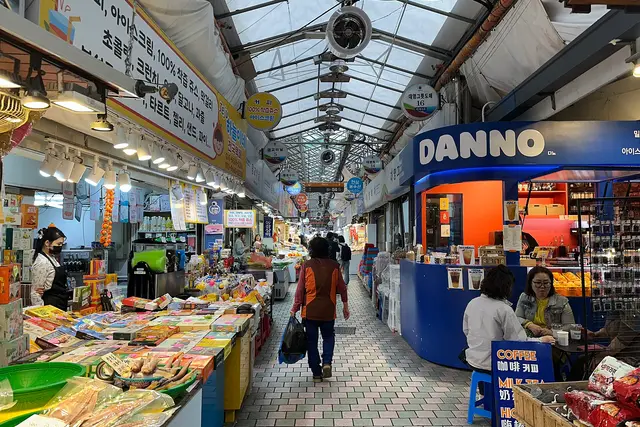
- Dongmun Market: Jeju’s best-known traditional market, about ten minutes’ walk away. Go for tangerines, hairtail and seafood stalls. The night market section runs in the evening.
- Samseonghyeol: the shrine marking the founding myth of Tamna, Jeju’s ancient kingdom. It is a longer walk or a short taxi ride southeast.
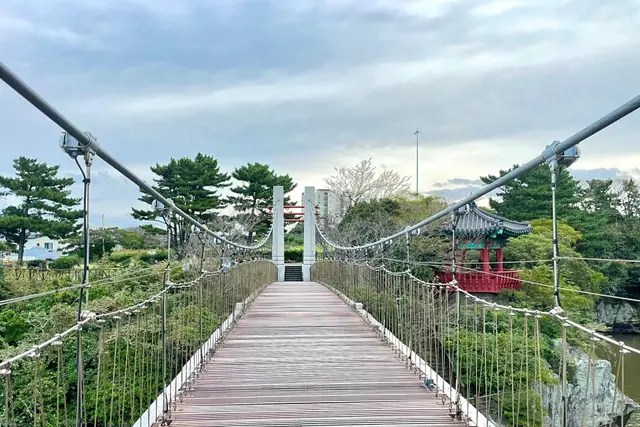
- Yongduam Rock: the dragon-head lava formation on the coast west of the centre. It pairs naturally with the seafront walk.
A sensible order is the Jeju-mok Government Office at 9am, then Gwandeokjeong, then lunch at Dongmun Market. That keeps you ahead of the weekend peak at the compound and puts you at the market when the food stalls are busy.
Frequently asked questions
When is the quietest time to visit the Jeju-mok Government Office?
On weekdays it is quietest from 9am to 10am. On weekends the calmer window is 9am to 12pm, but 10am to 1pm is the busiest stretch, so arrive right at the 9am opening.
What are the opening hours, and is it closed on any day?
It opens daily from 9am to 6pm, Monday through Sunday, with no weekly closing day. Aim to arrive by around 5pm so you have time to walk the whole compound.
How long should I spend there?
About an hour covers the gates, courtyards, main halls and Mangyeongru pavilion at an easy pace. Add 15 minutes for Gwandeokjeong Pavilion on the square in front.
How do I get there from Jeju Airport?
It is a short taxi ride to the old centre of Jeju City. Show the driver "제주목 관아". City buses also stop at the Gwandeokjeong stop in front of the square.
What else is nearby?
Gwandeokjeong Pavilion stands right at the entrance, and Dongmun Market is roughly a ten-minute walk away. Samseonghyeol shrine and Yongduam Rock are both a short taxi ride away.
Plan your trip to Jeju
Some links above are affiliate links — if you book through them, Wander Atlas earns a small commission at no extra cost to you. It's how we keep every guide free.