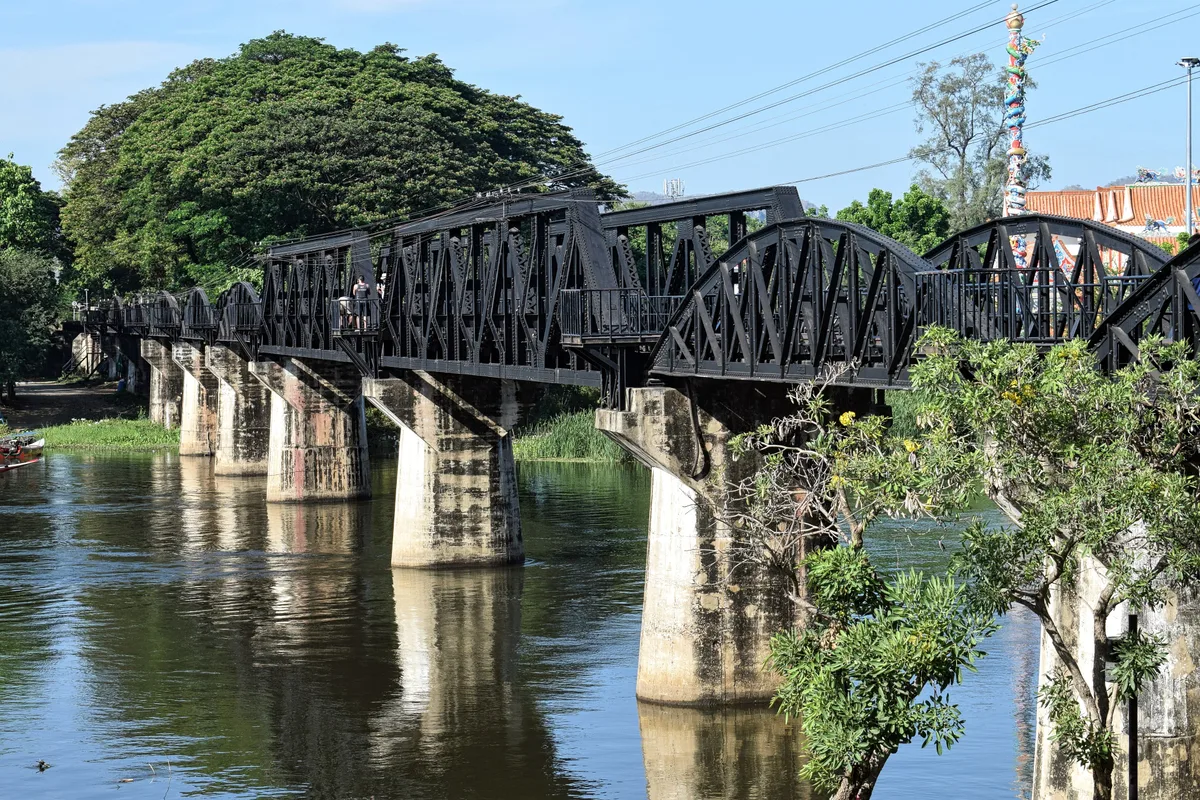
Steel, sleepers and a working line
Look down as you walk and you see the river between the sleepers. The bridge carries a single metre-gauge track over the Khwae Yai, and there is no separate walkway. Visitors walk on planks laid beside the rails. Small railed platforms jut out from the sides at intervals so you can step clear when a train comes.
The spans don’t match. The curved steel trusses at each end are the wartime originals, brought from Java by the Japanese army. The two straight, angular spans in the middle went up after the war to replace sections destroyed by Allied bombing in 1945. That join is the bridge’s history, and you can see it from the bank.
What happened here
This is one crossing on the Thailand–Burma Railway, which most people now call the Death Railway. The Japanese army built it in 1942–43 to supply its forces in Burma. Allied prisoners of war did the work, along with a much larger number of conscripted Asian labourers, and many thousands of them died from disease, starvation and brutal treatment.
The 1957 film The Bridge on the River Kwai made the name famous worldwide. It was shot in Sri Lanka, though, and the story is largely fiction. The river was renamed Khwae Yai in 1960, partly to match the film. Knowing this changes how the place feels: you are standing on a memorial that is still in use, not on a film set.
Getting to Maenamkwai Road
Kanchanaburi is roughly 130 km west of Bangkok. You have two main ways in:
- Train: the slow line from Bangkok’s Thonburi station takes about three hours. It stops at Kanchanaburi and then at River Kwai Bridge station, right beside the bridge, before it carries on toward Nam Tok.
- Bus or minivan: these leave from Bangkok’s Southern Bus Terminal and drop you at Kanchanaburi’s town bus station. From there, take a songthaew or tuk-tuk north up Maenamkwai Road.
- Bicycle: the town is flat and spread out along the river, so cycling from your guesthouse is easy and common.
The bridge is open around the clock, so you can choose your hour. Give the bridge itself 45 minutes to an hour. Leave a full day if you’re adding the museums.

Crossing with the trains
The trains have right of way, and they do come. Several times a day the Nam Tok service rumbles across at walking pace, and its horn is your signal to move. Step onto the nearest side platform and stay there until the last carriage has passed. Hold children’s hands and keep bags away from the edge.
Timing matters more here than almost anywhere in town. The bridge is calmest between 7am and 9am on weekdays, and between 7am and 8am on Saturday and Sunday. In that window the low light runs along the trusses and you get the planks almost to yourself.
Try not to turn up on a weekend from 9am to 8pm. Tour groups from Bangkok fill the span, and photos turn into a slow shuffle. Time ticks away fast in the queue. If a weekend is your only option, cross at 7am and then spend the busy hours at the museums.
A few more tips for the bridge:
- Pay small vendors at the approach in cash. Stalls selling snacks and souvenirs line the road near the station.
- Dress respectfully. Covered shoulders aren’t required, but this is a war memorial and a lot of visitors come to grieve.
- If you’re riding the train itself, sit on the left heading north for the river views beyond the bridge.
The rest of the story, nearby
Don’t make the bridge your only stop. Head south on Saeng Chuto Road to the Kanchanaburi War Cemetery (Don Rak), where nearly 7,000 Allied prisoners are buried in neat rows of bronze plaques. Directly opposite is the Thailand–Burma Railway Centre, the clearest museum in town for understanding how the line was built and who died building it.
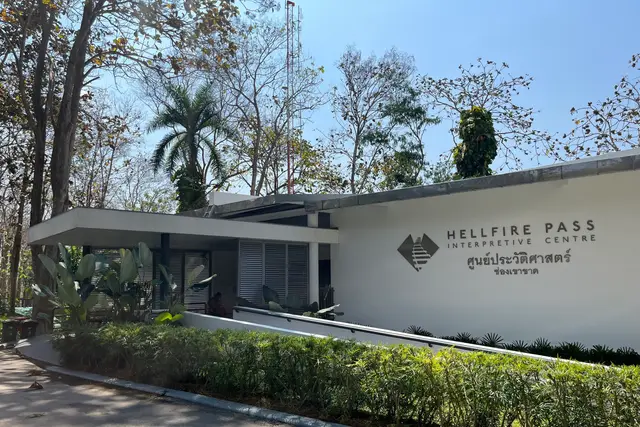
Closer to the river, the JEATH War Museum recreates a bamboo prisoner hut. Further up the line, the wooden Tham Krasae viaduct hugs a cliff above the river. Further still is Hellfire Pass, a cutting dug by hand through solid rock, with a memorial museum. Both make a good day trip on the same railway.
After dark on the river
Because the bridge never closes, evenings have their own rhythm. Lights pick out the trusses, and restaurants on the riverbank put tables out where you can watch the span. Each year, around late November and early December, the River Kwai Bridge Festival stages a light-and-sound show recreating the bombing. Check the dates for that year before you plan around it.
Frequently asked questions
When is the quietest time to visit the River Kwai Bridge?
The quietest times are 7am–9am on weekdays and 7am–8am at weekends. Avoid weekends from 9am to 8pm, which are the busiest hours.
Can you walk across the bridge, and is it safe with trains running?
Yes. It's open 24 hours and you walk on planks beside the track. When a train sounds its horn, step onto one of the railed side platforms and wait until it has fully passed.
How do I get to the bridge from Bangkok?
Take the train from Thonburi station, which takes about three hours and stops at River Kwai Bridge station beside the span. Or take a bus or minivan from the Southern Bus Terminal to Kanchanaburi, then a songthaew or tuk-tuk up Maenamkwai Road.
How long should I spend there?
About 45 minutes to an hour for the bridge itself. Allow a full day if you add the War Cemetery, the Thailand–Burma Railway Centre and the JEATH War Museum.
Was the film The Bridge on the River Kwai shot here?
No. The 1957 film was shot in Sri Lanka and is largely fictional. The real bridge was part of the Death Railway, built by prisoners of war and Asian labourers in 1942–43.
Plan your trip to Kanchanaburi
Thailand eSIM & staying connected →
Some links above are affiliate links — if you book through them, Wander Atlas earns a small commission at no extra cost to you. It's how we keep every guide free.
Related guides
 hidden gem
Hellfire Pass Interpretive Centre: Kanchanaburi Travel Guide
 attraction
Erawan National Park: Kanchanaburi Travel Guide (4.6★)
 attraction
Sai Yok National Park: Kanchanaburi Travel Guide (4.4★)
 hidden gem