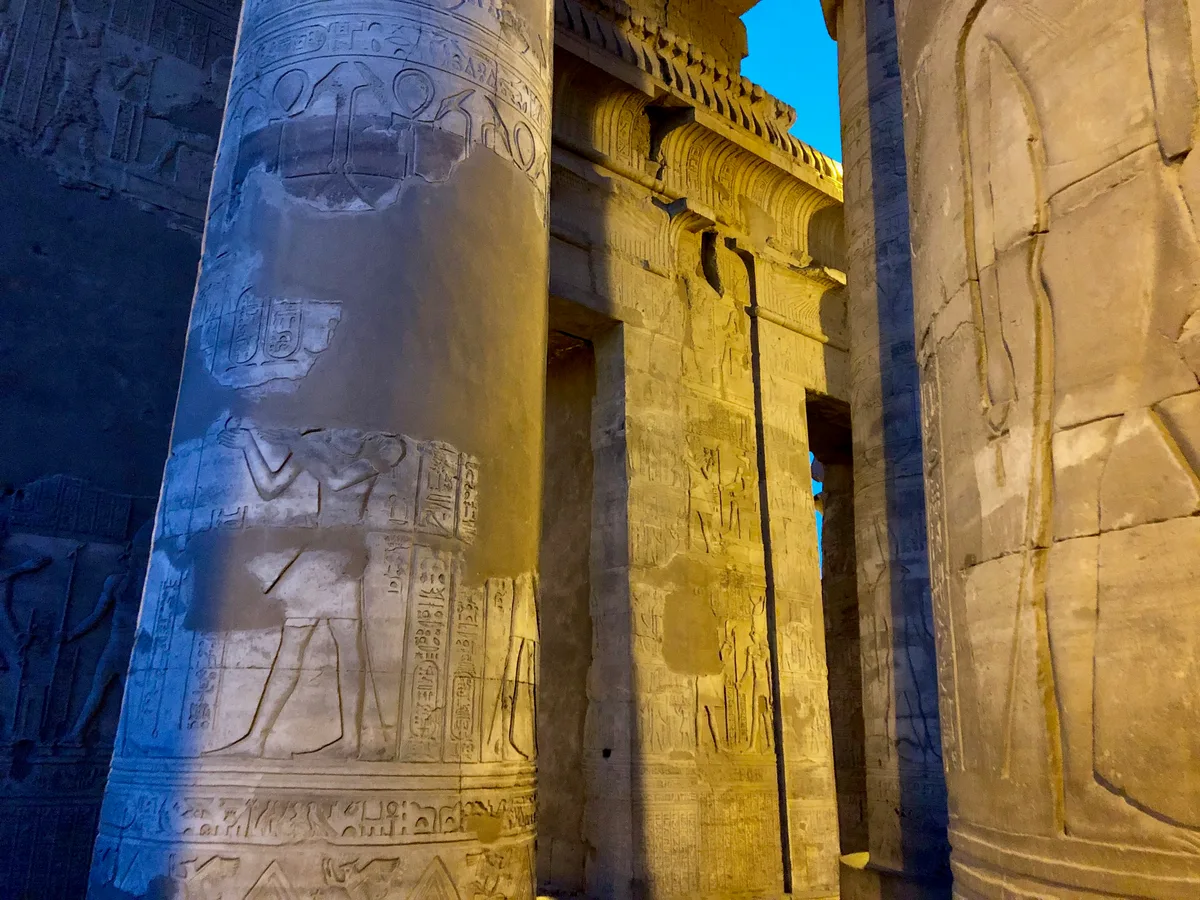
Two temples under one roof
Everything here comes in pairs. Two gateways open onto two parallel processional axes, and these run through mirrored hypostyle halls to twin sanctuaries. The left side belongs to Haroeris (Horus the Elder), the right to Sobek, the crocodile god of the river below.
Most of what stands dates from the Ptolemaic kings, with Roman emperors adding reliefs later. The sandstone sits on a low mound right above the water. Many roofs have fallen, so the columns still carry their painted capitals but the halls are open to the sky.
What to look for
Give the complex 1–1.5 hours, or longer if you read every wall. Head for these:
- The “surgical instruments” relief on the rear inner wall: rows of tools, often read as scalpels, forceps and scales, with seated figures beside them.
- The calendar reliefs in the passage around the sanctuaries, listing festival days.
- The Nilometer, a deep circular well with steps, used to measure the flood and so the taxes.
- The twin sanctuaries’ bases, the granite platforms where the gods’ barques once rested.
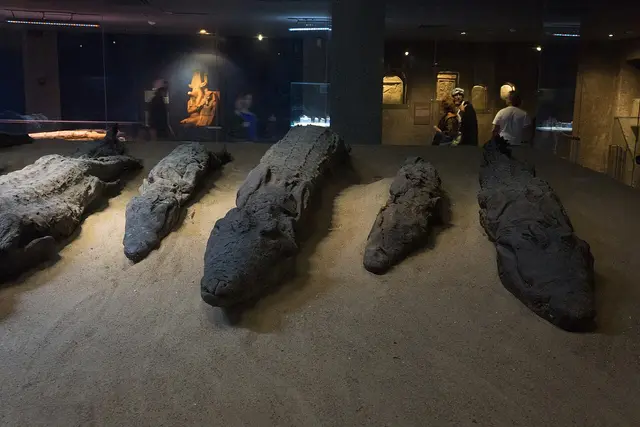
- The Crocodile Museum beside the temple, where mummified crocodiles from the local cemetery lie in glass cases alongside crocodile coffins.
After dark the temple is floodlit, and the reliefs read more sharply in the angled light than at noon.
Arriving by river or road
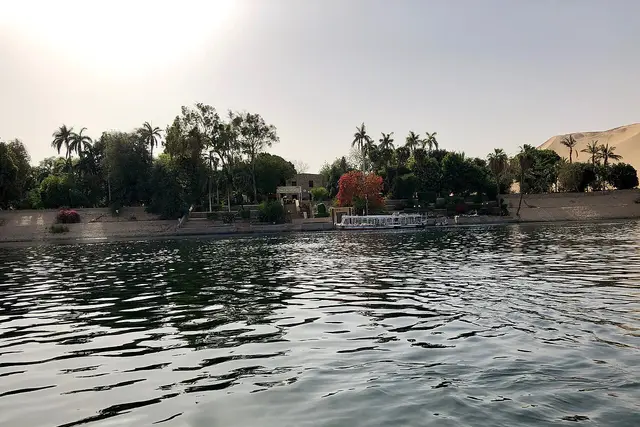
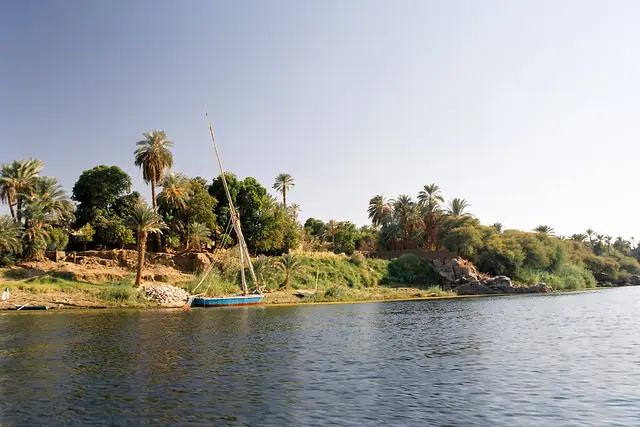
Most visitors come on a Nile cruise between Luxor and Aswan. The landing stage sits at the foot of the temple, and boats tie up several abreast. Kom Ombo is also the usual stop between Edfu and Aswan on a road day trip. By car from Aswan it takes about an hour north along the east bank.
The temple stands a few kilometres outside Kom Ombo town, among sugarcane fields. If you travel independently, a taxi or pre-arranged driver from Aswan is simpler than local transport. Edfu’s Temple of Horus lies further north and pairs naturally with this one in a single day.
Google currently lists 7am–9pm every day. Opening hours at Egyptian antiquities sites shift with the season and around holidays, so check the Ministry of Tourism and Antiquities site for this month’s times.
Beating the cruise-boat tide
This is one of the busiest stops on the Nile, so timing matters more than anything else. On weekdays it’s quietest 7am–9am and again 11am–1pm. Weekends are calm from 7am–4pm. Don’t arrive between 4pm and 9pm on a weekend, when the moored boats send their groups up together and the halls fill.
Some practical habits:
- Tickets are sold at the gate kiosk, where the current price is posted. Card payment is spreading at Egyptian sites but isn’t guaranteed, so carry some Egyptian pounds as well.
- Guardians in galabiyas may wave you towards a relief or a dark corner with a torch. They expect baksheesh afterwards. If you’d rather not pay, a polite “la, shukran” (no, thank you) works.
- Cruise passengers can wait out the first wave of their own boat’s group. Walking up 20 minutes later often means the sanctuary is half empty.
- Shade is scarce on the open mound. Midday in summer is harsh, so bring water and a hat.
The bazaar stalls between the landing stage and the gate sell scarabs and scarves. Haggling is expected there and nowhere else on the site.
Frequently asked questions
When is the quietest time to visit Kom Ombo Temple?
On weekdays it's typically calmest 7am–9am and 11am–1pm. At weekends it stays quiet from 7am–4pm, then gets busiest from 4pm–9pm as cruise groups arrive.
How long do I need at Kom Ombo Temple?
Allow 1–1.5 hours for the double temple, the Nilometer and the Crocodile Museum next door. Give it longer if you want to study the reliefs closely.
How do I get to Kom Ombo Temple from Aswan?
It's about 45km north of Aswan, roughly an hour by car or taxi. Most visitors arrive by Nile cruise, which docks right below the temple, or on a road trip combined with Edfu.
Can I visit Kom Ombo Temple at night?
At the moment it opens until 9pm and is floodlit after dark. Hours change through the year, so confirm on the official antiquities site before you plan an evening visit.
What is the temple famous for?
It's a symmetrical double temple dedicated to Sobek and Haroeris. It's known for the relief often read as surgical instruments, its Nilometer, and the mummified sacred crocodiles in the adjoining museum.
Plan your trip to Kom Ombo
Egypt eSIM & staying connected →
Some links above are affiliate links — if you book through them, Wander Atlas earns a small commission at no extra cost to you. It's how we keep every guide free.