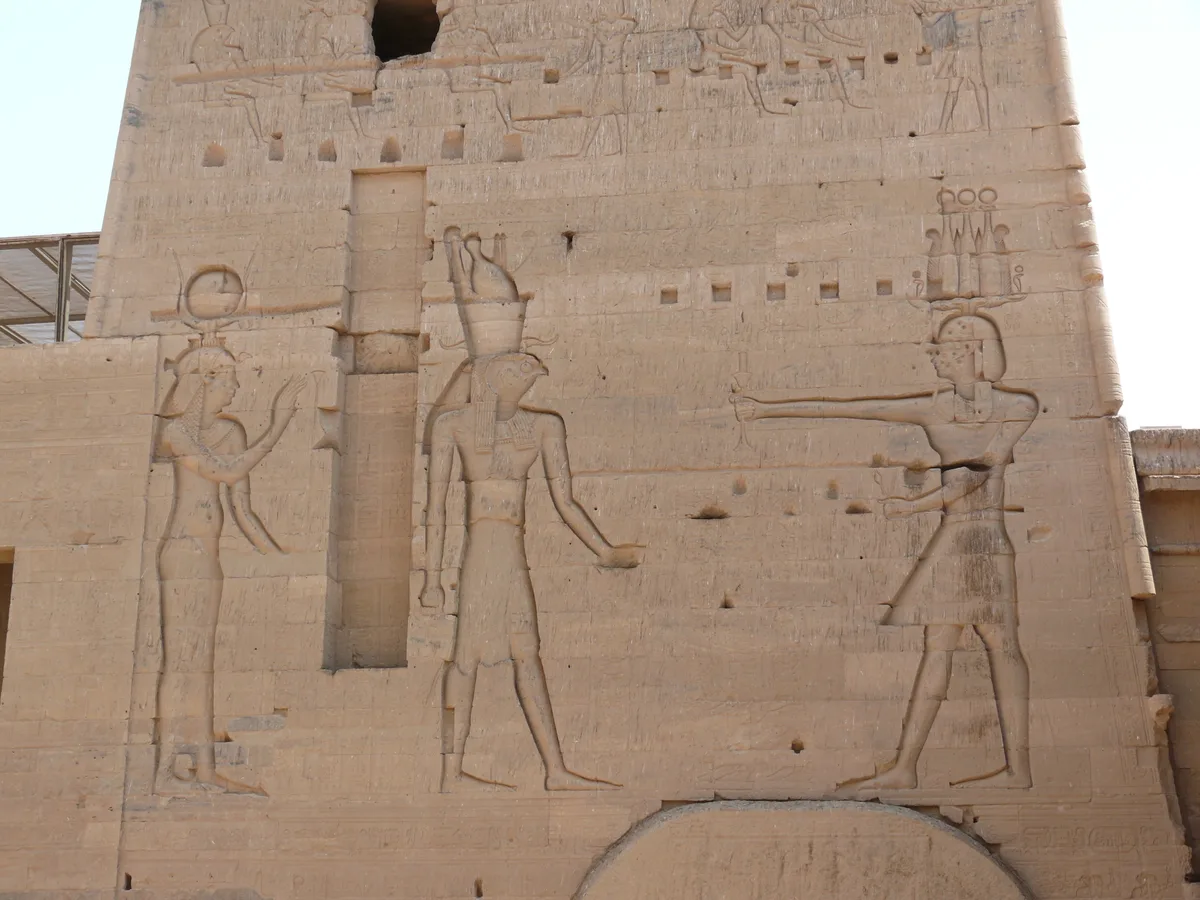
Horus, on Isis’s island
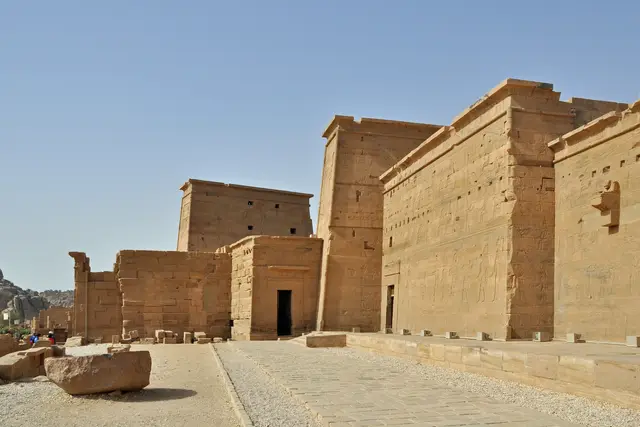
This pin is not the Edfu temple. The address gives it away: “Temple d’Isis”. It sits among the Philae monuments, where the falcon god appears as the son Isis protects, not as a lord in his own house.
Philae was Isis’s cult centre for centuries. Horus is everywhere in it: on the birth house walls, in the scant remains of a small shrine to Harendotes (“Horus the avenger”), and in reliefs of Isis nursing her son. Few people go looking for him by name, so this corner of the island tends to be quieter.
The boat across
You can only get to Agilkia by water. Motorboats leave from the Shellal landing, just south of the Old Aswan Dam. Most visitors get there by taxi or a hired car from central Aswan.
The ride is short. The boats are open wooden launches with bench seats and a canopy, and they thread between granite boulders that are black and smooth from the river. Then the colonnades come into view at the water’s edge.
The island you land on is not the original. In the 1970s, UNESCO’s Nubia campaign took the temples apart block by block and rebuilt them on higher ground at Agilkia. The old island of Philae was sinking under the water between the two dams. The work finished in 1980, and the layout was matched to the old site so closely that few visitors would notice the move.
Finding the falcon
The landing puts you at the southern end. Walk north along the long outer colonnade toward the first pylon of the Temple of Isis. The birth house (mammisi) is the building just beyond the pylon, on the left as you enter the forecourt. Its reliefs tell the story of Horus being born and raised in the marshes.
Things to look for as you go:
- Falcon-headed figures on the mammisi columns and walls, many with their faces chipped off by later Christian occupants
- Coptic crosses cut into the Isis temple doorways, from when part of it served as a church
- A French inscription from Napoleon’s 1798–1801 expedition, carved into the pylon passage
- Hadrian’s Gate, with its relief of the Nile god in a cave beneath the rocks
- The Kiosk of Trajan at the water’s edge, an unroofed pavilion of tall floral-capital columns
Philae also holds the last known hieroglyphic inscription, dated 394 AD. After that, the old script fell silent.
Working the Shellal landing
Buy your site ticket at the ticket office by the marina. The boat is a separate deal with the boatmen. Prices and payment methods for the site ticket change, so check the official Egyptian antiquities site or ask at the office rather than relying on old figures.
- Agree on the boat before you board. Settle the fare, whether it covers the return trip, and how long the boat will wait. Two hours is a comfortable amount of time to ask for.
- Pay the boatman at the end, once you’re back on the mainland. Have Egyptian pounds in small notes.
- Share a boat if you’re alone: launches take a dozen or more people, and splitting the fare is normal.
- Expect guards to offer a “special” view of a closed chamber or rooftop. That comes with an expectation of baksheesh, so decide before you follow.
- Cover your shoulders and knees. It isn’t strictly enforced at a pharaonic site, but it makes the day easier.
Nile cruise groups usually arrive mid-morning on organised excursions. Taking one of the first boats after opening generally gets you ahead of them. Opening hours shift through the year, and there’s an evening sound-and-light show on some nights. Check this month’s times before you set off.
Fitting it into an Aswan day
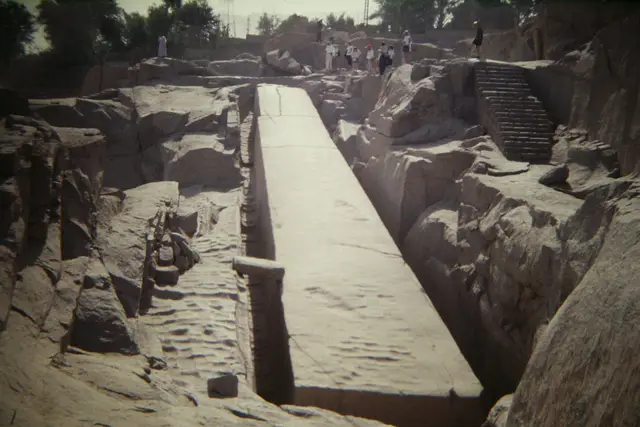
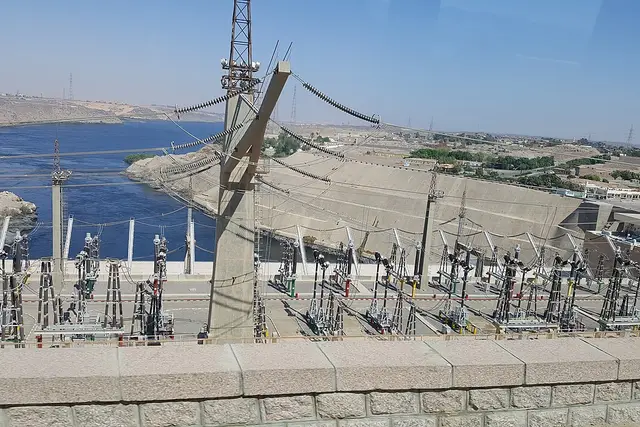
Philae pairs naturally with the sites south of town. The Unfinished Obelisk, still lying in its granite quarry, is on the road out. The Aswan High Dam is a short drive beyond Shellal. Many drivers will string all three into a single half-day loop.
Back in town, a felucca across to Elephantine Island or the West Bank Nubian villages makes a slower afternoon. Midday sun on Agilkia is harsh, and there’s little shade outside the temple halls. That’s another reason to go early.
Edfu, if you meant the big one
The vast, almost complete Temple of Horus is at Edfu. It lies on the Nile between Aswan and Luxor. Most Nile cruises stop there, and drivers do it as a day trip or on the road north. If you want towering pylons dedicated to Horus himself, book that separately. Philae shows you the god as a child, in his mother’s house.
Frequently asked questions
Is this the same as the Temple of Horus at Edfu?
No. This listing is inside the Philae complex on Agilkia Island near Aswan, where Horus appears in the birth house and a small ruined shrine. The large, intact Temple of Horus is at Edfu, between Aswan and Luxor, and is a separate trip.
How do I get to the Temple of Horus in Aswan?
Take a taxi or hired car to the Shellal marina, just south of the Old Aswan Dam. Buy your site ticket at the office there, then agree on a motorboat fare, including the return trip and waiting time, for the short crossing to Agilkia Island.
How long should I spend there?
Two to three hours covers the boat both ways and an unhurried walk past the Temple of Isis, the birth house, Hadrian's Gate and the Kiosk of Trajan.
What is the best time of day to go?
Early. Taking one of the first boats after opening usually gets you ahead of the mid-morning cruise groups and the strongest sun. Hours change through the year, so check the official site for current times.
What else can I combine it with?
The Unfinished Obelisk and the Aswan High Dam are both on the same southern route, and many drivers combine all three in a half day. Later, take a felucca to Elephantine Island or the Nubian villages on the West Bank.
Plan your trip to Aswan
Egypt eSIM & staying connected →
Some links above are affiliate links — if you book through them, Wander Atlas earns a small commission at no extra cost to you. It's how we keep every guide free.