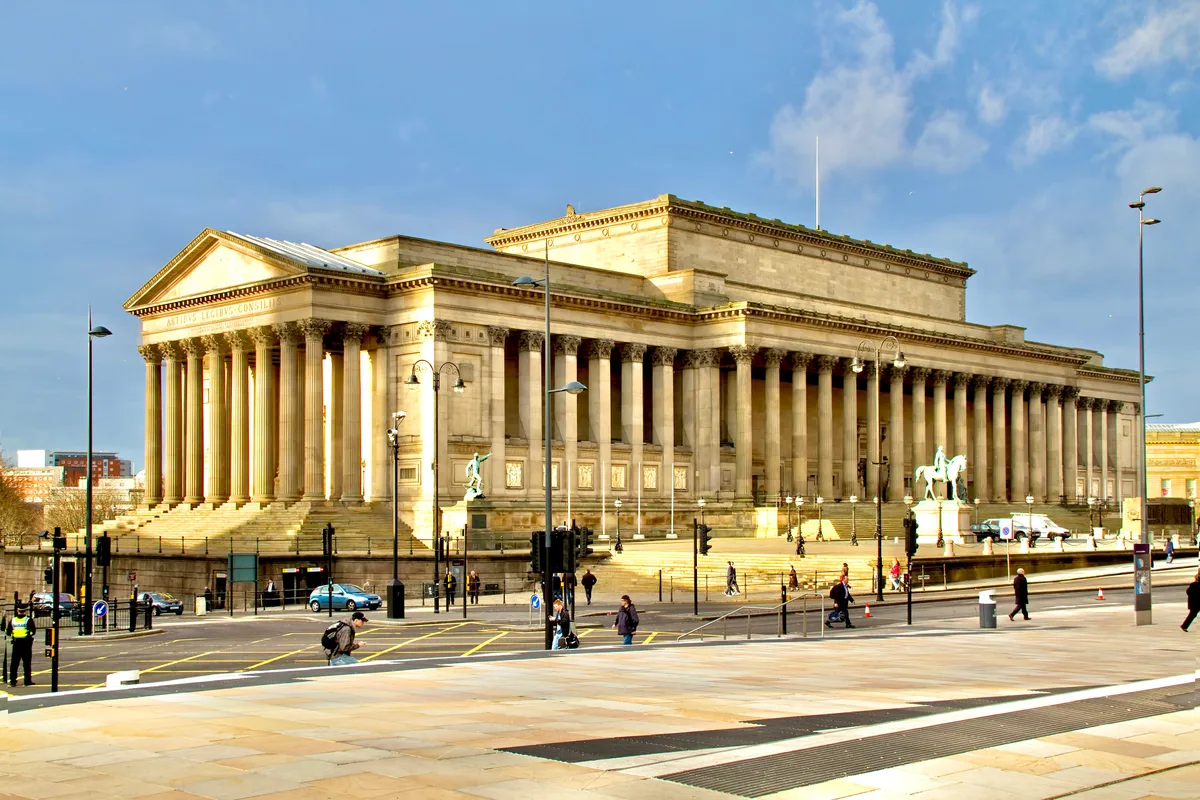
A temple facing the trains
Step out of Lime Street station and the whole view is columns. St George’s Hall fills the far side of the square: a long, pale neoclassical block of Corinthian columns and steps, guarded by stone lions on the plateau in front. It is one of the most celebrated neoclassical buildings in Britain and is Grade I listed.
Harvey Lonsdale Elmes won the design competition while still in his twenties. He died in 1847, before it was finished, and Charles Robert Cockerell completed the interiors. The hall opened in 1854 and combined two jobs under one roof: concert hall and law courts. You can see that dual life as you walk through.
Inside the Great Hall
The Great Hall is the reason most people climb the steps. It has a vast barrel-vaulted ceiling and polished granite columns, and a huge Willis organ fills one end. Look up and the plasterwork and coffering run the full length of the room.
Under your feet lies the famous Minton floor, more than 30,000 encaustic tiles laid in patterns of sea nymphs, tritons and the city’s coat of arms. For most of the year it is covered with boards to protect it. On rare occasions it is uncovered for public viewing, and the hall announces those dates in advance on its official site.
Courtrooms, cells and a quieter room
Away from the Great Hall the mood changes. The old Crown and Civil courts survive with their wood panelling, docks and benches. Below them are the holding cells, where prisoners once waited before going up the stairs into the dock.
Upstairs, the Small Concert Room is Cockerell’s work. It is a curved, galleried space with ornate balconies and a much more intimate scale. The Heritage Centre pulls the building’s story together, from construction to restoration, so it makes a good first stop.
- Great Hall: organ, ceiling, the (usually covered) Minton floor
- Courts and cells: the building’s legal history
- Small Concert Room: the most decorative interior
- Heritage Centre: context before you wander

Planning around the doors
The hours are tight, so plan for daytime. At the moment the hall opens at 9:30am every day except Sunday. It closes at 4:45pm Monday to Thursday and at 5pm on Friday and Saturday, and it is currently shut on Sundays. These times can change with events and holidays, so check the official site for this month’s hours before you set out.
The building is also a working events venue, and concerts, ceremonies and private functions sometimes close rooms. Coming in the morning gives you the most time before anything gets set up. You can also find out if a guided tour is running, because guides open up corners you would otherwise walk past.
Reading the building like a regular
Start on the outside. Walk the full length of the plateau, then go round to the back, where St John’s Gardens slope down beside the hall. From there you see the east portico and the building’s sheer size. Few visitors make the loop, and it changes how the interior feels when you step in.
Inside, treat it as a civic building, not a museum. Rooms can be closed for weddings or functions, so ask the front desk what is open today rather than assuming. If the floor matters to you, watch the official announcements: the uncovering weeks draw queues, and the people who see it without a long wait booked or turned up early. The on-site café works well as a pause between the courts and the Great Hall.
The street of museums next door
St George’s Hall anchors Liverpool’s cultural quarter, and William Brown Street runs along its northern side. In one short walk you pass:
- Walker Art Gallery: paintings from the medieval period to the present
- World Museum: natural history, ancient Egypt and a planetarium
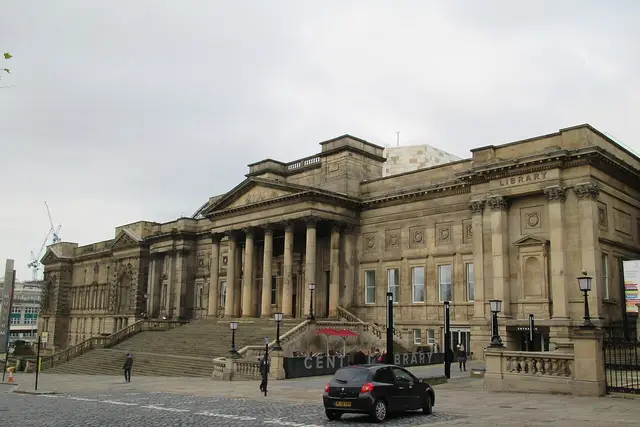
- Central Library: look for the domed Picton Reading Room
- Wellington’s Column and the Steble Fountain at the top of the street
Lime Street station, with its mainline and Merseyrail services, is straight across the square. From there, the shops around Church Street and the waterfront at the Pier Head are within walking distance. That makes the hall an easy first or last stop on a day in the city centre.
Frequently asked questions
How do I get to St George's Hall?
It sits on St George's Place (L1 1JJ), directly opposite Liverpool Lime Street station. Both mainline trains and Merseyrail stop there, and the walk across the square takes a couple of minutes.
Is St George's Hall open on Sundays?
Not currently. At the moment it opens from 9:30am, Monday to Saturday, and closes at 4:45pm Monday to Thursday and 5pm on Friday and Saturday. Hours can change with events and holidays, so check the official site before visiting.
Can I see the Minton tile floor?
Usually not: it is covered to protect it for most of the year. The hall uncovers it on occasional dates, which it announces in advance on its official website.
How long should I spend there?
An hour or two covers the Great Hall, the Small Concert Room, the courtrooms, the cells and the Heritage Centre. Add time for the café or a guided tour if one is running.
What else is nearby?
The Walker Art Gallery, World Museum and Central Library line William Brown Street right beside the hall, and St John's Gardens are directly behind it.
Plan your trip to Liverpool
United Kingdom eSIM & staying connected →
Some links above are affiliate links — if you book through them, Wander Atlas earns a small commission at no extra cost to you. It's how we keep every guide free.