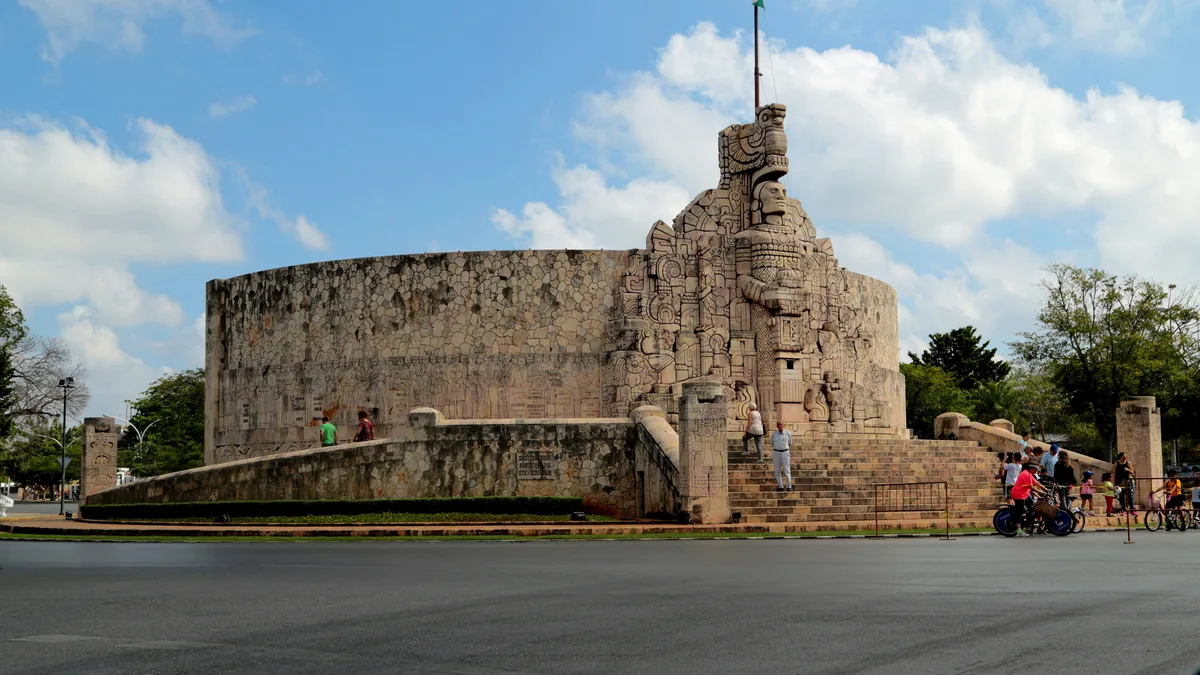
A History Lesson Carved in the Middle of Traffic
Cars swing around it all day. In the centre of a roundabout on Paseo de Montejo, Mérida’s grand boulevard, a low circular wall of pale carved stone rises out of the traffic. Up close it turns into a crowd of figures, faces and symbols. Together they tell Mexico’s story in a style borrowed from ancient Maya relief carving.
Colombian artist Rómulo Rozo designed it, and the work took him years. It was inaugurated in the 1950s. Rozo settled in Mérida and stayed for the rest of his life. It’s the most-photographed piece of public art on the Paseo, and the steady stream of visitors shows it.
Reading the Stone Panel by Panel
Plan to walk the full circle rather than shooting it from one side. The monument is round, so its story wraps around you. Hundreds of carved figures run from the pre-Hispanic world through conquest and independence to modern Mexico. The angular, stacked faces echo the carving at sites like Uxmal and Chichén Itzá, a couple of hours’ drive away.
Worth looking for as you go:
- The national eagle on the front face. It’s Mexico’s coat-of-arms emblem, an eagle on a cactus, carved in the same Maya-inspired style.
- The ceiba tree on the reverse side. The Maya held the ceiba sacred as the tree linking the underworld, the earth and the sky.
- The water at the base, which softens the stone’s hard lines and catches the light at night.
- The faces in profile along the curved walls. Many have the sloping foreheads and heavy ornaments of classic Maya art.
Take it slowly. You’ll spot more on a second lap than on the first.
Getting to the Roundabout on Paseo de Montejo
The address is Paseo de Montejo 438, Centro. The monument sits on the boulevard’s northern stretch, well up from where the Paseo begins near Calle 47. From the Plaza Grande and the cathedral, the walk is long and flat. In midday heat it feels longer, which is why many people take a taxi or a ride-hailing car for one leg.
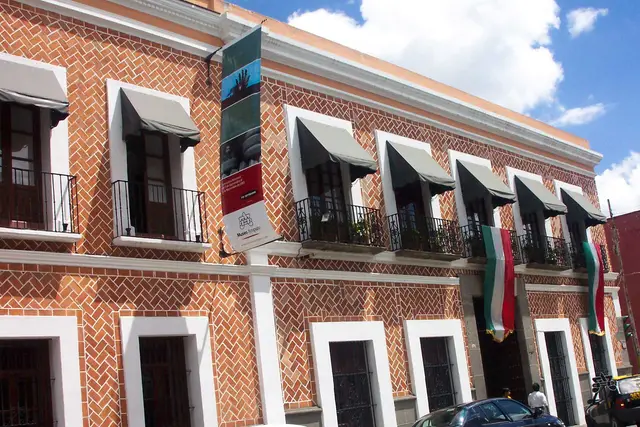
On foot, the best route is straight up the Paseo itself. You pass the old mansions built in the henequen boom, including Palacio Cantón, now a museum. The broad sidewalks are shaded in places by trees, which helps.

Crossing to the Monument Without Drama
Getting to the monument is the only tricky part. It’s an island in a working roundabout, and Mérida drivers don’t slow down just because you’re holding a camera.
- Use the marked crossings on the approach streets. Don’t dash across the curve, where drivers are watching other cars and not you.
- Wait for a real gap. Traffic arrives in waves, and a calm lull usually follows soon.
- Keep children close. The island has space to walk, but busy lanes surround it on every side.
- Respect the stone. Climbing the carvings for a photo is the move that gets people whistled at. Stay off the reliefs and out of the water.
There’s no gate, no ticket desk and no fixed schedule; it’s open 24 hours. You can come whenever the light suits you.
When the Floodlights Come On
The monument changes after sunset. Floodlights pick out the carved figures, and the deep shadows between them make the relief look sharper than it does in flat daytime light. Plenty of visitors decide the night visit is the better one.
Evening is also the practical choice in Mérida’s heat. The hottest months, roughly April and May, make a midday stop on unshaded stone hard going. An early-morning visit gives you softer light and a cooler walk. It’s also the calmer time for photos, before traffic builds. Since you can’t count on the area being empty, base the timing on comfort and light.
Sunday Mornings on the Boulevard
On Sunday mornings Paseo de Montejo partly closes to cars for the Biciruta, the city’s cycling route. Cyclists, skaters, joggers and families with strollers take over lanes that normally carry traffic. The roundabout feels completely different then, and crossing to the monument is much less stressful.
Bikes can be rented along the route. Still, check the current route and times with the city before you go, because arrangements change. If you’re not cycling, stay alert on the walkways, because the riders come through faster than you’d expect.
Making a Morning or Evening of It
Most people spend 20 to 40 minutes at the monument itself. It makes more sense as one stop on a slow walk along Paseo de Montejo than as a trip of its own.
A route that works:
- Start at the monument and look around the full circle.
- Walk south down the Paseo, past the boom-era mansions and Palacio Cantón.
- Stop at the cafés and restaurants along the boulevard. In the evening they fill with people out for a meal.
- Carry on toward the Centro and the Plaza Grande if you have the energy, or catch a ride for the last stretch.
Bring water in the daytime and a phone or camera that copes with low light after dark. That’s all the planning this place needs.
Frequently asked questions
Where exactly is Monumento a La Patria in Mérida?
It stands in a roundabout on Paseo de Montejo at number 438, in Mérida's Centro, on the boulevard's northern stretch. You reach it on foot via marked crossings from the surrounding streets.
What time is it open?
It's an outdoor monument listed as open 24 hours every day, with no gate. Floodlights come on after dark, and many visitors think that's the best time to see the carvings.
How long should I spend there?
Allow 20 to 40 minutes to walk the full circle and look at the carved panels. Add more time if you're combining it with a walk down Paseo de Montejo past Palacio Cantón.
What is the monument actually showing?
Colombian artist Rómulo Rozo carved it as a homage to Mexican history in a Maya-inspired style. Hundreds of figures cover the pre-Hispanic era through to modern Mexico. Look for the national eagle on the front and the sacred ceiba tree on the reverse.
Is it a good stop with kids or on a bike?
Yes, but hold children's hands when crossing, because traffic circles the island. On Sunday mornings the Biciruta closes parts of Paseo de Montejo to cars, which makes cycling or walking there much easier. Check the current route before you go.
Plan your trip to Merida
Some links above are affiliate links — if you book through them, Wander Atlas earns a small commission at no extra cost to you. It's how we keep every guide free.