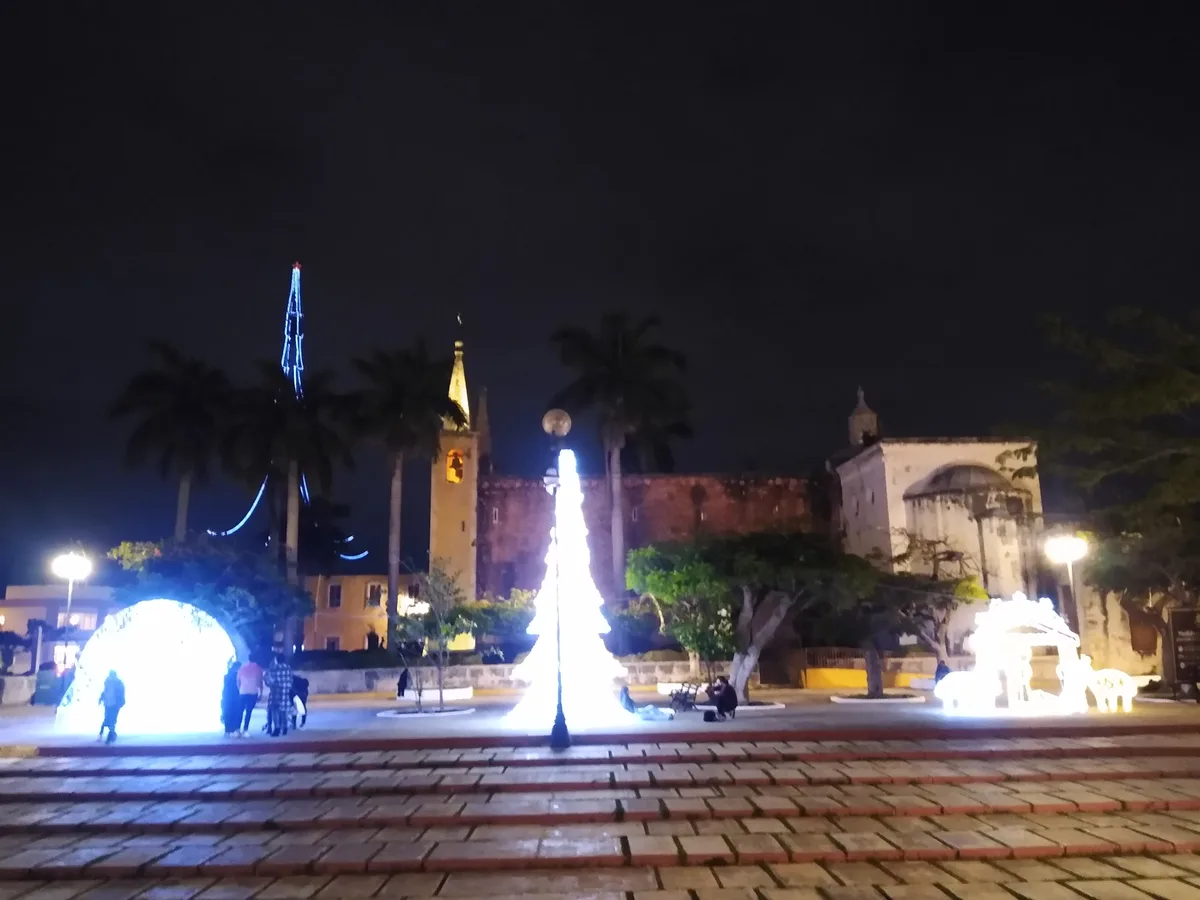
A plaza built around a church
Start at the church steps and look south. The Iglesia de Santa Ana closes off one side of the square: a pale stone facade with a single bell tower. Shade trees and benches fill the rest of the park, and food stalls line its edge. It is small enough to cross in a minute, and people sit in it for hours.
The church went up in the 1730s on the orders of Antonio de Figueroa y Silva, a colonial governor of Yucatán. Tradition holds that he is buried inside. The barrio of Santa Ana grew up around it on the northern edge of the old city. The neighbourhood still feels that way, with low colonial houses painted in faded colours along Calle 60.
Finding Calle 60 and 45
Santa Ana sits on Calle 60, the street that ties together several of Mérida’s central squares. From the Plaza Grande, walk north on Calle 60 for about eight blocks. On a single straight walk you pass:
- Parque Hidalgo and the Iglesia de Jesús (Tercera Orden)
- Teatro Peón Contreras and the Universidad Autónoma de Yucatán’s main building
- Parque de Santa Lucía, at Calle 55
- Parque de Santa Ana, at Calle 45
Mérida’s centre uses a numbered grid. Even-numbered streets run north–south and odd-numbered streets run east–west, so “60 y 45” is a precise address. Two blocks east, Paseo de Montejo begins at Calle 47. That makes the park a natural stop before or after the boulevard’s mansions. Taxis and ride-hailing apps work well if the heat makes the walk too much.
Eating at the Santa Ana stalls
The park’s other draw is food. Beside the church, the Mercado de Santa Ana houses a row of small cocinas (counter kitchens). Plastic stools and laminated menus are standard. This is where Mérida does Yucatecan comfort food quickly and cheaply, and it is a good place for a first taste of the region’s dishes. Look for:
- Cochinita pibil, achiote-marinated pork, served in tortas or tacos
- Panuchos, fried tortillas stuffed with black beans, then topped
- Salbutes, puffy fried tortillas with shredded turkey or chicken
- Sopa de lima, the lime-scented chicken soup of Yucatán
- Horchata or agua de chaya to cool off
Pickled red onion and a bowl of habanero salsa usually sit within reach. Try the habanero in small amounts first. It is properly hot. Prices are on the menus or written up at each stall.

Ordering and sitting like the regulars
The routine is informal. Grab a free stool at whichever counter looks good, then order by naming the dish and how many you want: “dos panuchos de cochinita” works perfectly. Pointing at a neighbour’s plate is fine too. Pay at the end, when you’re ready to leave.
- Carry Mexican pesos in small notes. Many stalls are cash-only, and big notes cause a delay.
- Leaving around 10 percent at a counter where you were served is a polite, common gesture.
- A plain “buen provecho” to the people next to you, when you sit or leave, is normal Yucatecan courtesy.
- Dress modestly if you go into the church. Keep quiet near the door when Mass is on.
Benches are shared space. Families, students and older residents use them all day, so give up a seat if someone elderly comes along.
When to come, and when to skip
The park itself never closes. Measured foot traffic shows weekends are busy from 9am to 11pm. Try not to arrive on a Saturday or Sunday expecting an empty bench or a free stool at the busiest stalls; that is when the square is fullest. A weekday visit is the easier choice.
Mérida’s midday heat counts as much as the crowds. The trees give real shade, but between late morning and mid-afternoon most people stay out of the sun. Early morning and evening are the comfortable hours. Once the street lights come on, the church facade is lit and the stalls do steady business.
How long, and what’s next
Half an hour covers a look at the church and a sit in the shade. Make it an hour if you’re eating. Most visitors fold Santa Ana into a longer Calle 60 walk rather than making a separate trip.
From here, the obvious next steps are:
- Paseo de Montejo, starting two blocks east at Calle 47, for the turn-of-the-century mansions
- Parque de Santa Lucía, a few blocks south, with its arcaded colonial square
- Plaza Grande, the Catedral de San Ildefonso and Casa de Montejo, at the south end of Calle 60
Walk south, eat at Santa Ana on the way, and you’ve crossed the historic core in one easy afternoon or evening.
Frequently asked questions
Where exactly is Parque de Santa Ana in Mérida?
It's at the corner of Calle 60 and Calle 45 in the Centro, about eight blocks north of the Plaza Grande on Calle 60 and two blocks west of where Paseo de Montejo begins at Calle 47.
When is the quietest time to visit?
Weekends are busiest, with crowds from 9am to 11pm on Saturdays and Sundays. Come on a weekday for more space, and avoid the midday heat by visiting in the early morning or the evening.
Is the park open at night?
Yes. The square is open 24 hours every day. Evenings are popular because the church is lit and the food stalls stay busy.
What should I eat at the Santa Ana stalls?
Try Yucatecan staples like cochinita pibil, panuchos, salbutes and sopa de lima, with horchata or agua de chaya on the side. Carry pesos in small notes, as many stalls take cash only.
How long should I spend here?
Allow 30 minutes to see the church and the square, or about an hour if you're eating. It fits easily into a walk along Calle 60 that also takes in Santa Lucía and the Plaza Grande.
Plan your trip to Merida
Mexico eSIM & staying connected →
Some links above are affiliate links — if you book through them, Wander Atlas earns a small commission at no extra cost to you. It's how we keep every guide free.