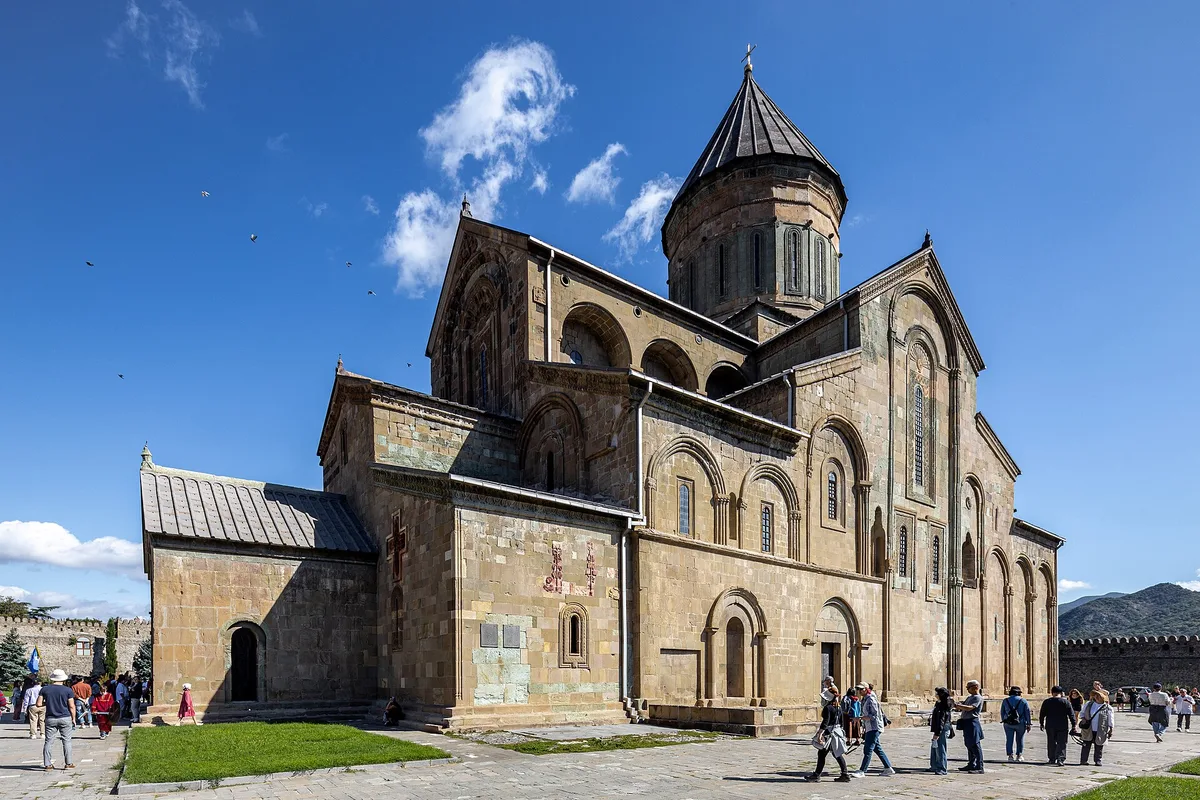
Stone ramparts with round corner towers enclose the cathedral, so the first thing you walk through is a gate in a fortress wall. Inside, a wide paved courtyard opens out, and the cathedral sits at its centre: a tall cross-shaped church of dressed stone under a single conical dome. Mtskheta’s small old town spreads around it in low streets of souvenir stalls and guesthouses.
This is one of the most visited sights in Georgia and has been on UNESCO’s World Heritage list since 1994 as part of the Historical Monuments of Mtskheta. It is also a working church at the centre of Georgian Orthodoxy, and visitors arriving by tour bus share the floor with people who come to pray.
A pillar, a robe and a carved hand
The name comes from a legend. Svetitskhoveli means “life-giving pillar”, and Georgian tradition holds that Christ’s robe was brought here from Jerusalem and buried on this spot. A cedar is said to have grown from the grave. In the 4th century, after Saint Nino converted King Mirian III, a wooden church went up where the tree stood.
The stone building you see today dates from 1010–1029 and was designed by the architect Arsukisdze. Look high on the exterior for a carved right hand holding a tool. Local legend says the architect’s hand was cut off out of jealousy, and the carving is read as his memorial.
The defensive walls are much later additions from the 18th century, built under King Erekle II. They explain why the complex looks more like a citadel than a parish church.
What to look for once you step inside
The interior is tall and dim, lit by candles and the light from the drum of the dome. Stone floors, painted walls and icons in gilded frames fill the space, with no pews. People stand, as they do in all Georgian Orthodox churches.
Find these while you walk the nave:
- The baptismal font, which dates back to the 4th century and is older than the building around it.
- The pillar marking the site of the legend. It is painted with icons and is the spiritual focus of the church.
- The small stone chapel built inside the nave, modelled on the chapel of the Holy Sepulchre in Jerusalem.
- The fresco fragments. Much of the original painting was whitewashed in the 19th century, but the surviving fragments include a large Christ in the apse.
- Royal tombs set into the floor. Several Georgian kings are buried here, among them Vakhtang Gorgasali and Erekle II.
Allow 45 minutes to an hour for the interior and the courtyard. Walk the outer wall too, because the facades carry carved reliefs, the carved hand among them.

Dress and manners at the door
People here observe the dress code, and staff will turn you away if you ignore it. Women cover their hair and wear a skirt below the knee. Men wear long trousers, and everyone covers their shoulders. Wraps and scarves are often available at the entrance, but carrying your own saves a wait.
Inside, keep your voice low and do not stand between worshippers and the icons they are facing. Thin beeswax candles are sold inside. Locals light one and place it in the sand trays in front of the icons, and visitors are welcome to do the same.
During a service, move to the back or the sides and put your camera away. Photography rules can tighten while a liturgy is on, so ask or watch what others are doing. Kissing icons and crossing yourself are for believers. Nobody expects it of visitors, but do not block the people who are doing it.
Saturday closes early
Check the day before you go. At the moment the cathedral opens at 8am Tuesday to Sunday and at 9am on Monday. It closes at 7pm every day except Saturday, when the doors shut at 4:45pm.
That Saturday cut-off catches a lot of day-trippers who come late after Jvari or lunch in town. Church hours can also change for feast days and services, so confirm on the day if your plan depends on a late visit.
Tour groups from Tbilisi usually arrive in mid-morning. Reaching the gate near opening time usually means a quieter nave, and early morning is also when you will see people coming in to pray before work. On 14 October the town holds Svetitskhovloba, its main religious festival. Expect big crowds and processions rather than a quiet visit.
From Tbilisi to the cathedral gate
Mtskheta is about 20 km north of Tbilisi, and getting there is easy:
- Marshrutka (minibus): these leave frequently from the Didube bus station, next to Didube metro station on Tbilisi’s Line 1. The ride takes roughly half an hour and drops you in town, a short walk from the cathedral.
- Taxi or ride-hailing app: this is the quickest door-to-door option from central Tbilisi, and Bolt and Yandex Go both work here.
- Organised day tours: most of them combine Svetitskhoveli with Jvari, and some carry on north along the Georgian Military Road towards Ananuri and Kazbegi.
The cathedral’s address is RPRC+V9C, Mtskheta, if you want to drop a pin. Inside the walls everything is flat and paved, though the old-town streets outside are cobbled.
Jvari, Samtavro and the meeting of two rivers
Mtskheta sits where the Aragvi and Mtkvari rivers meet, and the town’s other two big sights are a short trip from the cathedral.
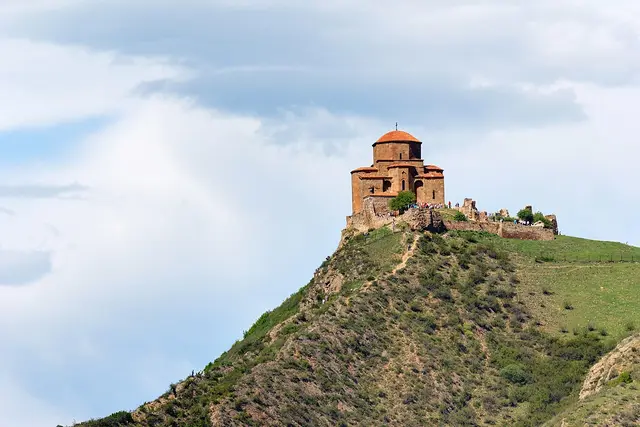
- Jvari Monastery is a 6th-century church on the hilltop across the river. From up there you see the confluence and the whole of Mtskheta, with Svetitskhoveli’s dome in the middle. You need a taxi to get there, because the road is not walkable from town.
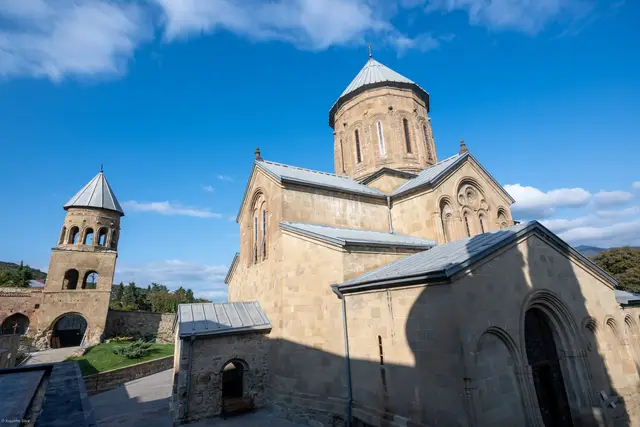
- Samtavro Monastery is a 10–15 minute walk north through town. It is a working convent linked to Saint Nino and holds the tomb of King Mirian III.
A half-day covers all three comfortably. If you stay for a meal, the restaurants around the cathedral serve standard Georgian dishes: khachapuri, khinkali and lobiani. You see the cathedral from a different angle on the way out, which is a good last look at it.
Frequently asked questions
How do I get to Svetitskhoveli Cathedral from Tbilisi?
Take a marshrutka (minibus) from Didube bus station, next to Didube metro on Line 1. They run frequently and take about half an hour to reach Mtskheta, and the cathedral is a short walk from the drop-off. A taxi or a Bolt ride is quicker door to door.
What are the opening hours, and is any day different?
At the moment it opens at 8am Tuesday to Sunday and at 9am on Monday. It closes at 7pm every day except Saturday, when it shuts at 4:45pm. Hours can change around services and feast days, so check on the day if you plan to arrive late.
What should I wear?
Cover your shoulders and knees. Women should wear a skirt and cover their hair, and men should wear long trousers. Wraps are often available at the entrance, but bringing your own scarf avoids the wait.
How long should I spend there?
Allow 45 minutes to an hour for the cathedral and its walled courtyard. Make it half a day if you add Jvari Monastery on the hill and Samtavro Monastery in town.
What else is near Svetitskhoveli?
Samtavro Monastery is a short walk away, and Jvari Monastery is a quick taxi ride up the hill across the river. Jvari has views over the meeting of the Aragvi and Mtkvari rivers. The old-town streets around the cathedral have places to eat Georgian food.
Plan your trip to Mtskheta
Georgia eSIM & staying connected →
Some links above are affiliate links — if you book through them, Wander Atlas earns a small commission at no extra cost to you. It's how we keep every guide free.
Related guides
 attraction
Jvari Monastery: Mtskheta Travel Guide (4.8★)
 attraction
Shiomgvime Monastery: Mtskheta Travel Guide (4.9★)
 hidden gem
Samtavro's Convent: Mtskheta Travel Guide (4.9★)
 attraction