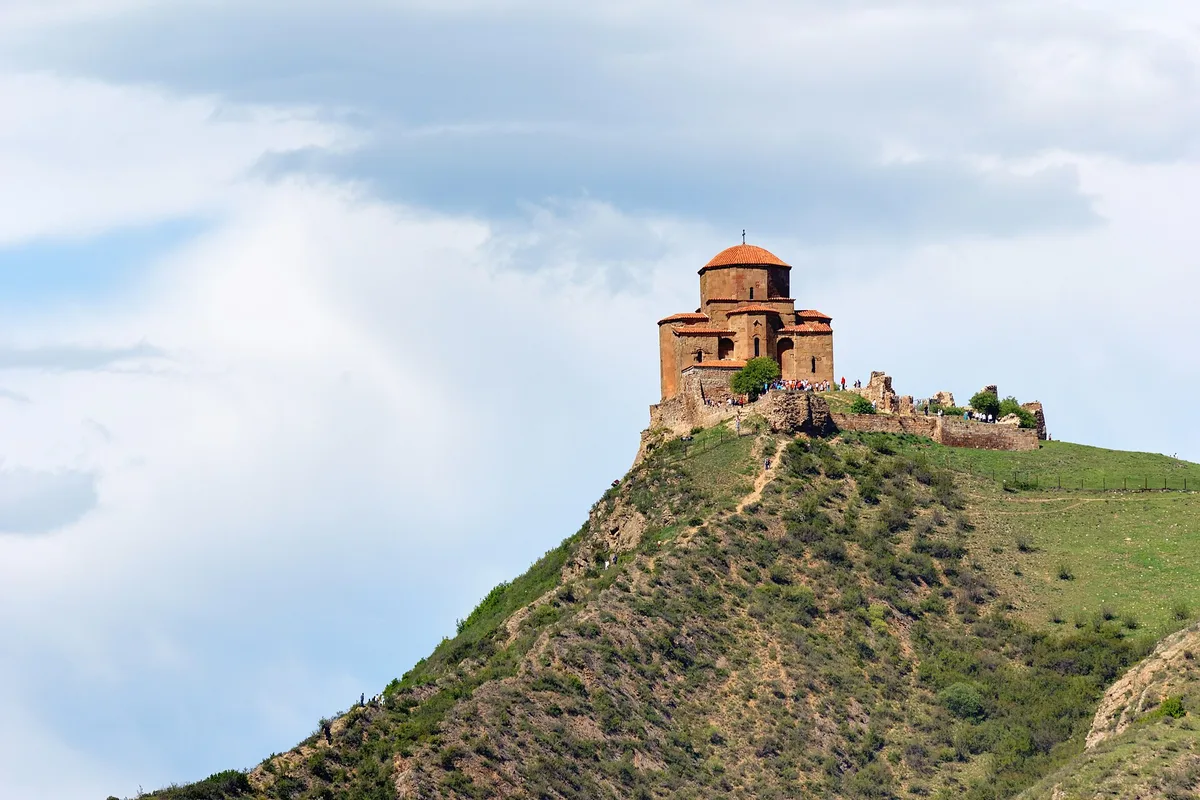
A cross above two rivers
The hill ends in a cliff. From the car park, a short path climbs to a squat church of pale stone blocks. Beyond it the ground drops away to the meeting of the Aragvi and the Mtkvari. Across the water, the roofs of Mtskheta gather around the long nave of Svetitskhoveli Cathedral.
Tradition says St Nino raised a wooden cross on this spot in the 4th century, after the Georgian royal court converted to Christianity. The stone church came later, built around 590 to 605. Its name, Jvari, simply means “cross”. Since 1994 it has been part of the UNESCO-listed Historical Monuments of Mtskheta.
Reading the stone
Jvari is small, so walk around it before going in. The plan is a tetraconch: four rounded apses set around a central dome, with narrow corner rooms tucked between them. Builders across Georgia and Armenia copied the design so often that architects still call it the “Jvari type”.
The bas-reliefs are on the outside. On the east facade, carved figures of donors kneel before Christ. Inscriptions in the old Georgian asomtavruli script name rulers including Stepanoz, Demetre and Adarnase. Over the south entrance, angels lift the Exaltation of the Cross. Fourteen centuries of wind have worn the carving soft, so you have to stand close to pick out faces.
Inside, the light is dim and the walls are mostly bare stone. In the centre, a tall wooden cross rises from an octagonal stone base. Tradition holds that the base marks where Nino’s original cross stood. Look out for the ruins of the Lesser Church of Jvari just beside the main building.
Getting up the hill
From Mtskheta the monastery looks close, but the road up loops back across the river by way of the highway. No regular bus goes to the top. Most visitors arrive in one of three ways:
- Taxi or ride-hailing app from Tbilisi. Bolt works in the city. Ask the driver to wait, because finding a ride down from the hilltop is not guaranteed.
- Marshrutka to Mtskheta, then a taxi up. Minibuses to Mtskheta leave from Didube bus station in Tbilisi. Taxis wait in town for the short hop up the hill.
- A day tour from Tbilisi. Almost every Mtskheta tour stops here, often paired with Svetitskhoveli and sometimes Ananuri further up the Georgian Military Road.

Dressing and behaving at the church door
Jvari is a working Orthodox church, and the dress rules are the same as anywhere in Georgia.
- Women: cover your hair and wear a skirt below the knee. Wraps are often left at the entrance, but bring a scarf in case there are none.
- Men: wear long trousers and take your hat off inside.
- Candles: thin beeswax candles are sold inside the church. Light one from another candle and push it into the sand tray in front of an icon.
- Photos: keep your camera off the worshippers. If a service is under way, stand toward the back and stay quiet.
- Weddings: Georgian couples sometimes come here after the ceremony. Give the party space at the viewpoint wall.
Tour minibuses from Tbilisi tend to arrive mid-morning, so arriving close to opening usually gets you the terrace before them. Visitors who have come straight from the city also tend to thin out late in the afternoon.
Timing your visit
At the moment, Jvari opens 9:30am–5:30pm every day of the week. Church hours shift with feast days and the seasons, so check before you go, especially around Orthodox Easter and Christmas on 7 January.
Thirty minutes covers the church and the view. An hour lets you walk the full outer wall and look properly at the reliefs. The hilltop is exposed, so bring a layer even when Mtskheta below feels warm. Spring and autumn usually give the clearest views up the Aragvi valley.
Down in Mtskheta afterwards
Mtskheta was the capital of the old kingdom of Kartli, and the town is worth the afternoon. Most visitors combine these stops with Jvari:
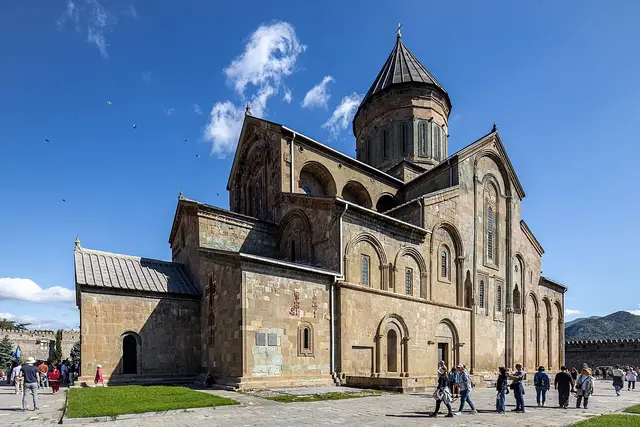
- Svetitskhoveli Cathedral: the 11th-century cathedral you saw from above. It is the traditional burial place of Christ’s robe and the site of many royal tombs.
- Samtavro Monastery: holds the graves of King Mirian and Queen Nana, the first Christian rulers, plus a small chapel linked to St Nino.
- The old streets around the cathedral: souvenir stalls, churchkhela strings and restaurants serving khachapuri and khinkali.
Seen in this order, the day makes sense: from the hilltop you see the whole town laid out, then you walk the streets you were just looking down on.
Frequently asked questions
How do I get to Jvari Monastery from Tbilisi?
The simplest way is a taxi or a Bolt ride straight to the hilltop. Ask the driver to wait, since getting a ride back down isn't guaranteed. You can also take a marshrutka from Didube bus station to Mtskheta and then a short taxi ride up. Most Mtskheta day tours include Jvari too.
Can I walk up to Jvari from Mtskheta town?
Driving up is the practical option. The monastery looks close from town, but the road loops back across the river via the highway, and no regular bus goes to the top. Taxis wait in Mtskheta for the trip up.
What are the opening hours?
At the moment it opens 9:30am–5:30pm every day of the week. Church hours can change with religious holidays and the seasons, so check before you visit.
What should I wear?
Women should cover their hair and wear a skirt below the knee. Wraps are often left at the entrance, but bring a scarf in case there are none. Men should wear long trousers and remove hats inside. Bring a warm layer as well, because the hilltop is windy.
How long should I spend there, and what else is nearby?
Allow 30–60 minutes at the monastery. Then go down to Mtskheta for Svetitskhoveli Cathedral and Samtavro Monastery, which together make an easy half-day trip from Tbilisi.
Plan your trip to Mtskheta
Georgia eSIM & staying connected →
Some links above are affiliate links — if you book through them, Wander Atlas earns a small commission at no extra cost to you. It's how we keep every guide free.
Related guides
 attraction
Svetitskhoveli Cathedral: Mtskheta Travel Guide (4.8★)
 attraction
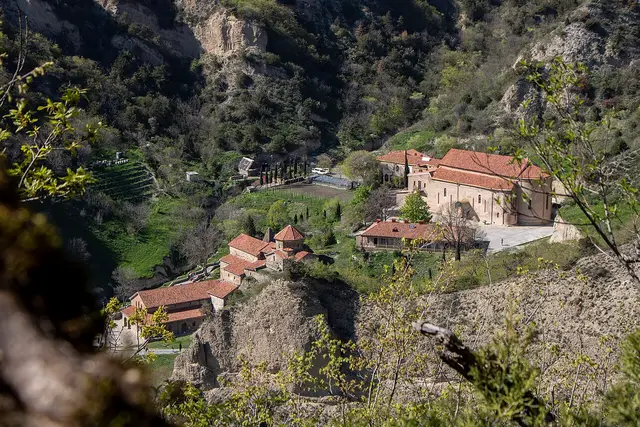
Shiomgvime Monastery: Mtskheta Travel Guide (4.9★)
 hidden gem
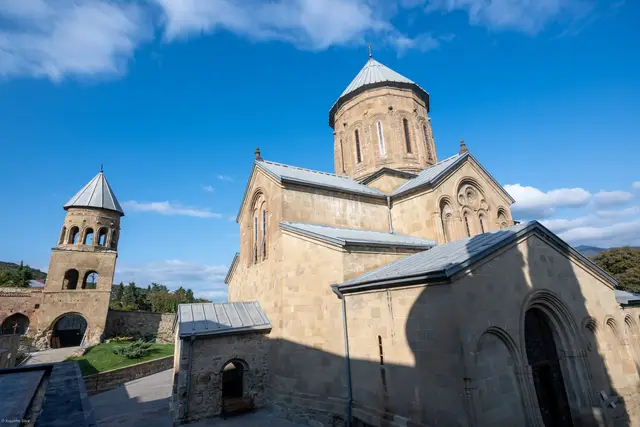
Samtavro's Convent: Mtskheta Travel Guide (4.9★)
 attraction