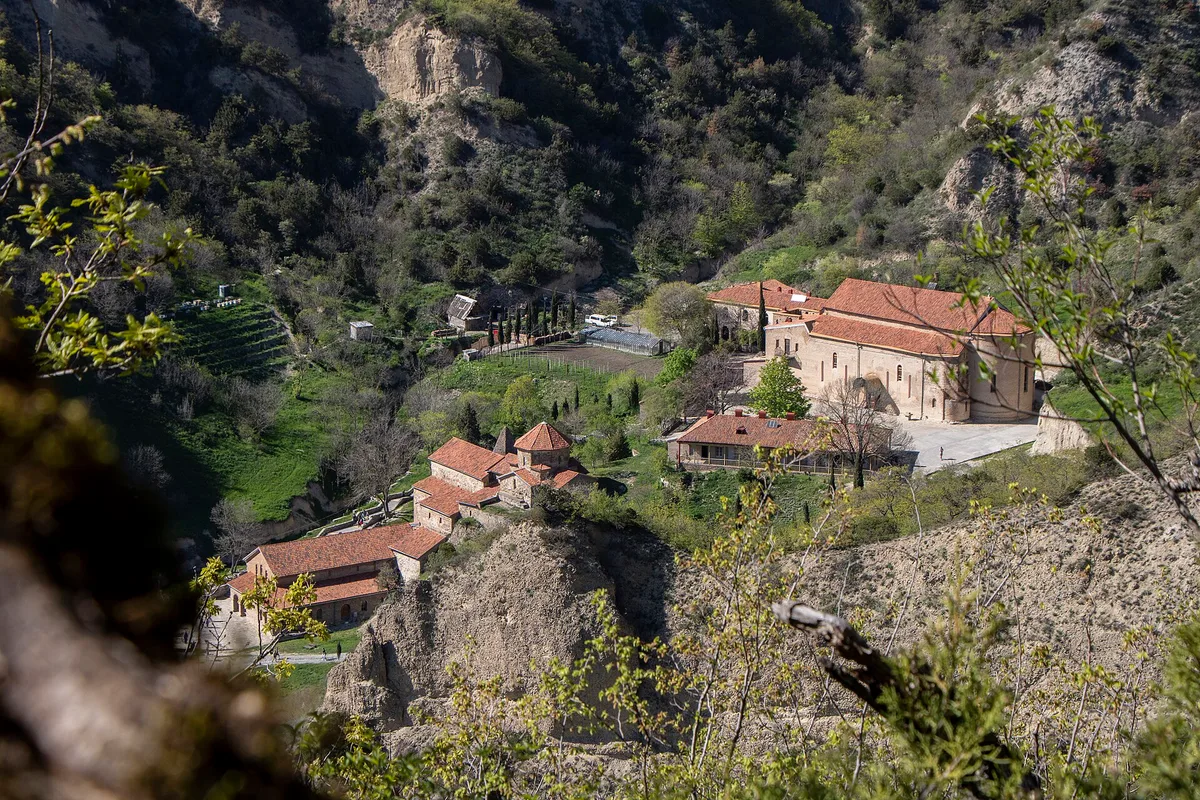
Cliffs close in around the last stretch of road. These are pale limestone walls full of holes, and some of those holes were dug by hand. Shiomgvime means “Cave of Shio”. The name is literal. Before there were any churches here, a monk lived in this rock, and the monastery grew out of the gorge around his cell.
A monastery that started in a cave
Saint Shio came to Georgia in the 6th century. He was one of the Thirteen Assyrian Fathers, the group of monks who set up much of the country’s early monastic life. He settled in this gorge as a hermit. Followers came to join him, and the community he started became one of the most important monasteries in medieval Georgia.
King David the Builder later made it a royal monastery and gave it land and privileges. It was raided and damaged more than once over the following centuries, then rebuilt each time. Monks still live here today. So treat it as a working religious house first and a historic site second, because that’s what it is.
The two churches in the lower compound
The lower compound sits on a shelf of the gorge. Its two main buildings come from very different eras:
- Church of Saint John the Baptist: the oldest building on the site. It’s a compact 6th-century stone church on a cross plan, and it goes back to Shio’s own lifetime.
- Cathedral of the Assumption: larger, first built in the 12th century under David the Builder and heavily rebuilt in the late 1600s. The thick walls and simple stonework show those repairs.
Inside you’ll find icons, candles and dim light, as in any active Georgian church. Services take priority over sightseeing. If monks are chanting, stand toward the back and keep still.
Down into Saint Shio’s cave
The cave is why most pilgrims make the trip. Tradition holds that Shio spent his last years shut away in a deep cave here, praying alone, and his grave is honoured at the monastery. Pilgrims go down to the cave to pray. Many light a candle before or after.
Look up at the cliffs from the compound and you’ll see other hollows cut into the rock. These are monks’ cells from the centuries when hundreds of hermits lived in this gorge. Keep to the paths that are clearly open. Some cells are unstable, and others are still in use.
The way down to Shio’s cave is narrow and can be slippery. Wear shoes with grip, and leave big bags in the car if you can.
Getting out to the gorge
Shiomgvime is outside central Mtskheta. You drive northwest along the Mtkvari, passing the village of Dzegvi, then take a minor road into the gorge. Most visitors come one of these ways:
- Taxi or ride-hail from Mtskheta or Tbilisi: the simplest choice. Agree on a return trip before you set off, because you can’t count on finding a car back.
- Rental car: you get to the door, but expect the last section to be narrow and winding.
- Day tour: many tours from Tbilisi pair Shiomgvime with Mtskheta’s own churches.
Public transport doesn’t run to the gate in any useful way. Without your own car, book the return before you go.
Covering up at the gate
Dress like you’re going to church, because you are. Georgian Orthodox monasteries ask the same of everyone:
- Women: cover your head and wear a skirt below the knee. Wraps are often left at the entrance of Georgian monasteries, but bring a scarf just in case.
- Men: long trousers, no hats indoors.
- Everyone: cover your shoulders, and no shorts.
Inside the churches, speak quietly. Don’t stand with your back to the altar to pose for photos, and ask before photographing a monk or a service. If you give a donation, put it in the box or buy a candle. Pay in Georgian lari, in small notes, because there’s no card terminal at a candle stand. Locals cross themselves as they go in. Nobody expects that of visitors, only respect.
Hours, timing and how long to stay
At the moment the gate is open 10:00am–7:00pm Monday to Friday, and 11:00am–7:00pm on Saturday and Sunday. Remember the late weekend start if you’re planning an early Saturday. Hours at religious sites can change for feast days and with the seasons. Check the current listing before you drive out.
Give it 1–2 hours. That’s time to see both churches, go down to the cave and stand looking up at the cliff cells. Weekdays generally suit sightseers better, since Sundays and Orthodox feast days bring worshippers in for services.
Spring and autumn are the easiest seasons for the walk down. Summer sun bounces off the pale rock, and in winter the paths can ice over.
Pairing it with Mtskheta
Shiomgvime makes an easy half-day with Mtskheta itself. Here’s what to add:
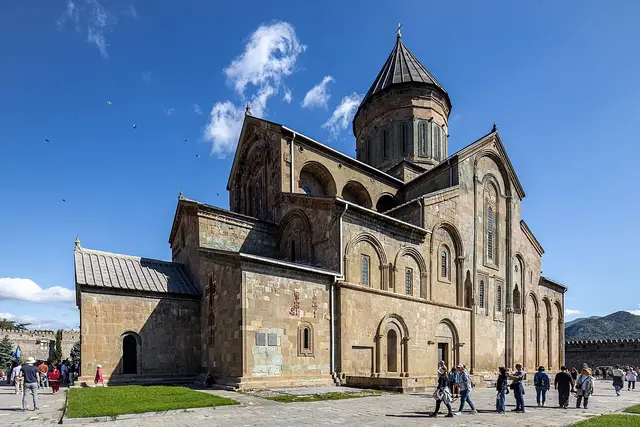
- Svetitskhoveli Cathedral: the great cathedral in the centre of Mtskheta and the town’s main draw.
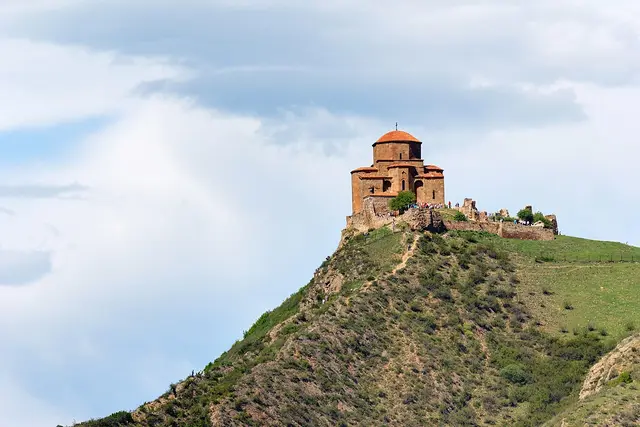
- Jvari Monastery: on a hilltop above where the Aragvi and Mtkvari rivers meet.
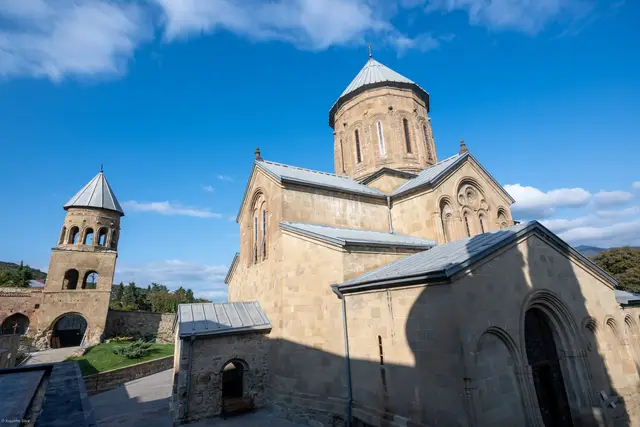
- Samtavro Monastery: in town, linked to Saint Nino, who brought Christianity to Georgia.
- Zedazeni Monastery: on a ridge across the valley, founded by another of the Assyrian Fathers, Ioane Zedazneli.
Visiting Zedazeni after Shiomgvime follows the same story. These monasteries were founded by two monks from the same group, each of whom picked his own remote spot.
Frequently asked questions
How do I get to Shiomgvime Monastery from Mtskheta?
Take a taxi, ride-hail or your own car northwest along the Mtkvari River, past the village of Dzegvi, then into the gorge on a narrow, winding road. Public transport doesn't usefully reach the gate, so agree on a return ride before you go.
What are the opening hours?
At the moment it's open 10:00am–7:00pm Monday to Friday and 11:00am–7:00pm on Saturday and Sunday. Hours can change for feast days and with the seasons, so check before you set off.
How long should I spend there?
Give it 1–2 hours. That covers the 6th-century Church of Saint John the Baptist, the Cathedral of the Assumption, the walk down to Saint Shio's cave and time to look up at the monks' cells in the cliffs.
Is there a dress code?
Yes. Women should cover their heads and wear a skirt below the knee. Men need long trousers. Everyone should cover their shoulders and skip shorts. Wraps are often provided, but it's safer to bring your own scarf.
What else can I see nearby?
In Mtskheta, see Svetitskhoveli Cathedral, Samtavro Monastery and the hilltop Jvari Monastery. Zedazeni Monastery is on a ridge across the valley. It was founded by another of the Thirteen Assyrian Fathers, so it pairs naturally with Shiomgvime.
Plan your trip to Mtskheta
Georgia eSIM & staying connected →
Some links above are affiliate links — if you book through them, Wander Atlas earns a small commission at no extra cost to you. It's how we keep every guide free.
Related guides
 attraction
Svetitskhoveli Cathedral: Mtskheta Travel Guide (4.8★)
 attraction
Jvari Monastery: Mtskheta Travel Guide (4.8★)
 hidden gem
Samtavro's Convent: Mtskheta Travel Guide (4.9★)
 attraction