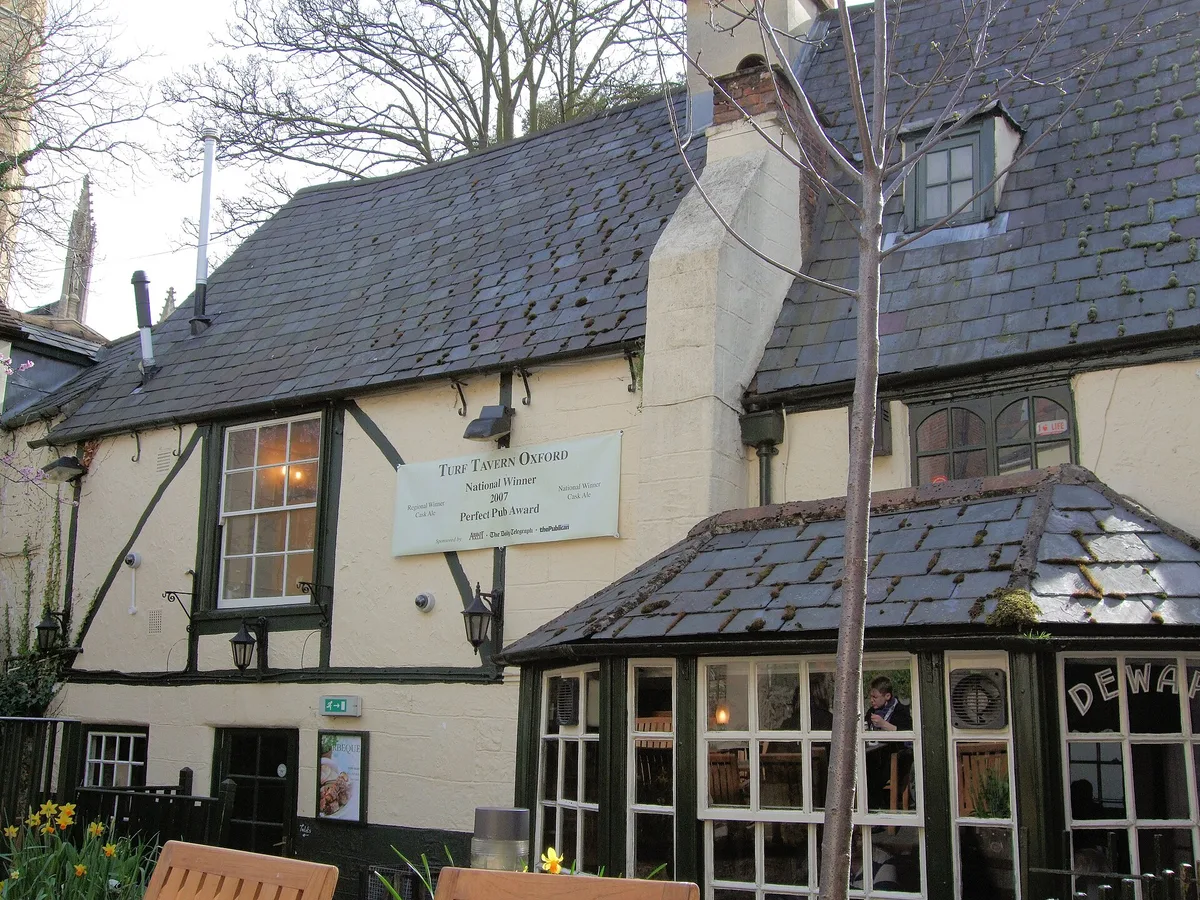
Two alleys and a low door
You can’t see the Turf Tavern from any main street. You reach it on foot, either down St Helen’s Passage or down Bath Place. Both are narrow walled lanes, and in places they’re barely wider than your shoulders.
St Helen’s Passage starts on New College Lane, almost under Hertford Bridge, the stone footbridge everyone calls the Bridge of Sighs. Bath Place starts on Holywell Street. Use one lane on the way in and the other on the way out.
Mind your head at the door. Inside, the rooms are small, the ceilings are low and the beams are lower still. The building is older than the pub licence. The Turf has been serving drink since 1831, but its walls feel older than that, and the dark interior suits it.
A beer garden under the medieval wall
Most people come for the garden. The outdoor courtyards sit right up against a surviving stretch of Oxford’s medieval city wall. The pale stone rises above the tables and makes a boundary no modern pub could build.
On a warm afternoon the courtyard fills up fast, with people standing three deep near the bar windows. In cooler months it’s easier to find a seat, and the stone still holds the light late into the evening. Bring a layer: the courtyard is enclosed, but it’s still open air.
Yards of ale, a famous non-inhalation and Morse
The Turf collects stories, and it’s happy to tell them. The best known involves Bob Hawke, later Prime Minister of Australia. As a Rhodes Scholar in Oxford in the 1950s, he downed a yard of ale (two and a half pints) in about eleven seconds. Pub lore says it happened here, and the claim gets repeated every time someone holds a long glass.
The second story belongs to another Rhodes Scholar, Bill Clinton. Local legend places his famous “didn’t inhale” moment in the Turf’s yard.
Neither story can be proven over a pint. Both are part of why visitors come down these alleys. Fans of Colin Dexter’s Inspector Morse also know the pub from the books’ Oxford.

Pints and plates
Come for the beer first. The Turf is known for real ales: cask beers that are hand-pulled at the bar, served cellar-cool and only lightly sparkling. The pump clips change, so read the bar before you order. If you don’t know a name, ask for a taste.
The food is classic British pub cooking, the plates you’d expect with a pint. Prices are mid-range, about what you’d pay in most central Oxford pubs. Today’s menu and prices are posted at the bar.
- To drink: a pint or half of whatever cask ale is on; cider if ale isn’t your thing.
- To eat: a pub classic, eaten outside if the garden has room.
- To skip: a big group dinner on a weekend afternoon. Space is tight.
Ordering at the Turf’s bar
Do what you’d do in any British pub: go to the bar, order and pay there, then carry your drinks back to your table. Don’t wait to be served at your table. Ask the bar staff how food orders work, and whether they need a table number.
- Paying: contactless card is standard in UK pubs. Have a backup in case a card machine is down.
- Tipping: nobody expects a tip for drinks at the bar. Some people say “and one for yourself”, but it’s optional.
- Rounds: groups usually take turns buying for the whole table. Keep track so you don’t miss yours.
- Seats: in the garden, a free stool at a shared table is fair game if you ask first.
- The alleys: they’re narrow and the lanes have neighbours, so keep your voice down when you leave late.
When to slip in
Timing makes a huge difference here. The Turf is one of Oxford’s most-visited pubs, and there aren’t many rooms. On weekdays it’s calmest from 11am to 2pm and again from 10pm to 11pm. On weekends the quiet windows are shorter: from 11am to noon, and from 10pm to 11pm.
Try not to arrive on a Saturday or Sunday between 1pm and 9pm. That’s when it’s busiest, the garden fills and the bar queue spills into the courtyard. At the moment it opens at 11am every day and closes at 11pm. Check before you go, as pub hours can change on holidays.
The best weekday plan is a late-morning ale before the lunch crowd arrives. The best weekend plan is a last drink after 10pm, once the day-trippers have caught their trains.
Within a five-minute walk
The pub is a good pause in a walk around the old centre. Come out of St Helen’s Passage and you’re under the Bridge of Sighs. From there it’s a short walk to these sights:
- Bodleian Library and Radcliffe Camera: a couple of minutes south-west.
- Sheldonian Theatre: at the top of Broad Street.
- New College: further down New College Lane, with its own stretch of the city wall.
- Holywell Music Room: on Holywell Street, near the Bath Place entrance.
Oxford railway station is roughly a 20–25 minute walk west, and a taxi or city bus is quicker. Don’t drive into the centre: parking near the pub is very limited. The Park & Ride sites on the edge of the city connect to the centre by bus.
Frequently asked questions
How do I find the Turf Tavern in Oxford?
Walk down one of its two lanes. St Helen's Passage starts on New College Lane, right by the Bridge of Sighs (Hertford Bridge). Bath Place starts on Holywell Street. The address is 4 Bath Place, OX1 3SU. You can't drive to the door.
When is the quietest time to visit the Turf Tavern?
On weekdays it's quietest from 11am to 2pm and from 10pm to 11pm. On weekends the quiet windows are 11am to 12pm and 10pm to 11pm. Avoid weekends between 1pm and 9pm, which are the busiest hours.
What are the Turf Tavern's opening hours?
At the moment it's open from 11am to 11pm every day of the week. Hours can change on holidays, so check before a special trip.
Is there outdoor seating?
Yes. The beer garden courtyards sit against a surviving stretch of Oxford's medieval city wall. They fill quickly on warm weekend afternoons.
What is there to see near the Turf Tavern?
The Bridge of Sighs is at the end of St Helen's Passage. The Bodleian Library, Radcliffe Camera, Sheldonian Theatre, New College and Holywell Music Room are all within a few minutes' walk.
Plan your trip to Oxford
United Kingdom eSIM & staying connected →
Some links above are affiliate links — if you book through them, Wander Atlas earns a small commission at no extra cost to you. It's how we keep every guide free.