The dome is the first thing that makes sense of the whole building. Painted mustard yellow and cast in reinforced concrete, it rises above four wings that stretch out like a cross, an Art Deco design finished in 1937 when this was reportedly one of the largest markets in Asia. Stand under the central rotunda and you can see how the whole structure funnels light and air down into the stalls below, a piece of engineering doing double duty as a covered bazaar.
Phsar Thmei, not just “Central Market”
Cambodians call it Phsar Thmei, meaning New Market, because it replaced an older marshland market on the same site nearly a century ago. Street 51 is its address, but ask any tuk-tuk driver for “Central Market” and they’ll know it just as well by the Khmer name. The building itself, restored with French development funding in the 2000s, keeps its original yellow paint and the cross-shaped footprint intact.
Under the dome sit the gold and silver dealers, rows of small glass counters where dozens of vendors sell jewelry side by side. That’s the priciest, most concentrated section, and also the most orderly: prices are chalked or whispered, and haggling here is gentler than in the clothing aisles. The four arms radiating outward hold everything else.
What’s actually in the four wings
Each wing has its own character, and knowing this before you go saves a lot of aimless wandering.
- Electronics and watches: mostly in the wings nearer the entrances, heavy on knockoff and genuine mixed together
- Clothing and shoes: a maze of stalls selling everything from school uniforms to printed t-shirts
- Souvenirs and textiles: kramas (the checkered scarves), silk scarves, wood carvings, postcards
- Fresh food and snacks: tucked toward the market’s outer edges and the surrounding street stalls, where the real breakfast action happens
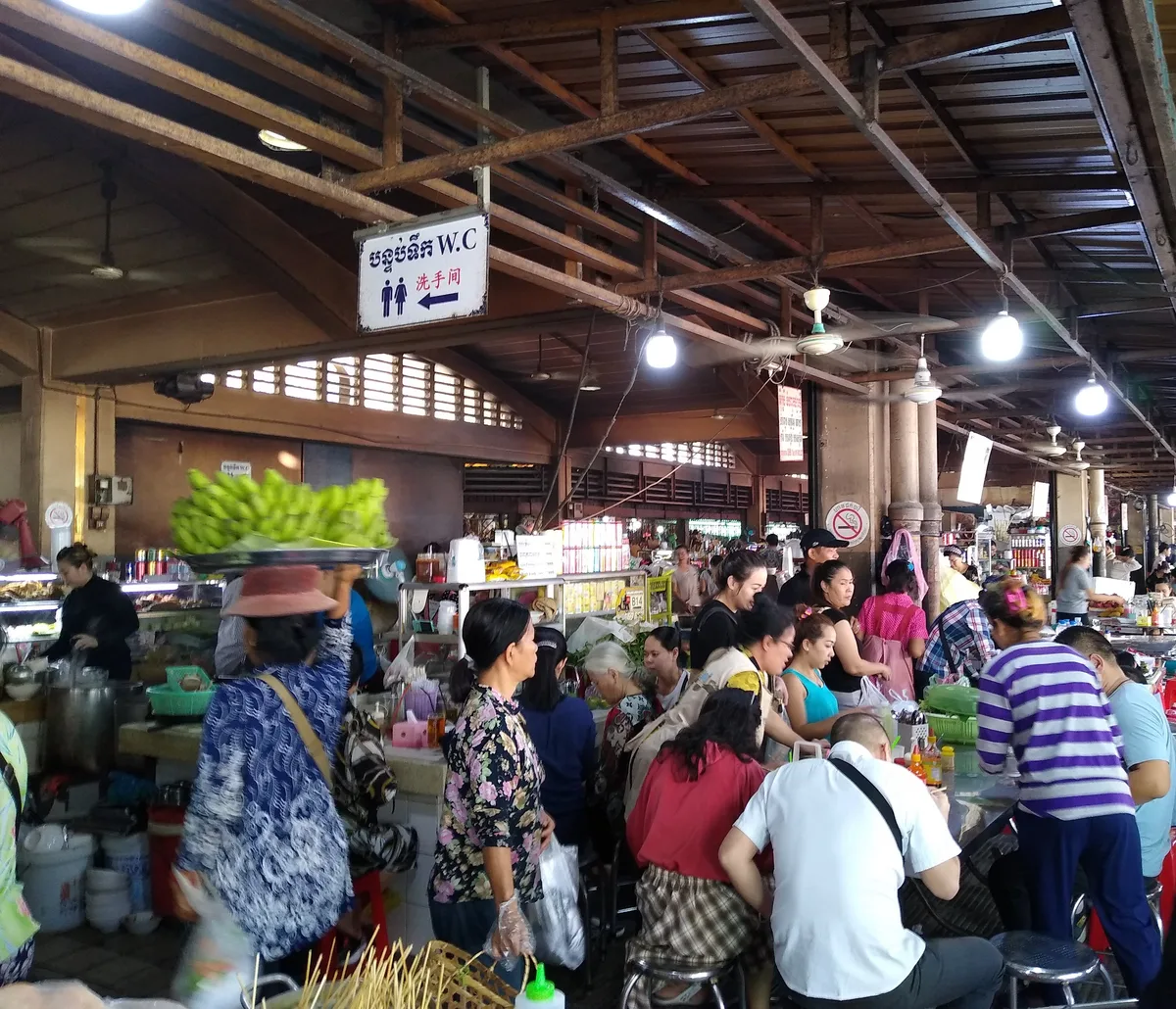
The food is looser and cheaper than the souvenir stalls, and it’s where the market feels most like a neighbourhood institution rather than a tourist stop.

Breakfast at the edges, before the heat sets in
The stalls ringing the market’s exterior, especially along the side facing Street 130, serve Cambodian breakfast staples like num banh chok (rice noodles in fish-based curry sauce) and bai sach chrouk (grilled pork over rice). These are cash-only, plastic-stool setups, no menus in English, and they’re busiest with locals grabbing food on the way to work.
Go before 9am if you want a seat without waiting, and expect to eat for the equivalent of a couple of dollars. Point at what looks good if the vendor doesn’t speak English; it works fine here.
The quiet window locals and vendors actually use
Crowd patterns here are consistent: the calmest stretch is 7am to 9am, on both weekdays and weekends, right after the gates open. On weekends specifically, avoid arriving between 10am and 4pm, when tour groups and shopping crowds fill the aisles and the dome area turns into a bottleneck.
Under-the-radar doesn’t mean empty, but Central Market hasn’t been swallowed by the mass tourism that’s reshaped some of Phnom Penh’s other sights, and the early morning hours here still feel like a working market first, an attraction second. Vendors are setting up stock, sweeping their stall fronts, and the gold counters under the dome are still shuttered or half-lit. If photography of the dome without crowds in frame matters to you, this is the window.
Haggling at the jewelry counters versus the clothing stalls
The way bargaining works shifts depending on which section you’re in. At the gold and silver counters under the dome, prices track the metal’s market value closely, so discounts are modest and negotiation is quieter, more like a conversation about design and weight than a back-and-forth over price.
In the clothing, souvenir, and electronics wings, opening prices are often set high for foreign visitors, and a friendly counter-offer at 40 to 50 percent of the asking price is a normal starting point. Cash, preferably small US dollar bills or Cambodian riel, is still how most transactions here happen; card readers are rare outside the mall next door.
Don’t feel obligated to buy after negotiating a price down. Vendors expect some browsers to walk, and a polite thank-you as you step away closes the exchange without offense.
Getting there and making the most of an hour or two
Central Market sits an easy walk from Sorya Center Point mall and roughly a ten to fifteen minute walk from the Tonle Sap riverfront, so it pairs naturally with a morning that starts at the river and ends here before the midday heat. Tuk-tuks know the market by name and it’s a common drop-off point, so no address needed beyond “Phsar Thmei.”
Budget an hour for a walk through all four wings plus the dome, longer if you’re seriously shopping or eating. The market runs 7am to 5pm every day of the week, no closing day, so it’s a reliable stop to slot in whenever the rest of your itinerary allows. Bring small bills, wear something you don’t mind sweating in, and treat the covered dome as shade relief if you’re walking the city in the middle of the day.
Frequently asked questions
What is Central Market in Phnom Penh known for?
It's known as Phsar Thmei, a 1937 Art Deco market with a distinctive yellow dome and four wings selling gold and silver jewelry, clothing, electronics, souvenirs, and street food.
When is the quietest time to visit Central Market?
Both weekdays and weekends are calmest between 7am and 9am, right after opening. On weekends, try to avoid 10am to 4pm, when it gets busiest.
How do I get to Central Market from the riverfront?
It's about a 10 to 15 minute walk from the Tonle Sap riverfront, or a short, inexpensive tuk-tuk ride; drivers know it by the name Phsar Thmei.
Is haggling expected at Central Market?
Yes, especially in the clothing, souvenir, and electronics wings, where starting with a counter-offer around 40 to 50 percent of the asking price is normal. Prices at the gold and silver counters under the dome are less negotiable since they track metal value.
How much time should I plan for a visit?
About an hour covers a walk through the dome and all four wings; add extra time if you plan to eat at the surrounding food stalls or shop seriously.
Plan your trip to Phnom Penh
Cambodia eSIM & staying connected →
Some links above are affiliate links — if you book through them, Wander Atlas earns a small commission at no extra cost to you. It's how we keep every guide free.
Related guides
 hidden gem
 Independence Monument: Phnom Penh Travel Guide (4.5★)
 attraction
 Wat Phnom Daun Penh: Phnom Penh Travel Guide (4.4★)
 attraction
 National Museum of Cambodia: Phnom Penh Travel Guide (4.2★)
 attraction