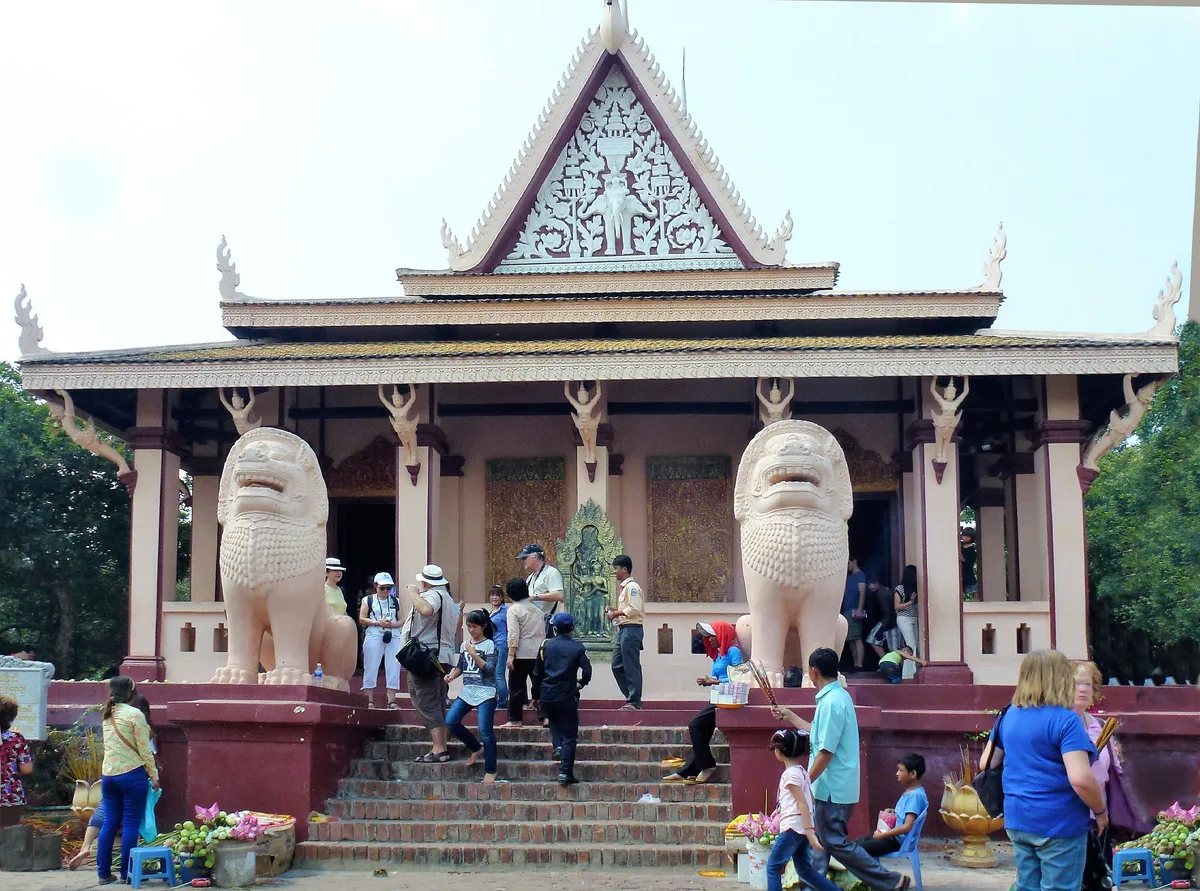
Wat Phnom Daun Penh sits on the only real hill in a city that’s otherwise flat as a rice paddy, and that alone explains why it matters. Legend says a woman named Penh found four Buddha statues washed up on the Mekong and built a shrine here in the 14th century, giving the capital its name, “Penh’s Hill.” What stands today is newer, but the site’s gravity as the spiritual anchor of Phnom Penh hasn’t changed in six centuries.
You climb a long flight of stone steps flanked by naga balustrades, incense smoke drifting down to meet you before you even reach the top. Vendors sell birds in cages for release, lotus flowers, and joss sticks along the way. At the summit, the vatta (the tall central stupa) contains the ashes of King Ponhea Yat, and the main pagoda’s interior is dense with murals, gilded Buddha images, and the low murmur of chanting.
What you’ll actually see
The complex is compact but layered, and every corner has a different focus.
- The main vihara (sanctuary) with its Buddha statues and painted ceiling panels depicting the Ramayana
- A smaller shrine to Preah Chau, a local spirit tied to the city’s founding myth
- The royal stupa of King Ponhea Yat, the 15th-century monarch credited with moving the capital here
- Panoramic views over the rooftops toward the Mekong and Tonlé Sap confluence
- Resident macaques that patrol the grounds and the stairs, entertaining, but not shy about snatching food
Because it’s the tallest religious structure in the city center, the hill itself is worth the climb even before you factor in the shrines.

Getting there
Wat Phnom sits at the top of Norodom Boulevard, an easy 15–20 minute walk from the Royal Palace or the riverside promenade along Sisowath Quay. Tuk-tuks and motodops know it by name, just say “Wat Phnom”, and fares from most central guesthouses run short and cheap. It’s also a natural stop if you’re walking the river from the Night Market up toward the French Quarter, since it sits roughly midway between the two.
When to go
The hill is open daily from 7am to 7pm, and the light changes what the visit feels like. Early morning brings monks in saffron robes making rounds and locals lighting incense before work, and this is generally the quietest time to visit. Weekend afternoons tend to draw tour buses and evening strollers who pack the steps and summit platform, so plan around that if you can.
Overcast days in the wet season (June–October) keep the stone cool underfoot; the dry season (November–February) gives clearer river views from the top.
How to visit like a local
Cambodians visit Wat Phnom for genuine devotion, not sightseeing, so dress and behave accordingly, shoulders and knees covered, shoes off inside the vihara. Small change is useful for the entry fee at the base of the steps and for offerings; card payment isn’t an option here. Locals tend to walk clockwise around the stupa, in keeping with Buddhist custom, so follow the flow rather than cutting against it.
This is a heavily visited landmark, not a quiet backstreet find, so the trick is timing rather than avoidance. Arriving right at opening beats the crowds and the midday heat at once. Keep bags zipped and food out of sight around the macaques, who’ve learned that tourists carry snacks. If a self-appointed “guide” offers birds to release for good luck, know it’s a paid transaction, not a free blessing, agree on a price first or politely decline.
Nearby to combine with the visit
Wat Phnom pairs naturally with a longer riverside route. The Royal Palace and Silver Pagoda are a short tuk-tuk ride south, and the Night Market along Sisowath Quay is walkable if you time your visit for late afternoon before the crowd crush. Central Market (Phsar Thmei), with its Art Deco dome and stalls of street food, is another 10–15 minutes away and makes a natural next stop.
Frequently asked questions
What are the opening hours for Wat Phnom Daun Penh?
It's open every day from 7:00 AM to 7:00 PM, with no weekly closing day.
When is the quietest time to visit?
Weekdays between 7am and 8am are calmest; on weekends the quiet window stretches slightly to 7am–9am. Avoid weekend evenings from 5pm to 7pm, the busiest stretch.
How do I get to Wat Phnom from the riverside?
It's a 15–20 minute walk from the Royal Palace or Sisowath Quay, or a short, cheap tuk-tuk ride — drivers know it simply as 'Wat Phnom'.
How long should I plan for the visit?
Most visitors spend 45 minutes to an hour, enough time to climb the steps, tour the main vihara, see the royal stupa, and take in the view.
Is there an entrance fee?
Foreign visitors typically pay a small entry fee in cash at the base of the steps; bring small bills since card payment isn't accepted.
Plan your trip to Phnom Penh
Cambodia eSIM & staying connected →
Some links above are affiliate links — if you book through them, Wander Atlas earns a small commission at no extra cost to you. It's how we keep every guide free.
Related guides
 attraction
 National Museum of Cambodia: Phnom Penh Travel Guide (4.2★)
 attraction
 Riverside Walk Street: Phnom Penh Travel Guide
 attraction
 Royal Palace Park: Phnom Penh Travel Guide (4.5★)
 attraction