A sky that hums
Cambodian kites make a sound. The classic Khmer kite, the khleng ek, carries a bow called an ek fixed across its frame. Its taut string vibrates in the wind and gives off a low, steady drone, and a field full of them overhead sounds something like a swarm.
That sound is what the Dough Sokheng Festival is built around. Kite makers from across Cambodia bring their work to Phnom Penh. Flying them is a prayer as well as a contest: a request for a good harvest and kind weather in the season ahead.
The full moon of Maksir
The date follows the moon, not the Western calendar. The festival falls exactly one month after the Water Festival, on the full moon of the Khmer month of Maksir. In 2026 that puts it in the November–December window.
The timing makes sense. By Maksir the rice harvest is under way and the rainy season is over. The dry season’s winds pick up across the Mekong plains, which gives kite flyers steady air from one day to the next.
It is also the most comfortable stretch of the year to be in Phnom Penh. Heat and humidity are lower than in the months either side. Visitors who time a trip around the Water Festival often stay on, or come back, a month later for the kites.
Venue and tickets
This is a folk tradition, not a promoted event. The information available to us names no single fixed venue and no ticketing platform for the 2026 edition. We would rather say so than print a location or a price nobody has confirmed.
Some things follow from how kites work. They need open ground and clear sky, away from power lines and tall buildings. The flying happens on big open spaces, not inside a hall, and you see it as much from a distance as from up close.
What that means in practice:
- There is no seat to reserve. You watch from the ground, and the kites are visible from a long way off.
- Larger kites take a team to launch, so the space around them gets busy.
- The sound carries further than you might expect, which helps you find the flying.
How to read a Khmer kite
Most visitors only notice size. Spend some time on the craft and there is more to see. A Khmer kite has a split-bamboo frame covered in paper or cloth. The bow on top is what tells you it is a khleng ek and not a plain kite.
Watch for:
- The ek itself. The tension and material of the bow string decide the pitch, so no two kites hum quite alike.
- Launch teams. Big kites go up with several people holding the line while one person runs it out.
- Height and stability. A kite that climbs and then sits motionless, humming, shows a well-balanced frame. Makers take pride in exactly that.
Watching the flying without getting tangled
Kite lines are the hazard most visitors never think about. Keep these in mind:
- Walk around launch teams, not between them. A line can lie almost invisibly across the grass, and stepping over it at launch can bring a kite down.
- Ask before photographing makers up close. A smile and a gesture toward your camera is the usual way. Most people are happy to show off a kite they built.
- Dress with prayers in mind. The festival carries a prayer for the harvest, so covered shoulders and knees fit in better than beachwear.
- Carry small notes. US dollars and Cambodian riel both circulate in Phnom Penh, and street vendors handle small riel notes most easily.
- Get around by tuk-tuk or ride-hailing. PassApp and Grab are the usual way to cross the city. Drivers know the Khmer name Bon Dough Sokheng better than “kite festival”.
Pairing it with the rest of the city
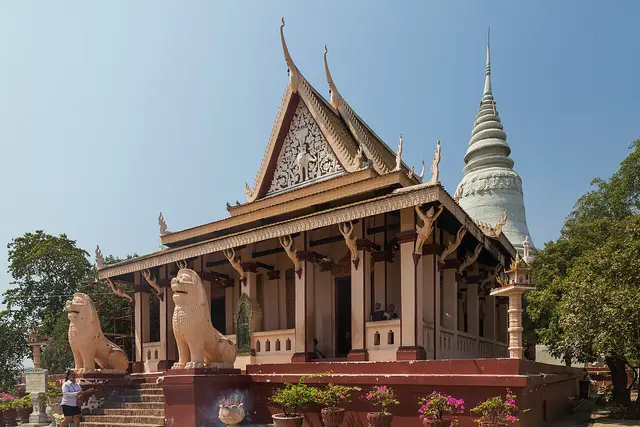
The kites are a half-day thing at most, which leaves room for more. The Royal Palace and Silver Pagoda sit on the riverfront at Sisowath Quay. The National Museum of Cambodia is next door, and its Angkorian sculpture puts some of the festival’s agricultural prayers in context.
For the city’s harder history, Tuol Sleng Genocide Museum is in the south of the city. Choeung Ek, the killing fields memorial, is a tuk-tuk ride beyond the outskirts. Both are sobering visits and suit a quiet morning more than the hours after a festival.
In the evening the riverfront promenade fills with families, food carts and Mekong breezes. In the cooler months of Maksir it is a pleasant place to finish a day spent looking up.
Frequently asked questions
When is the Dough Sokheng Festival in 2026?
It falls in the November–December 2026 window, on the full moon of the Khmer month of Maksir, exactly one month after the Water Festival.
Do I need tickets for the Kite Flying Festival in Phnom Penh?
The details available name no ticketing platform. It is a traditional open-air gathering of kite makers, and you watch the kites from open ground, not from reserved seats.
What makes Cambodian kites different?
The traditional khleng ek carries a bow (the ek) across its frame. Its string vibrates in the wind and gives off a steady humming drone, so the kites are heard as well as seen.
What is the festival for?
Kite makers from across Cambodia fly their kites as a prayer for a good harvest and good weather. It comes as the rice harvest gets under way and the dry-season winds arrive.
What else is there to see in Phnom Penh at the same time?
The Royal Palace and Silver Pagoda, the National Museum of Cambodia, Tuol Sleng Genocide Museum and the Sisowath Quay riverfront all pair well with the festival in the cooler dry-season weather.
Plan your trip to Phnom Penh
Cambodia eSIM & staying connected →
Some links above are affiliate links — if you book through them, Wander Atlas earns a small commission at no extra cost to you. It's how we keep every guide free.
Related guides
 event
AIA Pink Run 2026: Dates, Tickets & Venue (Phnom Penh)
 event
Bon Om Touk (Cambodian Water Festival): Dates, Tickets & Venue (Phnom Penh)
 event
Cambodia Independence Day: Dates, Tickets & Venue (Phnom Penh)
 Ended