A Stream Below the Street
Cheonggyecheon sits below the city. At street level you have Jongno’s office towers and taxis. Take the stone steps down and you’re on a walkway beside shallow, clear water, a few metres under the traffic.
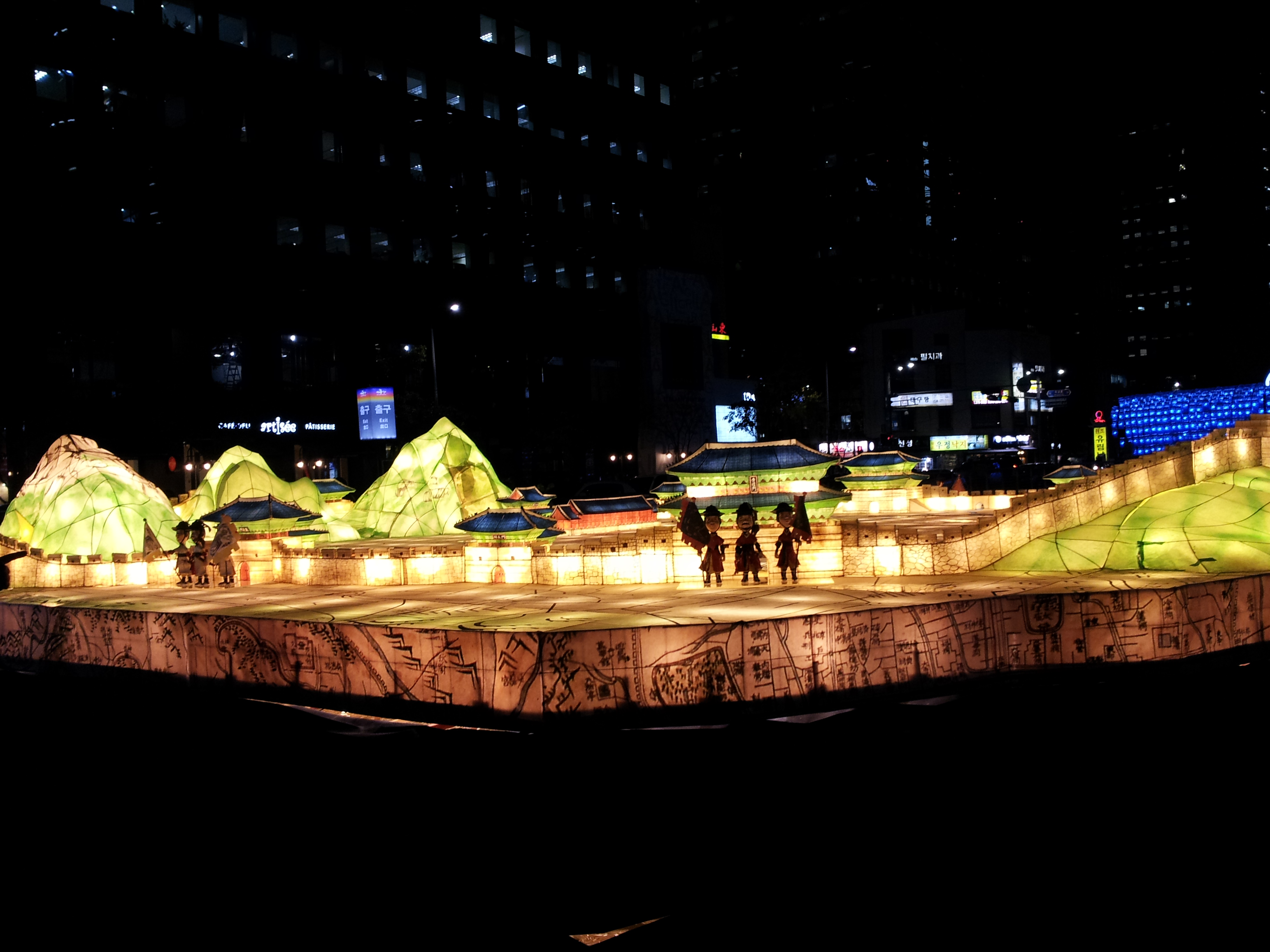
In November that sunken corridor fills with light. Lantern figures stand in the stream itself, line both banks and hang above the path. The traffic noise drops away and the sound of running water takes over.
The setting has a history of its own. Cheonggyecheon was covered with concrete and an elevated highway for decades. In 2005 the city tore the road out and restored the stream as a public walkway nearly 11 km long. The festival uses the western stretch, starting near the plaza where the stream begins.
Dates: Two Weeks in November 2026
The 2026 festival runs for two weeks in November. Over that time more than 50,000 lantern installations go up along the stream. That makes it one of the biggest light displays in the city’s autumn calendar.
November evenings in Seoul are cold, and late in the month they can drop close to freezing. Most visitors come in the first few hours after dark, with coats, scarves and a hot drink from one of the convenience stores up at street level. Sunset comes early this late in the year, so the lanterns are already glowing by the time offices close.
The organiser posts the exact opening dates and daily lighting hours on the festival’s official site. Those times decide when the lanterns are switched on and off each evening.
Tickets and Getting In
Cheonggyecheon is a public walkway. You reach it by the open staircases and ramps that come down from the bridges and streets along its length. In past editions, walking the lantern route has not needed a timed ticket in the way a concert does.
Any ticketed extras, such as workshops or special programmes, are set by the organiser and listed on the festival’s official site. No price appears in this guide because we haven’t been given one, and we won’t guess.
Getting to Cheonggye Plaza
The route starts at Cheonggye Plaza. Look for the tall striped spiral sculpture, Spring by Claes Oldenburg and Coosje van Bruggen, which marks the head of the stream. Three subway stations are within walking distance:
- Gwanghwamun Station (Line 5): comes out by Gwanghwamun Square, a few minutes north of the plaza.
- City Hall Station (Lines 1 and 2): take the exits on the Seoul Plaza side and walk north up Sejong-daero.
- Jonggak Station (Line 1): lets you join the stream a little further east, close to the Jongno crossing.
Taxis can’t stop on the stream, and the roads around Gwanghwamun get congested in the evening. The subway is the easier choice. If you’re leaving from the east end, the stations along Jongno, including Jongno 3-ga and Jongno 5-ga, are close to the stream as well.
Walking With the Current
The lanterns are laid out as a route, and you walk it as one. The paths on both sides of the water are narrow, about a few people wide in places. Stepping stones cross the stream at intervals. On busy evenings people end up walking in the same direction, heading downstream (east) from the plaza and passing the displays one by one.
Most visitors walk from Cheonggye Plaza east towards the bridges near Jongno. They climb back up to street level wherever the lanterns stop. At a slow pace with stops for photos, the lit stretch usually takes an hour or two.
Lanterns standing in the water reflect off the surface, so the best views are often from the bank opposite a display, not right beside it. The bridges above give a wider view down the length of the stream.
Moving Through the Evening Crowd
On a busy night the crowd runs the walk, so it helps to know how it works.
- Keep to the right and keep moving. Steady foot traffic is expected on the narrow paths. If you want a photo, step to the edge or wait for a gap, and don’t stop in the middle.
- Weekdays are generally easier. Weekend evenings bring families and couples from across the city, so a weeknight usually means more room on the path.
- Use the stepping stones carefully. They’re low and close to the water, and they get slippery when it’s cold. People cross one at a time and wait their turn.
- Pay by card. Cafés and convenience stores at street level take cards and Korean mobile payments without fuss. Tipping isn’t part of Korean custom.
- Toilets are up at street level. Public restrooms in the subway stations and nearby buildings are the usual stops, since the walkway itself has very little.
Lanterns are for looking at, not touching. Volunteers and staff on the route keep people back from the installations on the water.
Before and After the Lanterns
The festival is in the middle of Seoul’s historic core, so you can easily pair it with a day of sightseeing. Gyeongbokgung Palace is at the top of Gwanghwamun Square, a straight walk north from the plaza. Visitors often tour the palace in the afternoon and walk down to the stream as the light fades.
Insadong’s lanes of tea houses, galleries and paper shops sit just north of the stream, near Jonggak. Further east, Gwangjang Market is a short walk from the Jongno 5-ga end. Its stalls serve bindaetteok (mung bean pancakes) and other hot food, which helps after an hour in the cold.
To the south, Myeongdong’s shopping streets are within walking distance of City Hall. That makes them an easy stop if you’re heading back towards your hotel.
Frequently asked questions
When is the Seoul Lantern Festival in 2026?
It runs for two weeks in November 2026 along Cheonggyecheon Stream. The organiser posts the exact dates and nightly lighting hours on the festival's official site.
Which subway station is closest to the Seoul Lantern Festival?
Gwanghwamun Station (Line 5) and City Hall Station (Lines 1 and 2) are both a short walk from Cheonggye Plaza, where the route starts. Jonggak Station (Line 1) is close to the stream a little further east.
Do I need a ticket for the lantern walk?
Cheonggyecheon is a public walkway, and in past editions walking the lantern route hasn't needed a timed ticket. Any ticketed programmes are listed on the festival's official site.
How long does it take to see the lanterns?
Most visitors spend one to two hours walking east from Cheonggye Plaza, stopping for photos. They climb back up to street level where the displays end.
What else is nearby?
Gyeongbokgung Palace and Gwanghwamun Square are just north of the plaza. Insadong is near Jonggak, and Gwangjang Market is by the eastern Jongno 5-ga end of the stream.
Plan your trip to Seoul
South Korea eSIM & staying connected →
Some links above are affiliate links — if you book through them, Wander Atlas earns a small commission at no extra cost to you. It's how we keep every guide free.
Related guides
 event
event Benson Boone: Wanted Man Tour: Dates, Tickets & Venue (Seoul)
 event
event Diana Krall Concert: Dates, Tickets & Venue (Seoul)
![EXO Planet #6 – EXhOrizon [dot] Encore Concert: Dates, Tickets & Venue (Seoul) — Seoul](/wall/13e6699140923ff5.webp?c=v3-40-26-5-47) event
event EXO Planet #6 – EXhOrizon [dot] Encore Concert: Dates, Tickets & Venue (Seoul)
 event
event