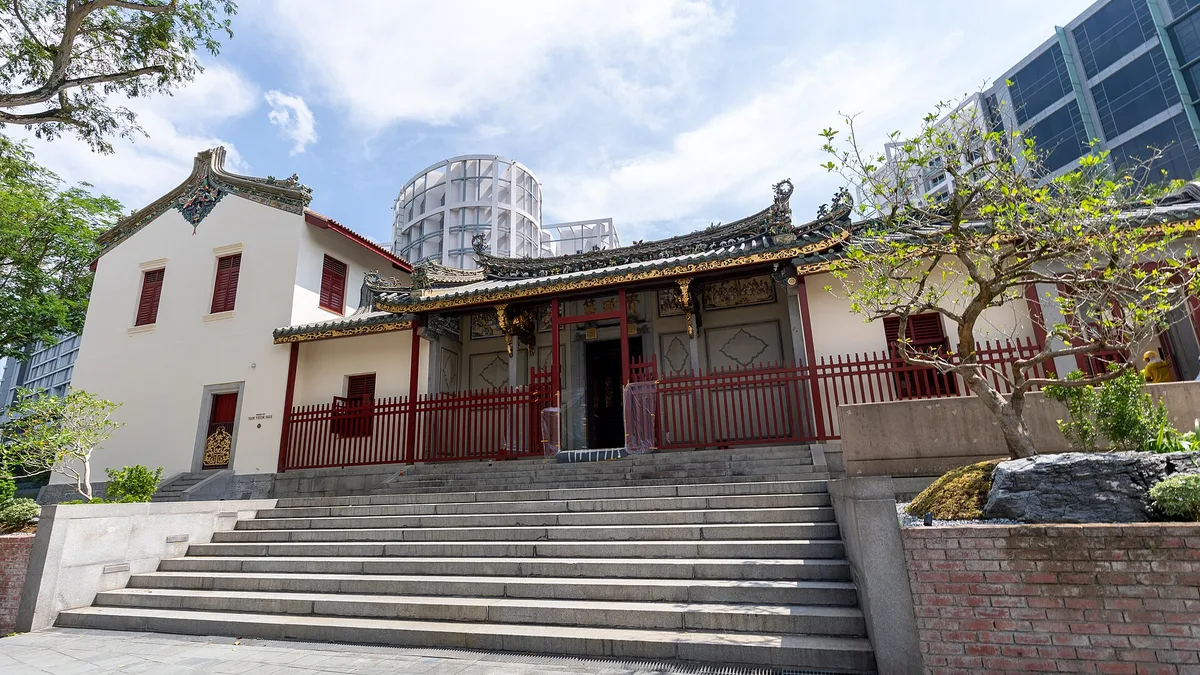
Walk down Penang Road past the glass towers of Orchard’s southern edge and you hit a wall of grey granite that looks lifted from another century, because it was. This is one of the last freestanding Teochew courtyard mansions in Singapore, built in the 1880s for a wealthy trader, and it has spent the last few years being carefully turned into something you can actually walk into with a drink in hand.
What the house was built to be
Tan Yeok Nee made his fortune in the gambier and pepper trade and in Chinese indentured labour, and he built this mansion in the southern Chinese style: swallowtail roof ridges, granite pillars shipped from China, and internal courtyards designed to let light and air move through the building without windows facing the street. It’s a rare surviving example in a city that lost most of its grand merchant houses to redevelopment.
The building has had several lives since: a convent school, a training school, offices for the old railway company. What you see today is a restoration that kept the bones, the granite, the carved timber beams, while fitting modern kitchens and bars into the shell.
Bar Kap and Jing Studio
The mansion’s current chapter splits the building between a handful of separate concepts, most talked about among them Bar Kap and Jing Studio. Bar Kap occupies part of the ground floor and courtyard space with a cocktail-and-small-plates format that plays on the building’s Teochew roots without being a museum piece about it. Jing Studio runs alongside it as a distinct concept in its own section of the house.
Because the operators run independently, hours, menus and booking policies differ between them and can change. Check each concept’s own listings before you go rather than assuming one set of hours covers the whole building.
Finding it on Penang Road
The house sits directly on Penang Road, an easy walk from the Somerset and Dhoby Ghaut MRT stations, both a few minutes on foot depending on which exit you take. It’s tucked among newer commercial buildings, so look for the granite facade set back slightly from the road rather than a shopfront sign at street level.
Arriving on foot from Orchard Road itself takes about ten minutes past Plaza Singapura, making it an easy add-on to an afternoon in that shopping stretch rather than a separate trip.
Reading the building while you’re there
Give yourself time to actually look at the architecture rather than heading straight for a table. The internal courtyards are the clearest clue to how the house originally worked, channelling light and rain into the centre of the building instead of relying on street-facing windows.
- Look up at the roof ridges for the swallowtail curves typical of Teochew great houses
- Check the granite pillars and lintels for carved detail, much of it original
- Notice how the bar and cafe fit-outs sit inside the old room divisions rather than knocking them through
Settling in like a regular
Reservations matter here more than at a typical bar, since seating in a heritage building is limited by the original room sizes rather than by how many tables an operator wants to fit. Booking ahead, especially for weekend evenings, saves you from being turned away at the door.
Payment inside runs on the usual Singapore mix of card and mobile wallet, with cash rarely needed. Dress leans smart-casual rather than beachwear, in keeping with a venue that trades partly on its setting.
Because this is a newly opened, still-settling-in operation inside a heritage-protected building, opening hours and reservation systems are the kind of detail that shifts in the first year. Confirm directly with Bar Kap or Jing Studio’s own channels before turning up, particularly on public holidays when heritage sites sometimes run adjusted hours.
Making it part of a bigger walk
Pair the visit with the rest of the Selegie and Dhoby Ghaut area, which still holds a scatter of pre-war shophouses worth a slow walk. The National Museum of Singapore and Fort Canning Park are both within easy reach on foot, making this a natural midpoint stop between an afternoon of museums and an evening out on Orchard Road.
Frequently asked questions
Where exactly is House of Tan Yeok Nee?
On Penang Road in Singapore, near the Somerset and Dhoby Ghaut MRT stations, a short walk from Orchard Road and Plaza Singapura.
Do I need a reservation for Bar Kap or Jing Studio?
Booking ahead is recommended, since the mansion's original room layout limits seating more than a purpose-built bar would. Check each concept's own booking channel directly.
What is the building itself, historically?
A restored 1880s Teochew courtyard mansion built for merchant Tan Yeok Nee, one of the few surviving freestanding merchant houses of that era in Singapore.
How long should I plan to spend there?
Enough for a slow look at the architecture plus a drink or meal, roughly 1 to 2 hours, more if you're pairing it with a walk around nearby Fort Canning Park or the National Museum.
Are the opening hours listed online reliable?
Because the concepts inside are newly opened and independently run, confirm current hours and any reservation requirements on Bar Kap's or Jing Studio's own listings before visiting.
Plan your trip to Singapore
Singapore eSIM & staying connected →
Some links above are affiliate links — if you book through them, Wander Atlas earns a small commission at no extra cost to you. It's how we keep every guide free.