Tokushima Awa Odori: What to Know (Tokushima)
How this guide is made
Produced with AI assistance and reviewed against live data sources. Facts such as hours, ratings, and location come from Google Places; images are licensed or public domain. Details can change — please verify before visiting. Editorial policy
Why go
Long before you see a single dancer, you hear it: the two-beat thump of the shime-daiko drum, a shamisen line looping over and over, a flute cutting through the noise of a hundred thousand people packed onto a downtown street. Awa Odori is Tokushima’s reason for existing every August, a 400-plus-year-old Obon dance tradition that has grown into the largest dance festival in Japan, pulling in well over a million spectators across its five nights.
There’s no stadium big enough to hold it, so it just happens outdoors, in the streets, block after block, troupe after troupe.
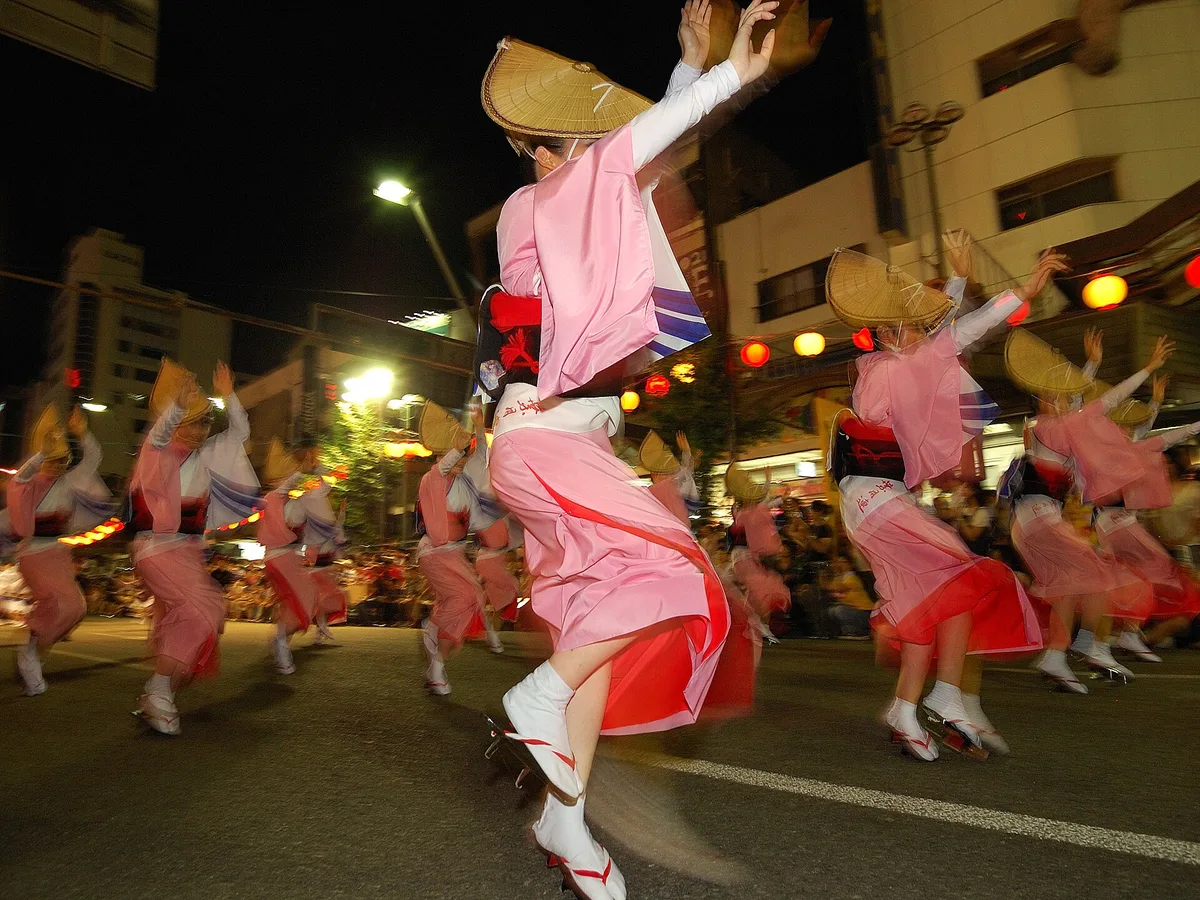
The dance itself is deceptively simple to describe and mesmerizing to actually watch: rows of dancers in shallow zigzag formation, arms raised at identical angles, feet turned out, moving in a loose, rolling shuffle-step down the street. Each “ren” (troupe) has its own costume palette and its own energy, some lines move with tight, formal precision, others break into loud, grinning, almost chaotic bursts of improvisation.
The chant that locals shout back and forth the whole time roughly translates to “the dancing fool and the watching fool are both fools alike, so you might as well dance”, which tells you everything about the spirit of the thing.
Getting there
Tokushima City sits on Shikoku, reachable by direct flight into Tokushima Awaodori Airport (yes, that’s really its name) or by JR train and highway bus from Osaka in around 2.5–3 hours. During the festival, the action is concentrated in the streets immediately around Tokushima Station, the walk from the station to most of the main performance corridors takes ten to fifteen minutes.
A rental car is of little use here. The entire downtown grid closes to traffic for the duration of the event, and parking evaporates.
What to see and do
The festival was set for the five nights of August 11–15, 2026, timed to the Obon period when families traditionally welcome back ancestral spirits, Awa Odori is, at its root, a dance for the dead, even if it now looks and feels like the country’s biggest street party. Performances come in two forms: informal “nagashi” processions that move continuously along certain streets, free to watch from the roadside, and ticketed performances on raised stages and enclosed “performance venues” (engei-jou), where troupes do a tighter, choreographed set.
Areas like Yasaki-machi and Aiba-hama are historically among the main stage zones, though exact venue layouts shift year to year, and the official festival announcement carries the current map.
Many visitors also join in, certain nights and troupes allow spectators to dance along, usually in a designated beginner-friendly ren. Locals and on-the-ground signage point the way; it’s one of the few dance festivals in Japan where tourists are actively invited to move rather than just spectate.
When to go
Dancing was scheduled after dark on all five nights, roughly from early evening once the heat breaks, continuing for several hours. The opening night and the final night have a different character. The first evening is a touch looser and less packed, while the last night builds toward a bigger, more triumphant atmosphere as troupes give their final performances of the year.
For great dancing without shoulder-to-shoulder crowds, the 11th or 12th are typically calmer than the weekend-adjacent nights. Good sightlines along the nagashi routes fill in fast on any of them.
How to visit like a local
Locals treat this less as a spectator sport and more as a five-night communal ritual: they bring a folding stool or a mat, station themselves early along a favorite stretch of nagashi route, and settle in with drinks and snacks bought from streetside stalls rather than fighting for a single perfect vantage point. Cash still rules at most food stalls, and small bills are the useful kind.
In the free roadside sections, the route and the dance lane stay clear, spotters and staff wave people back, and it’s considered bad form to wander into the performers’ space for a photo. The single biggest mistake newcomers make is treating this purely as a photo op from the sidelines; half the fun, and the whole point of the festival’s famous chant, is that everyone is invited to be a little bit foolish and dance along when a troupe waves them in.
Dates, ticketed venue locations, and prices are set and adjusted by the festival organizers each year, and the official Awa Odori Tokushima tourism site is where the schedule, the stage map, and ticket information are published.
Frequently asked questions
What are the exact dates for 2026?
The dates announced were August 11–15, 2026, the five nights of the Obon period.
Do I need a ticket to watch?
The free nagashi processions move along public streets and are open to anyone, while the enclosed stage performances (engei-jou) require tickets, sold through official channels.
How do I get to central Tokushima for the festival?
Tokushima Awaodori Airport takes direct flights, and JR trains and highway buses run from Osaka in about 2.5–3 hours; the festival streets are a 10–15 minute walk from Tokushima Station, and downtown closes to cars during the event.
Which night has the smallest crowds?
Opening night, August 11, and the following evening tend to be less packed than the later nights, which build toward a bigger finale by August 15.
Can tourists join the dancing?
Yes — on select nights certain troupes welcome spectators into a beginner-friendly ren, and on-the-ground announcements and festival staff point out where to join in.
Plan your trip to Tokushima
Some links above are affiliate links — if you book through them, Wander Atlas earns a small commission at no extra cost to you. It's how we keep every guide free.