
A spa town turns to wine
Tskaltubo was built for bathing. In the Soviet decades, people came from across the USSR to soak in its radon-carbonate springs. Grand colonnaded sanatoriums went up around a central park, and many of them now stand empty, with trees growing through their halls.
On Saturday, December 5, 2026, the town hosts the Amerimeri Natural Wine Festival, a gathering devoted to Georgian natural wine. The name echoes Amer-Imeri, the old Georgian term for the lands on either side of the Likhi Range, meaning east and west Georgia together.
What fills the glass
Georgian natural wine is fermented with wild yeasts and very little added sulphur, often in a qvevri. That is a beeswax-lined clay vessel buried up to its neck in the ground. UNESCO added the qvevri method to its intangible heritage list in 2013. Here in Imereti, the western region around Kutaisi, many families call the vessel a churi.
Imeretian whites usually spend less time on their skins than the deep amber wines of Kakheti in the east. They tend to come out lighter, fresher and more citrusy. Grape names you are likely to see on labels across the region:
- Tsolikouri: the workhorse white of western Georgia
- Tsitska: a tense, high-acid white, also used for sparkling wine
- Krakhuna: a rounder white with more body
- Otskhanuri Sapere: a dark, tannic red native to Imereti
December is a young-wine month. The autumn harvest, rtveli, finished only weeks earlier, so the newest vintage is often barely out of the clay.
Date, venue and tickets
The festival is held in Tskaltubo on December 5, 2026. The organiser publishes the specific venue, opening times and ticket links on its official site and social channels. This guide gives no lineup of producers or prices, because none were supplied to us.
Tskaltubo is small. Its central park and the main avenue of sanatoriums and newer hotels are compact enough to cross on foot, so wherever the event sits in town, it is never far from the rest.
Reaching Tskaltubo from Kutaisi
Kutaisi is the gateway. Kutaisi International Airport, a hub for budget flights from Europe, lies a short drive from Tskaltubo. Trains and minibuses link Kutaisi with Tbilisi, a journey of several hours either way.
From central Kutaisi, marshrutka minibuses run to Tskaltubo, and taxis cover the trip in well under half an hour. Most festival-goers stay in Kutaisi’s guesthouses and walk its old centre in the evening. Others book into one of Tskaltubo’s restored spa hotels and turn the weekend into a bathing trip.
Manners at the tasting table
Georgian wine culture runs on hospitality, and a tasting follows the same instincts. A few habits that help:
- Let the winemaker pour. Hold your glass out and wait; at small producers’ tables, the person pouring is usually the person who made it.
- Ask about the village. Producers love being asked where the vines grow and how long the wine sat on its skins.
- Spitting is fine. Dump buckets are a normal part of serious tastings, and nobody minds you using one.
- Learn one toast. Gaumarjos (“to victory”) is the standard cheers. At a sit-down meal, the tamada, or toastmaster, leads the toasts, and guests wait for him before drinking.
- Carry lari. Small family makers who sell bottles on the spot often prefer cash in Georgian lari over cards.
Most visitors leave the car behind and use taxis between Kutaisi and Tskaltubo. A day of qvevri wine adds up faster than the small pours suggest.
Caves, baths and monasteries nearby
Winter suits the area’s underground sights. A few worth combining with the festival:
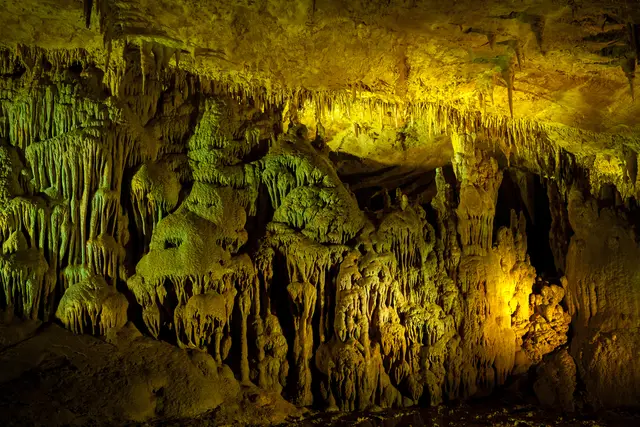
- Prometheus Cave: a large show cave just outside Tskaltubo, with lit chambers of stalactites
- Sataplia Nature Reserve: dinosaur footprints preserved under a protective hall, plus a karst cave, on the hills above Kutaisi
- Tskaltubo’s bathhouses: Bath No. 6, linked by legend to Stalin, is the most famous of the Soviet-era baths
- Gelati Monastery: a 12th-century UNESCO-listed monastery founded by King David the Builder, with gold-ground frescoes
- Bagrati Cathedral: the 11th-century cathedral on its hill above Kutaisi
Opening times for the caves and monasteries shift through the year, and each site’s official page carries the current hours. Kutaisi’s covered Green Bazaar is the place for churchkhela, Imeretian cheese and the round, cheese-filled Imeretian khachapuri.
Frequently asked questions
When is the Amerimeri Natural Wine Festival?
It takes place on Saturday, December 5, 2026, in Tskaltubo, near Kutaisi in western Georgia.
Where exactly is it held, and how do tickets work?
The festival is in the spa town of Tskaltubo. The organiser publishes the specific venue, times and ticket links on its official site and social channels.
How do I get to Tskaltubo?
Fly into Kutaisi International Airport or take a train or minibus from Tbilisi to Kutaisi. From central Kutaisi, marshrutka minibuses and taxis reach Tskaltubo in well under half an hour.
What kind of wine will I taste?
Georgian natural wine, much of it made in clay qvevri (called churi in Imereti). Expect local grapes such as Tsolikouri, Tsitska, Krakhuna and the red Otskhanuri Sapere, often from the autumn's fresh vintage.
What else is there to do nearby?
Prometheus Cave sits just outside Tskaltubo, and the town has its Soviet-era thermal baths. In and around Kutaisi you'll find Sataplia's dinosaur footprints, Gelati Monastery, Bagrati Cathedral and the Green Bazaar.
Plan your trip to Tskaltubo
Georgia eSIM & staying connected →
Some links above are affiliate links — if you book through them, Wander Atlas earns a small commission at no extra cost to you. It's how we keep every guide free.
Related guides
 trendy
Magnolia: Tskaltubo Travel Guide (4.3★)
 attraction
Prometheus Cave Natural Monument: Tskaltubo Travel Guide
 attraction
Sanatorium Imereti: Tskaltubo Travel Guide (4.4★)
 hidden gem