
Columns. That’s what Tskaltubo built its reputation on, along with mineral water and the promise of a cure. Sanatorium Imereti is one of the grand Soviet health palaces from the decades when trade unions sent workers here to soak in the town’s radon-carbonate springs.
Today it sits off Sulkhan-Saba Street, half reclaimed by trees. It’s a quieter find than the famous lists suggest: well rated by the people who make it here, and nowhere near as busy as the big sights around Kutaisi.
A spa town that outlived its empire
Tskaltubo was a Soviet spa town. Its springs come out of the ground at roughly body temperature, and the water was prescribed for joints, nerves and the heart. Stalin had his own bath here, and the town filled with sanatoriums built to look like classical palaces.
When the Soviet Union fell, the visitors stopped coming. After the war in Abkhazia in the early 1990s, many of the empty sanatoriums became shelter for displaced families, and some buildings in town are still lived in. Others, like Imereti, are left to the weather and to photographers.
What you walk into
Expect a big masonry shell with its Soviet-era grandeur still readable under the decay. The usual sights inside Tskaltubo’s ruined sanatoriums look like this:
- Long corridors of empty treatment rooms and guest rooms
- Stairwells with broken or missing railings
- Peeling plaster and moss on inner walls, with saplings pushing up through the floors
- Window frames with no glass, looking out onto overgrown grounds
The pleasure is in the scale. These buildings were designed to make a factory worker feel like a guest of the state. Their bones still do that, even with ferns growing out of the cornices.
Exploring the ruin without getting hurt
Nobody runs this building as an attraction. There’s no ticket desk, no signage and no one to call if a floor gives way. Treat it as a structure that is actively falling apart, because it is.
- Wear boots or solid trainers. Expect rubble, glass and rotten floorboards.
- Stay off upper floors and balconies if they look soft, sag, or have no railing.
- Bring a torch. Interior rooms and stairwells get dark even at midday.
- Go in daylight, ideally with a friend. Mobile signal can be patchy inside thick walls.
- Respect anyone living nearby. If a wing or a neighbouring building has laundry, curtains or doors that lock, it’s somebody’s home. Don’t enter it or photograph it.
Drones and tripods draw attention. If someone on site asks you to leave or not to film, do as they ask. Take your rubbish out with you; these grounds don’t have bins.

Getting to Sulkhan-Saba Street
Kutaisi is the gateway. David the Builder Kutaisi International Airport is the nearest airport. Kutaisi’s centre is about 10 km from Tskaltubo, and the drive takes around 20 minutes. Marshrutkas (minibuses) run between the two towns, and Bolt and local taxis cover the same route.
In Tskaltubo, the sanatoriums are spread around the central Spa Park, so you can walk from one to the next. Search the plus code 8JG5+9X4 in your maps app to find Imereti’s exact spot on Sulkhan-Saba Street. Street signs are mostly in Georgian script, so the pin will help you more than the signs.
Building a Tskaltubo day around it
Imereti works best as one stop on a loop. Sixty to ninety minutes inside is plenty for most people. Good additions nearby:
- Spa Park, the leafy centre of town, with other sanatorium shells around its edges
- Bathhouse No. 6, the bath associated with Stalin, a short walk from the park
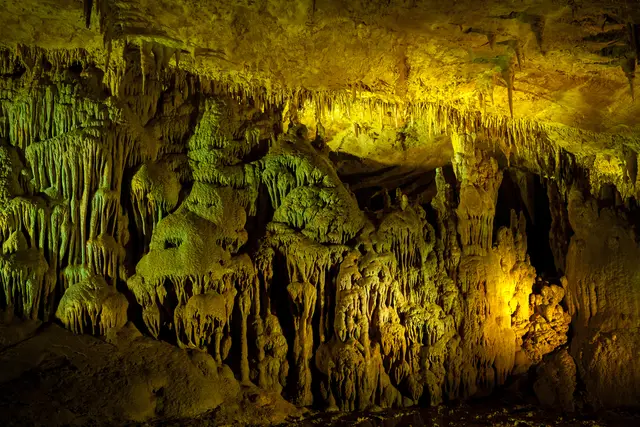
- Prometheus Cave, a few kilometres north, with lit chambers of stalactites and an underground river
- Sataplia Nature Reserve, known for its dinosaur footprints and a glass viewing platform
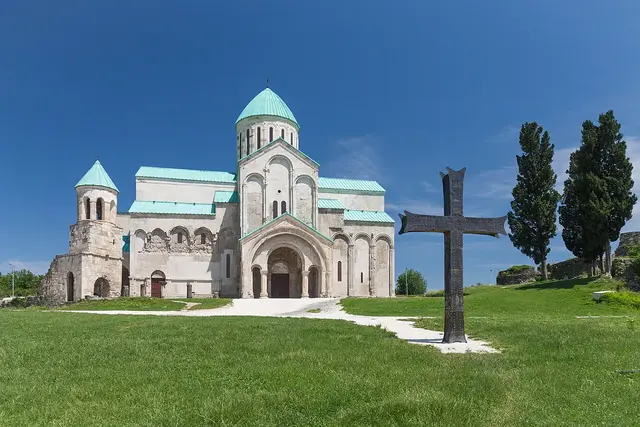
- Kutaisi’s Bagrati Cathedral and Gelati Monastery for the afternoon or the next day
Spring and autumn are the most comfortable seasons for clambering around. Imereti’s summers are hot and humid, and the undergrowth around the ruins gets thick by July. In winter the bare trees open up views of the façades, but stairwells can be slick.
The camera, the light and the etiquette of ruins
Photographers are the main visitors here. Morning light tends to be softer on the façades, while interiors suit overcast days, when shadows are less harsh. Bring a wide lens; the rooms are tall and the corridors long.
The unwritten rule in Tskaltubo is simple: leave it as you found it. Don’t take tiles, signs or fittings as souvenirs. Don’t add graffiti, and don’t move things around to stage a shot. Georgians in town are usually used to curious visitors. A “gamarjoba” (hello) to anyone you pass goes a long way.
If you’d like the water and not just the ruins, some of Tskaltubo’s bathhouses still offer mineral-spring treatments. Check what’s operating before you go, as availability changes.
Frequently asked questions
How do I get to Sanatorium Imereti from Kutaisi?
Tskaltubo is about 10 km from central Kutaisi, roughly a 20-minute drive. Take a marshrutka (minibus), a local taxi or Bolt, then use the plus code 8JG5+9X4 on Sulkhan-Saba Street to find the building.
Is it safe to go inside?
It's an unmanaged, decaying building with no supervision. Wear solid shoes, carry a torch, avoid upper floors and balconies with rotten flooring or missing railings, and go in daylight, ideally with someone else.
How long should I spend there?
Most visitors need 60–90 minutes for Imereti itself. Add the Spa Park, Bathhouse No. 6 and other sanatorium shells around town and you have a comfortable half day.
Do people still live in Tskaltubo's old sanatoriums?
Some buildings in town still house families displaced by the war in Abkhazia in the early 1990s. If a building or wing shows signs of being lived in, treat it as a private home: don't enter it or photograph it.
What else is nearby?
Prometheus Cave and Sataplia Nature Reserve are both a short drive from Tskaltubo. Kutaisi's Bagrati Cathedral and Gelati Monastery are easy to reach from there for the rest of the day.
Plan your trip to Tskaltubo
Georgia eSIM & staying connected →
Some links above are affiliate links — if you book through them, Wander Atlas earns a small commission at no extra cost to you. It's how we keep every guide free.
Related guides
 attraction
Prometheus Cave Natural Monument: Tskaltubo Travel Guide
 trendy
Magnolia: Tskaltubo Travel Guide (4.3★)
 hidden gem
Sanatorium Metallurgist: Tskaltubo Travel Guide (4.5★)
 attraction