Under Kumistavi
Ten minutes earlier you were in orchard country. Now the air is cool and damp, and stone hangs over your head.
The ground above you is the farmland of Kumistavi, a village in the Imereti lowlands near Tskaltubo. Below it, water has spent millions of years cutting into limestone. What it left behind is a run of chambers joined by tunnels.
Speleologists found the cave in 1984, and it opened to visitors in 2012. Only some of its halls are on the tour route. The rest are left to researchers and the dark.
What the walk is like
You follow a paved path with handrails. It is lit the whole way, with steps that go up and down.
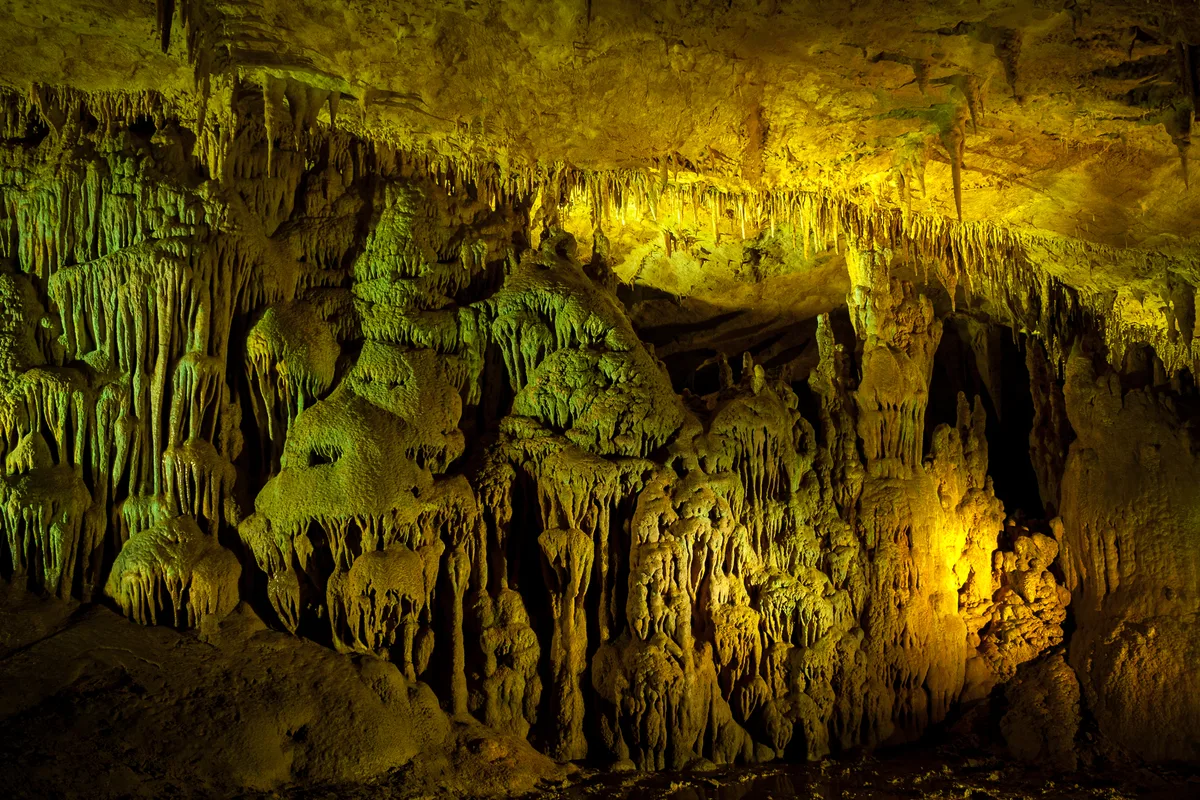
The lighting is the part people remember. LEDs in shifting colours pick out curtains of flowstone and stalactites as thin as straws. They also light thick stalagmites that have been growing up from the floor for longer than anyone can measure.
Some halls are tall enough that the ceiling disappears beyond the lights. Others close in around you, and the path narrows between wet walls. The temperature stays cool all year, around 14°C, and the air is humid enough that the stone shines.
Plan on about an hour underground. The route is more than a kilometre long. It is easy for most people, but there are plenty of stairs. Some sections are slick, and children and older visitors take them slowly.
Why it carries Prometheus’s name
The name comes from Georgian myth, not geology.
Greek tradition put the chained Titan Prometheus somewhere in the Caucasus. Georgia tells the story through its own hero, Amirani, who was bound to a mountain for defying the gods. When the cave was opened to the public, it was named after that legend. People locally still call it after the village, Kumistavi.
It helps to know this before you go in. Guides often bring up the legend in the first big hall, and the story makes more sense if you’ve heard it before.
The underground river
The water that made the cave is still flowing through part of it. At the end of the walking route, an underground river leaves the cave system, and an optional boat ride follows part of its course out.
Whether the boats run depends on the water level and the time of year. It is sold separately from the walking tour. Ask at the ticket desk when you arrive rather than counting on it. If it’s running, it is a quieter, slower way out than the walking exit.

Getting there from Kutaisi and Tskaltubo
The cave sits just outside Tskaltubo, the old Soviet spa town whose big sanatoriums now stand mostly empty around its central park. Kutaisi is the nearest city and has the closest airport, Kutaisi International.
- Taxi or Bolt from Kutaisi: the simplest choice, at roughly half an hour each way. Agree before you go in whether the driver will wait.
- Marshrutka: minibuses run from Kutaisi to Tskaltubo, and from there a short taxi gets you to the cave. Some services run closer, so ask at the Kutaisi bus station.
- Self-drive: there is parking by the visitor centre, and the roads in are signposted from Tskaltubo.
The tour finishes some way from where it started, so expect a short transfer or walk back to the entrance.
Getting in ahead of the coach groups
This is one of the most visited natural sites in western Georgia. You’ll be sharing it.
- Arrive at opening. Day tours from Kutaisi and further away usually come mid-morning or later. At the moment the first tours go from 10am, and being at the desk then is the best way to get a smaller group.
- Buy tickets at the visitor centre. You can’t walk in on your own, and tickets are sold for timed group tours. Current prices are posted at the ticket desk and on the official Agency of Protected Areas website.
- Ask for your language. Tours run in Georgian, English and Russian. If you want English, say so when you buy, as you may wait a little for the next English group.
- Don’t touch the formations. Oil from skin stops them growing, and guides will tell you if you reach out. Stay on the path.
- Take photos, without flash. Phones do fine with the LED colours. Flash flattens the scene and slows the group behind you.
- Bring a layer and grippy shoes. It’s cool and damp underground even in July, when Imereti outside can be very hot.
- Carry some lari. Use it for taxis, marshrutkas and the roadside stalls. Arrange your ride back before you go down.
The current hours are 10am–5pm, but as with most protected areas in Georgia they shift through the year. Check the official site before you plan around a late afternoon visit.
Pairing it with Sataplia and Kutaisi
The cave fills half a day, and the area makes it easy to add more.
Sataplia Nature Reserve is close by, on a hill above Kutaisi. It has preserved dinosaur footprints under a protective building, a smaller cave of its own, and a glass viewing platform over the forest. Many people visit both on the same day.
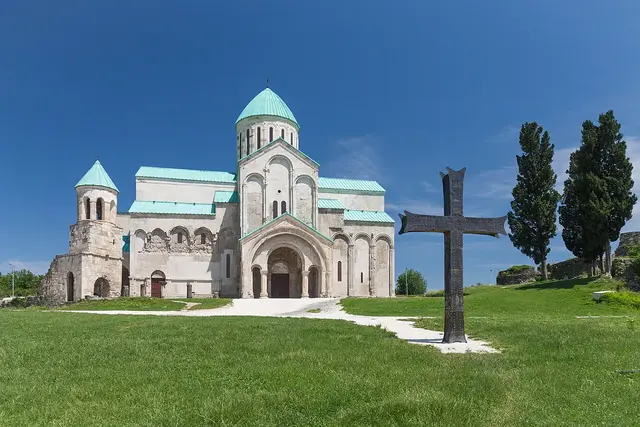
In Kutaisi itself, Bagrati Cathedral stands over the Rioni River. Gelati Monastery, a UNESCO site known for its medieval mosaics, is a short drive east.
If you have a full day and a driver, Martvili Canyon and Okatse Canyon are further north in Samegrelo and Imereti. They’re often combined with Prometheus on organised tours from Kutaisi.
Back in Tskaltubo, a walk through the spa park and past the crumbling sanatoriums is an unusual way to end the day after the colours underground.
Frequently asked questions
How do I get to Prometheus Cave from Kutaisi?
A taxi or Bolt from Kutaisi takes about half an hour. If you're on a budget, take a marshrutka from Kutaisi to Tskaltubo, then a short taxi to the cave near Kumistavi village. Some minibuses run closer, so ask at the Kutaisi bus station.
How long does the Prometheus Cave tour take?
Plan on about an hour underground. The guided walk covers more than a kilometre of lit paths and stairs. Add time for buying tickets, the transfer back to the entrance, and the boat ride if it's running.
What are the opening hours?
At the moment the cave is open 10am–5pm. Protected areas in Georgia change their hours with the season, so check the official Agency of Protected Areas website before you go. Arriving at opening is the best way to get ahead of the tour groups.
Is there a boat ride inside the cave?
There's an optional boat ride on the underground river at the end of the route. It depends on water levels and the season, and it's sold separately, so ask at the ticket desk when you arrive.
What should I wear?
Bring a light jacket, because the cave stays at around 14°C all year. Wear shoes with good grip, since the paths and stairs can be wet. You'll want the extra layer most in summer, when it's hot outside.
Plan your trip to Tskaltubo
Georgia eSIM & staying connected →
Some links above are affiliate links — if you book through them, Wander Atlas earns a small commission at no extra cost to you. It's how we keep every guide free.
Related guides
 hidden gem
Sanatorium Metallurgist: Tskaltubo Travel Guide (4.5★)
 attraction
Bagrati Cathedral: Kutaisi Travel Guide (4.7★)
 attraction
Colchis Fountain: Kutaisi Travel Guide (4.7★)
 attraction