A palace built for steelworkers
Columns come first. A row of pale pillars holds up a facade that looks like it was built for a ministry. In fact it was built for Soviet metallurgy workers, sent here to soak in Tskaltubo’s mineral water as a reward for time spent at the furnaces.
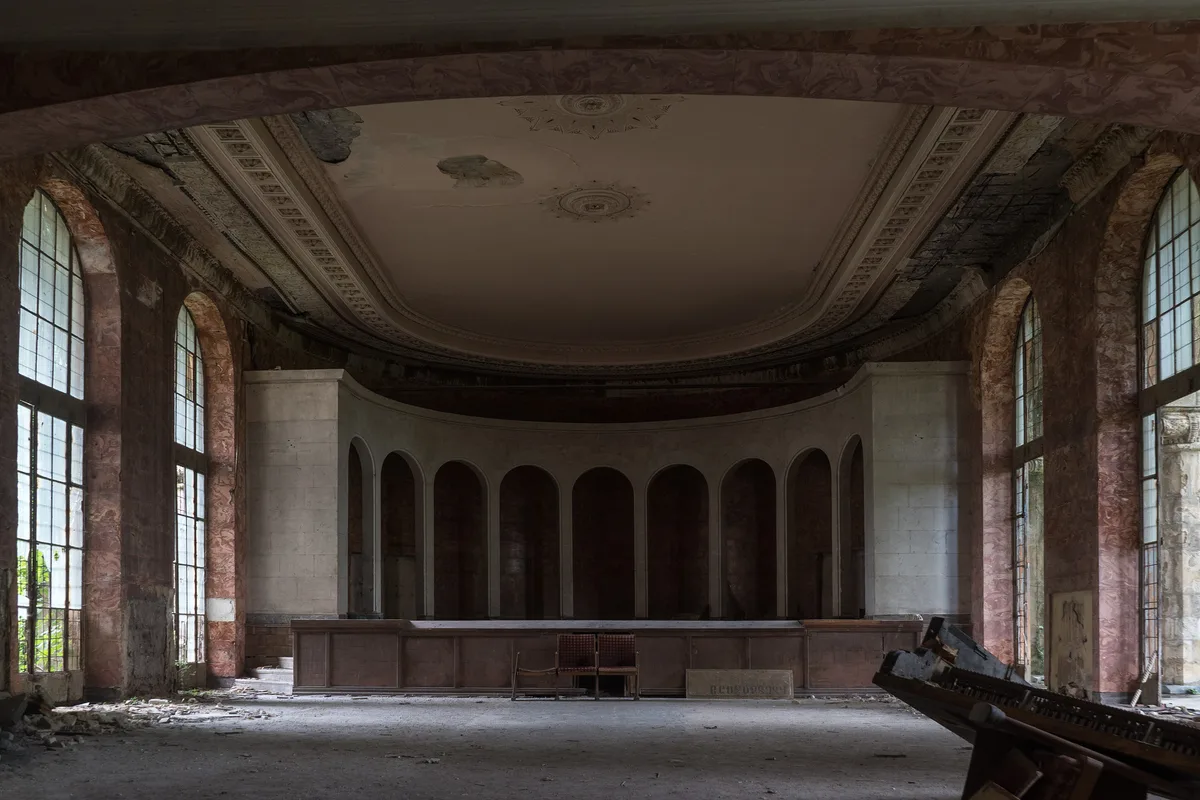
Today the stucco is flaking and trees are pushing up through the terraces. The building still keeps its proportions, though, and that is the reason to come. Grand staircases, tall window bays and moulded ceilings survive under the damp. Stand in the forecourt and you see the Stalinist neoclassical style at full scale, the kind usually kept for capitals.
Why Tskaltubo has so many empty palaces
The town grew around its warm, mildly radioactive radon-carbonate springs. In the Soviet decades it became one of the union’s best-known spa resorts, with direct trains from Moscow and sanatoria owned by ministries and industries. Metallurgist was one of them.
After the Soviet collapse the guests stopped coming. In the early 1990s many sanatoria were used to house people displaced from Abkhazia, and some families stayed for decades. That history is why a few buildings in town are still partly lived in. Others, Metallurgist among them, were left to the weather.
It all makes Tskaltubo one of the strangest small towns in the Caucasus. The resort park is still kept up, and you can still take the waters. A few streets away, whole palaces stand open to the sky.
Inside the Metallurgist
Metallurgist rewards slow walking more than ticking off rooms. Expect:
- The colonnade and front steps. Shoot these from across the forecourt; up close you lose the scale.
- Stairwells and corridors. Light from the broken windows falls across the long halls, and the plaster detail is clearest here.
- The main halls. Look up. The ceilings carry most of the surviving decoration, with mould and moss slowly spreading over it.
- The grounds. Overgrown paths and old terraces circle the building. Ivy and young trees have taken over much of the stonework.
Nothing is labelled, roped off or explained. That is the appeal, and also the risk. You are in a decaying structure with no maintenance, so treat every floor as untested.

Walking a ruin without getting hurt
Metallurgist is not a managed attraction. There is no ticket office, no set opening hours and no promise you will get in. Status can change from one season to the next as sites are sold or fenced, so ask in Kutaisi or at your guesthouse before you set off.
If you do get in, a few habits matter:
- Wear boots with real soles. You will meet broken glass, loose tiles and rusted rebar.
- Test before you step. Keep to floors that are visibly solid, and skip upper levels where the ceiling below has given way.
- Bring a torch. Interior rooms get dark quickly, even at midday.
- Come in daylight, with someone. Phone signal can be patchy inside thick walls.
At some abandoned sites around town a caretaker or resident may be on the grounds. Ask before you walk in, accept a “no”, and keep your camera off anyone’s laundry or windows. If a watchman lets you through and you want to thank him, small cash in lari is the usual courtesy. How much is up to you.
Getting to Tskaltubo
Tskaltubo sits roughly 10 kilometres northwest of Kutaisi, Georgia’s third city. Kutaisi International Airport is also close, which makes this a realistic first or last stop in the country.
Marshrutkas (shared minibuses) run between Kutaisi and Tskaltubo through the day. The destination is posted in Georgian script on the windscreen, so learn the shape of წყალტუბო, or simply ask the driver. A taxi or Bolt from Kutaisi is quick and makes it easy to link several sanatoria in one loop.
The address is the plus code 8HGV+4FF. Pasting it straight into a maps app is the most reliable way to find the gate, since “Metallurg” spellings vary.
Making a day of the spa town
One building rarely satisfies anyone who makes the trip. Combine Metallurgist with:
- Tskaltubo Spa Resort Park. The central park holds the town’s bathhouses and is the obvious place to start walking.
- Bathhouse No. 6. Popularly linked to Stalin, it is one of the most photographed interiors in town.
- Other sanatoria. Several more Soviet-era hulks are within walking or short taxi distance. Each one has a different style of ruin.
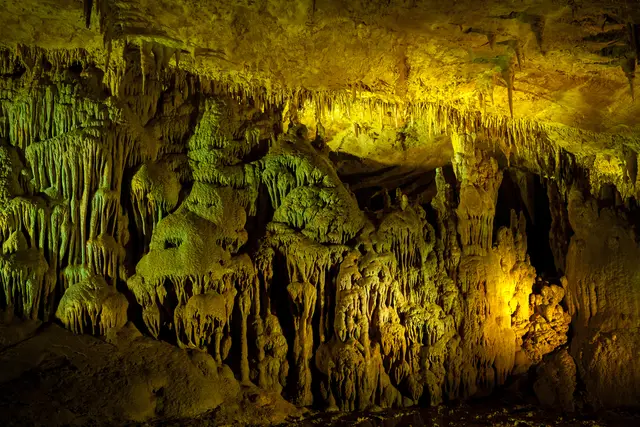
- Prometheus Cave. A big lit show cave just outside town, and an easy pairing for half a day.
- Sataplia Nature Reserve. Dinosaur footprints and a cave and forest walk on the road back towards Kutaisi.
If you want to take the water yourself, the working spa facilities in town offer radon baths. Check current treatments and prices directly with them.
When the light is right
Late spring and early autumn are the easy seasons. Western Georgia’s summers are humid, and in high summer the overgrowth around the building is at its thickest. Winter strips the trees and shows off more of the facade, but the interiors are cold and wet.
Inside, mid-morning to mid-afternoon gives the most usable light through the window bays. Afterwards, walk back through the resort park in the evening and finish with dinner in Kutaisi. You will be in town in well under half an hour.
Frequently asked questions
How do I get from Kutaisi to Sanatorium Metallurgist?
Take a marshrutka (shared minibus) from Kutaisi to Tskaltubo, about 20 minutes, or use a taxi or Bolt. Put the plus code 8HGV+4FF into your maps app to find the building.
Can you go inside Sanatorium Metallurgist?
Often, but not reliably. It is an abandoned building with no official opening hours, and Tskaltubo's sanatoria are gradually being sold and fenced. Check locally before you go, and go only where floors look solid.
How long should I spend there?
An hour or two covers the facade, the main halls and the grounds. A half or full day lets you add the spa park, Bathhouse No. 6, other sanatoria and Prometheus Cave.
Is it safe to explore?
Treat it as a ruin. Wear sturdy boots, bring a torch, go in daylight with a companion, stay off damaged upper floors, and respect anyone living or keeping watch on site.
What else is near Sanatorium Metallurgist?
Tskaltubo Spa Resort Park and Bathhouse No. 6 are in town. Prometheus Cave is just outside, and Sataplia Nature Reserve is on the way back to Kutaisi.
Plan your trip to Tskaltubo
Georgia eSIM & staying connected →
Some links above are affiliate links — if you book through them, Wander Atlas earns a small commission at no extra cost to you. It's how we keep every guide free.