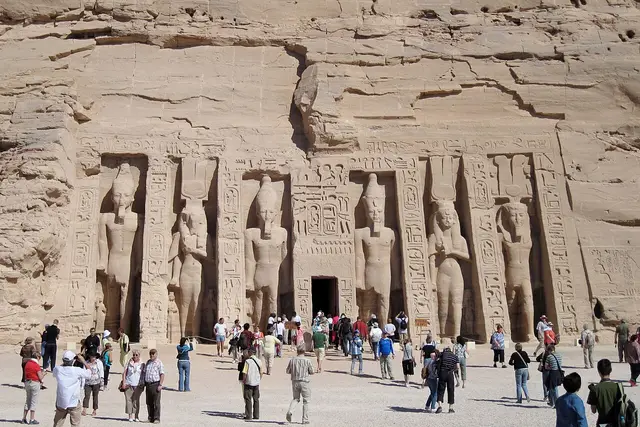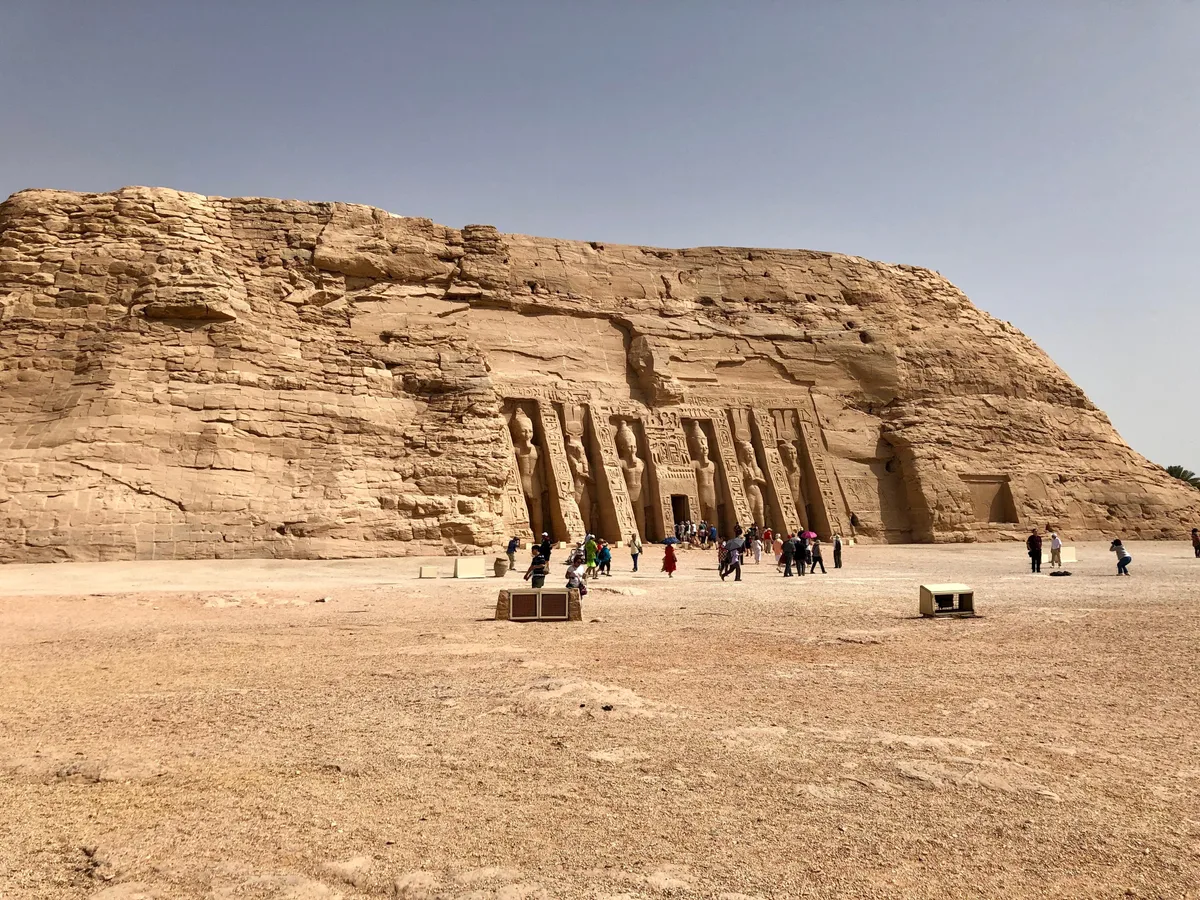
Six stone figures step out of the cliff toward the water. Four are Ramesses II and two are his queen, Nefertari, and all six stand at the same height, about ten metres. In Egyptian royal sculpture a queen is usually carved knee-high beside her husband. Here she is his equal in scale. That single choice is the reason to walk the extra hundred metres past the Great Temple.
A queen carved at the king’s height
The Temple of Nefertari, often called the Small Temple, was built in the 13th century BC. Ramesses II dedicated it to Nefertari and to the goddess Hathor. An inscription on the facade calls it a temple made for the Great Royal Wife Nefertari, “for whose sake the very sun does shine.”
Look down at the colossi’s legs. Smaller figures of the royal princes and princesses stand there, carved straight out of the same sandstone. The facade is cut at a slant, so the statues seem to lean out of the hillside instead of sitting against it. Buttresses carrying lines of hieroglyphs separate each figure from the next.
Inside the hall of Hathor
The interior is compact, and you can take in the whole layout from the doorway. A pillared hall comes first. Its six square pillars are topped with the face of Hathor, with her cow ears and the sistrum-style capital linked to her music and worship.
The walls are the highlight. Nefertari is shown in a fine pleated gown, offering to the gods. In one well-known scene Hathor and Isis crown her. Past the hall, a narrow vestibule leads to the sanctuary, where Hathor appears as a cow emerging from the rock. The colours are faded but still readable: ochre, black, and touches of blue.
Moved, block by block
The cliff you are looking at is not the original one. When the Aswan High Dam was built, the rising waters of Lake Nasser would have drowned both temples. Between 1964 and 1968 an international campaign led by UNESCO sawed them into huge blocks. The blocks were rebuilt about 65 metres higher and roughly 200 metres back from the river.
Behind the facades sits a man-made hill around a concrete dome. Check the joints in the stone and you can sometimes spot the cuts. Abu Simbel is part of the “Nubian Monuments from Abu Simbel to Philae” World Heritage Site.

Getting to the southern edge of Egypt
Abu Simbel sits about 280 km south of Aswan, close to the Sudanese border. You have two realistic ways to get there:
- By road from Aswan: the drive takes around three and a half hours each way through open desert. Most day tours leave Aswan before dawn.
- By air: short flights run from Aswan to Abu Simbel’s small airport, and a transfer takes you to the temples.
- Overnight: Abu Simbel town has a handful of hotels. Staying lets you see the site at a quieter hour than the day-trip crowd.
From the entrance a paved path leads along the lakeshore. The Great Temple comes first and Nefertari’s temple stands just beyond it to the north.
Timing the Small Temple right
Most visitors are hurried, and that works in your favour. The tour groups arriving from Aswan usually head straight for the Great Temple and spend most of their limited time there. Reverse the order. Walk to Nefertari’s temple first, and you will often have the hall nearly to yourself for a few minutes.
- Hours: Google currently shows 6:30am–4pm every day. Hours at Egyptian monuments shift with the season and around holidays, so check the official site before you go.
- Tickets: one site ticket covers both temples. Current prices are posted at the ticket office and on the official site. Rules for photography inside the temples have changed before, so ask at the gate.
- Heat: there is almost no shade along the shore path. Bring water and a hat, and visit early whenever you can.
- Sun Festival: on 22 February and 22 October the sunrise lights the inner sanctuary of the Great Temple, not this one. Those mornings are the busiest of the year.
Respecting a 3,000-year-old room
Inside, guards keep visitors moving and watch for anyone touching the walls. Keep your hands and bags away from the reliefs, because skin oils damage the paint. Flash photography is not allowed.
Local guards may offer to point out details or open a view in exchange for a tip. That is common practice, and small cash in Egyptian pounds is the normal way to tip. If you don’t want the help, a polite “la, shukran” (no, thank you) is enough.
Give the doorway a final minute on your way out. From inside the hall you look straight across the lake toward Nubia, the same direction the statues face.
Frequently asked questions
How do I get to the Temple of Nefertari from Aswan?
Either drive about 280 km south through the desert, which takes around three and a half hours each way, or take a short flight from Aswan to Abu Simbel airport and then a transfer. Most day tours leave Aswan before dawn.
Is the Temple of Nefertari included with the Abu Simbel ticket?
Yes. One site ticket covers both the Great Temple of Ramesses II and the Temple of Nefertari. Current prices are posted at the ticket office and on the official site.
How long should I spend at the Temple of Nefertari?
The temple is small, so 30–45 minutes is enough to study the facade, the Hathor pillars and the reliefs. Plan two to three hours for the whole Abu Simbel site.
What are the opening hours?
Google currently lists 6:30am–4pm every day. Hours at Egyptian monuments change with the season and around holidays, so check the official site before you travel.
Does the Sun Festival happen at Nefertari's temple?
No. On 22 February and 22 October the sunrise lights the sanctuary of the Great Temple next door. Expect much bigger crowds across the whole site on those days.
Plan your trip to Abu Simbel
Egypt eSIM & staying connected →
Some links above are affiliate links — if you book through them, Wander Atlas earns a small commission at no extra cost to you. It's how we keep every guide free.