White stone, three volcanoes
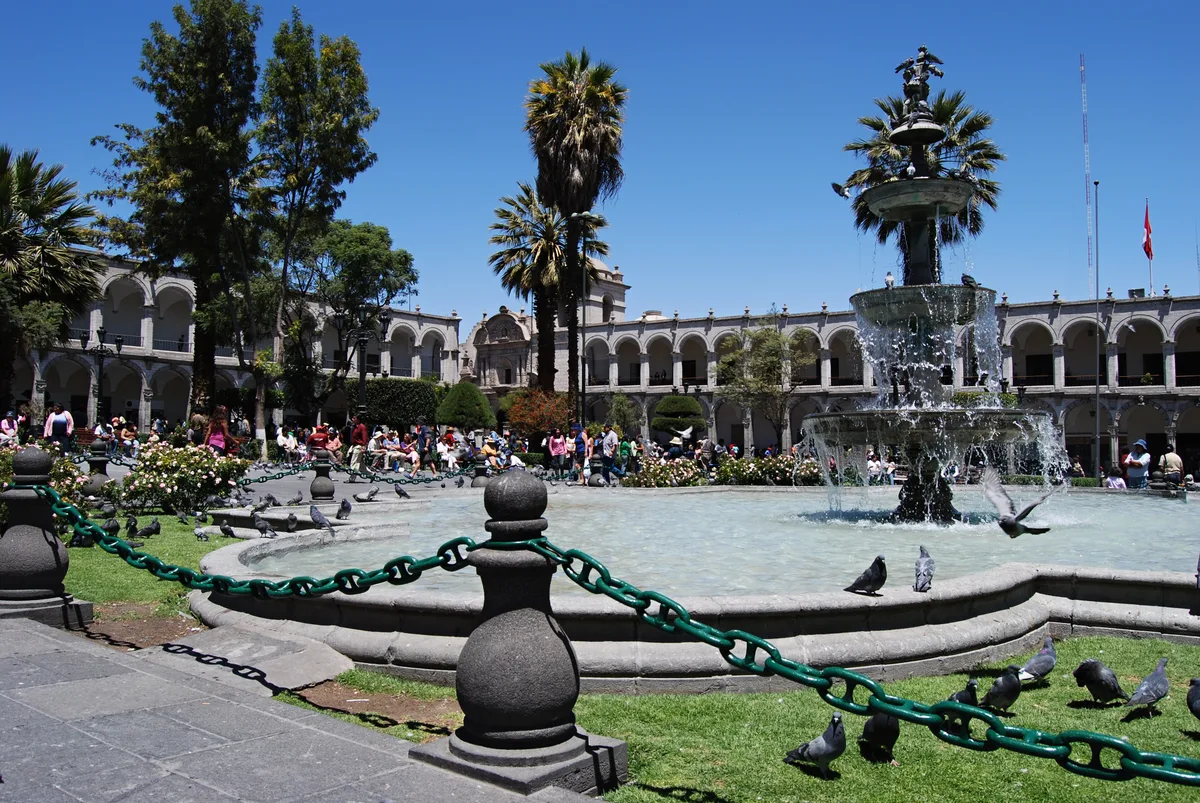
Everything here is built from sillar. That is the pale volcanic tuff that gives Arequipa its nickname, La Ciudad Blanca, and in strong highland sun the whole square glows off-white. Palms and lawns fill the middle, cut by paths that meet at a bronze fountain.
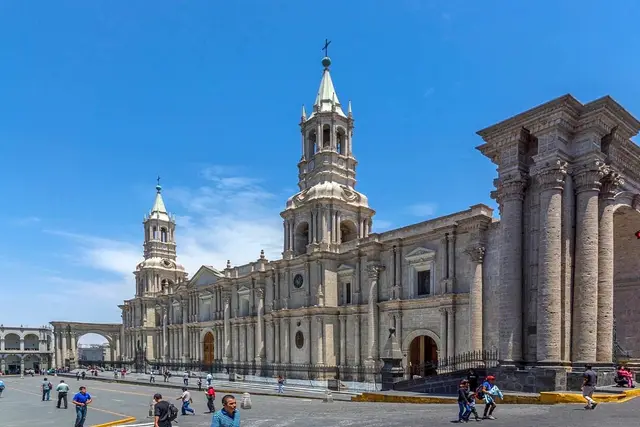
Look past the cathedral roofline and you see where the stone came from. El Misti’s cone rises behind the towers, with Chachani to one side and Pichu Pichu to the other. The square dates to the city’s founding in 1540. It sits at the centre of the historic district UNESCO listed as a World Heritage Site in 2000.
The fountain’s top figure is a small trumpeting soldier. Locals call him the Tuturutu. Pigeons gather around the basin, and the benches nearby are where people actually sit.
A cathedral as wide as the square
The Basilica Cathedral of Arequipa takes up the entire north side of the plaza. Few Peruvian cathedrals do that. Its neoclassical facade is a long run of sillar columns between two bell towers, and fire and earthquakes forced repeated rebuilding. The 2001 earthquake brought down one of the towers, and it has since been restored.
Inside, two things deserve most of your attention:
- The organ: a large Belgian-built instrument, often cited as one of the biggest in South America.
- The pulpit: carved wood with the devil writhing at its base, crushed beneath the preacher.
The cathedral runs guided visits and has a small museum. Its visiting hours are separate from mass times, and both change, so check the cathedral’s own notices before planning around them.
Under the portales
The other three sides are lined with two-storey arcades called portales. The ground floor is a shaded colonnade of shops, travel agencies and restaurant entrances. Upstairs, cafés and restaurants open onto long balconies facing the cathedral.
Those balconies are the reason to sit down here. Order a coffee upstairs and you get the whole composition at once: towers, palms, fountain and, on a clear day, the volcano. The arcade on the west side holds the municipal building. Expect restaurant staff under the arches to hand you menus as you pass.

When El Misti shows up
Timing matters more here than at most city squares, because the best view depends on the sky. Mornings in Arequipa are usually the clearest, with Misti sharp behind the cathedral. As the day goes on, cloud can build over the peaks, especially in the wetter months from roughly January to March.
For reliable volcano views, come between May and October, the dry season. Shoot from the south side of the square with your back to the arcades. That frames both towers with the cone between or behind them.
Come back after dark too. The cathedral facade is floodlit, and the arcades glow under their lamps. Google lists the plaza as open around the clock, since it is public space. The cathedral and businesses around it keep their own hours.
Getting into the centre
Arequipa has no metro, so you reach the plaza on foot or by taxi. Most hotels in the historic centre are within a few blocks, and the grid of streets around the square is easy to walk. The pedestrianised Calle Mercaderes runs off the southeast corner and is a pleasant way in.
From Rodríguez Ballón airport or the Terrapuerto bus terminal, a taxi into the centre is the usual option. Use an official airport or terminal taxi, or a ride-hailing app. Give the driver “Plaza de Armas” and they will know it.
The city sits at about 2,335 metres. That is gentle compared with Cusco, but if you have just flown in from the coast, take the stairs up to the café balconies slowly.
Moving through the square like an Arequipeño
The plaza has its own unwritten rules, and following them makes a visit easier.
- Touts: menu-carriers and tour sellers work the arcades. A short “no, gracias” while you keep walking is normal and nobody takes offence.
- Inside the cathedral: dress modestly, keep your voice down, and don’t take photos during mass. If a service is under way, stay at the back or come back later.
- Paying: café and restaurant prices are in soles. Bigger places on the portales usually take cards, but carry some cash for vendors and small purchases. A tip of around ten percent is customary at sit-down restaurants when service isn’t already added. Prices are posted on each menu.
- Sun: UV at this altitude is strong even when the air feels cool. Locals stick to the shaded arcades and benches under the palms in the middle of the day, and you should too.
- Sunday lunch: Arequipeños traditionally eat adobo arequipeño, a slow-cooked pork stew, on Sunday mornings. Ask for it by name at a traditional picantería rather than expecting it from a tourist menu.
The plaza is one of the most visited places in the city, so it is never empty. Early morning is calmer and also gives the clearest light on the stone.
Two blocks out
The best of the centre is within a short walk of the fountain.
- Iglesia de la Compañía: the Jesuit church just off the southeast corner. Its facade is carved in dense mestizo baroque, and the arcaded cloisters next door now hold shops.
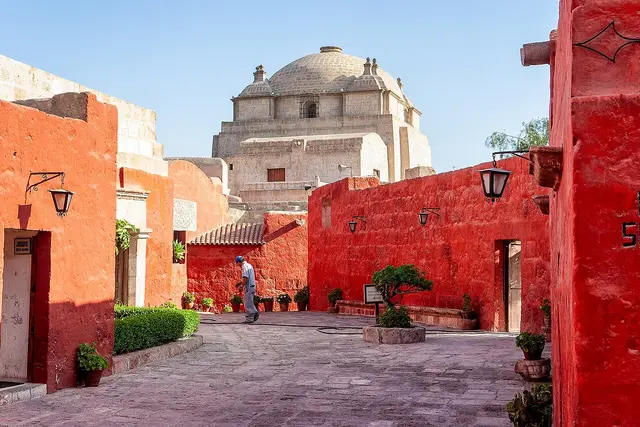
- Santa Catalina Monastery: a few blocks north. It is a walled city within the city, with painted streets of cells and courtyards. Plan a couple of hours there.
- Queso helado: Arequipa’s spiced, milky frozen dessert. Street vendors in the centre scoop it from metal tubs.
- Yanahuara: a viewpoint across the Chili River with sillar arches framing El Misti. It is a short taxi ride, or a longer walk over the bridge.
A sensible half-day starts at the plaza in the morning, goes to the cathedral and La Compañía, then has lunch before Santa Catalina in the afternoon. Return to the balconies at dusk to see the facade lit up.
Frequently asked questions
When is the best time of day to visit Plaza de Armas in Arequipa?
Morning usually gives the clearest view of El Misti behind the cathedral, because cloud can build over the volcanoes later in the day. Come back after dark to see the cathedral facade floodlit. The square is public space and Google lists it as open 24 hours.
How long should I spend at the Plaza de Armas?
Allow about an hour for the square and the cathedral, more if you stop for a drink on a portal balcony. Add a couple of hours if you continue to Santa Catalina Monastery, a few blocks north.
Can I go inside Arequipa Cathedral?
Yes. The cathedral offers guided visits and has a museum, and inside you'll find a large Belgian organ and a carved pulpit with the devil at its base. Visiting hours and mass times change, so check the cathedral's posted notices before you go, and avoid taking photos during services.
How do I get to the Plaza de Armas from the airport or bus terminal?
Arequipa has no metro. Take an official taxi or use a ride-hailing app from Rodríguez Ballón airport or the Terrapuerto bus terminal and ask for "Plaza de Armas". From hotels in the historic centre, it's usually a short walk.
What is there to see near the Plaza de Armas?
Iglesia de la Compañía and its cloisters are just off the southeast corner. Santa Catalina Monastery is a few blocks north, and Calle Mercaderes is a pedestrian street leading off the square. The Yanahuara viewpoint, across the Chili River, frames El Misti through sillar arches.
Plan your trip to Arequipa
Peru eSIM & staying connected →
Some links above are affiliate links — if you book through them, Wander Atlas earns a small commission at no extra cost to you. It's how we keep every guide free.