A town behind a single wall
From Calle Santa Catalina you see a long, high wall of pale stone and very little else. Walk through the entrance and the scale changes. Inside there are lanes, plazas, cloisters, kitchens and rows of private cells, a whole settlement where Dominican nuns lived in seclusion for centuries.
The monastery was founded in the late 16th century. For almost four hundred years it stayed closed to outsiders, and it only opened to the public in 1970. A community of nuns still lives in one part of the complex, which stays off limits. The rest is yours to walk.
It’s one of the most visited sights in Arequipa and one of the most reviewed. Don’t expect it to yourself. Expect a place big enough that the crowd thins once you leave the first courtyards.
Calle Toledo, Calle Granada and the colours of the walls
The lanes inside carry the names of Spanish cities: Toledo, Granada, Córdoba, Sevilla, Málaga. They’re narrow, cobbled and lined with walls of sillar, the white volcanic stone that Arequipa’s colonial centre is built from.
What makes them so photographed is the paint. Some stretches are washed a deep indigo blue. Others are a strong terracotta red, with geraniums in pots set against the plaster. The colours are block-sized, so each turn takes you from one into the other.
Calle Córdoba is the lane most people come back to, with its blue walls and potted flowers. Follow the lanes in order rather than heading for one famous spot, because the layout makes more sense once you’ve walked it as a town.
Cells, kitchens and the laundry
The nuns’ cells explain how the place worked. Many were small private houses rather than bare rooms. They came with a sitting area, a sleeping alcove and a soot-blackened kitchen with a stone hearth. Women from wealthy families arrived with servants and belongings, and the rooms still hold period furniture, cooking pots and devotional art.
Spots to look for as you go:
- Claustro de los Naranjos, the Orange Tree Cloister, with its painted arches and citrus trees
- The Great Cloister, lined with murals on the life of the Virgin and of Christ
- The Novices’ Cloister, where entrants spent their first years
- The laundry, a row of huge earthenware jars cut in half and fed by a channel of running water
- The cell of Sor Ana de los Ángeles Monteagudo, a nun of the monastery beatified by Pope John Paul II in 1985
- The art gallery, with colonial religious paintings in the Cusco school style
There’s also a raised walkway on the upper level. From it you look over the tiled roofs toward El Misti, the volcano that stands over the city.

Beating the midday surge
Timing matters more here than at most sights. The quietest window is 9am–10am, on weekdays and weekends alike. On weekends, 4pm–5pm is quiet too.
Don’t arrive on a weekend between 12pm and 2pm. That’s when the entrance area and the best-known lanes are at their fullest, and the slow photo queues on Calle Córdoba get longer. Right now the monastery opens at 9am and closes at 5pm, so the late weekend window gives you only an hour.
Hours at museums like this one shift through the year, and the monastery has held evening openings on some nights. Check the official site for this month’s schedule, last entry included. Morning light is softer on the white stone. Late-afternoon sun brings out the reds and blues.
Hiring a guide at the gate
Guided tours run from the entrance, and they’re worth taking on your first visit. The complex has no posted story line. A guide explains who lived in which cell, how a novice became a nun and why the walls were painted as they were. Tours are offered in Spanish, English and other languages.
How the guides are paid isn’t fixed, so ask at the ticket desk when you buy your ticket. Many visitors tip their guide at the end. Prices are posted at the ticket desk and on the official site. Carry some soles in case a card machine isn’t working.
Some practical points:
- Respect the cloister. One section is still a working convent, and the doors there stay closed.
- Keep your voice down in the chapel and the cells.
- Ask before you use a tripod. Photography is part of the visit, but the rules can change.
- Take it slowly. Arequipa sits at about 2,300 metres, and the cobbles and stairs add up.
Getting there from the Plaza de Armas
The monastery is a few blocks north of the Plaza de Armas, along Calle Santa Catalina. Walk up past the arcades on the plaza’s side streets and you reach the long white wall. The entrance is at number 301.
Most hotels in the historic centre are close enough to walk. The streets of the centre are on a grid, which makes navigating simple. Taxis know the monastery by name if you’re coming from Yanahuara or further out.
The blocks around Calle Santa Catalina
The whole historic centre is a UNESCO World Heritage Site, and much of it is the same white sillar. That makes it easy to link the monastery to a half-day of walking.
Close by:
- Museo Santuarios Andinos, home of the Inca ice mummy known as Juanita, a short walk south
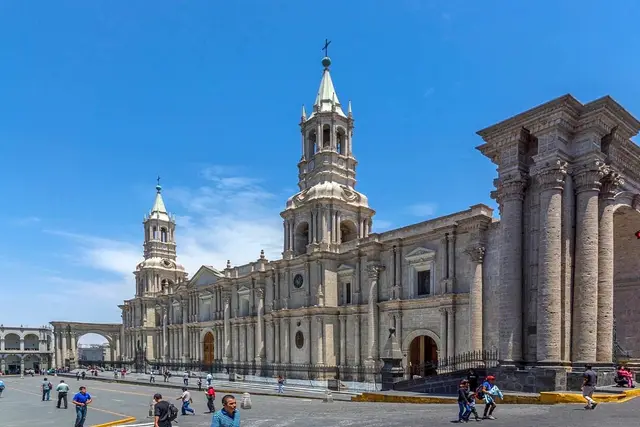
- Basilica Cathedral of Arequipa, which fills one whole side of the Plaza de Armas
- Iglesia de la Compañía, the Jesuit church with a heavily carved sillar facade, at a corner of the plaza
- Mirador de Yanahuara, across the river, with arches framing El Misti, worth a taxi in the late afternoon
Morning at the monastery, lunch near the plaza, then the cathedral or Juanita in the afternoon: that order keeps you out of the weekend midday crowd at Santa Catalina.
Frequently asked questions
When is the quietest time to visit Santa Catalina Monastery?
Between 9am and 10am on any day of the week, and also 4pm–5pm on weekends. Avoid weekends from 12pm to 2pm, which is the busiest window.
How long should I spend inside?
Plan on two to three hours. A guided tour covers the main cloisters and cells. Allow extra time to walk the painted lanes and go up to the walkway with the El Misti view.
Where is it and how do I get there?
It's at Santa Catalina 301, a few blocks north of the Plaza de Armas in Arequipa's historic centre. Most visitors staying in the centre walk there. Taxis know it by name.
Is a guided tour worth it?
Yes, on a first visit. The complex has little signage, and a guide explains the cells, the novice system and the history of the order. Guides are arranged at the entrance, and the ticket desk can tell you how they're paid.
What is there to see nearby?
Museo Santuarios Andinos (the Juanita mummy), the Basilica Cathedral and Iglesia de la Compañía are all a short walk away. The Mirador de Yanahuara, across the river, is a quick taxi ride.
Plan your trip to Arequipa
Peru eSIM & staying connected →
Some links above are affiliate links — if you book through them, Wander Atlas earns a small commission at no extra cost to you. It's how we keep every guide free.