A long grey wall on a quiet lane
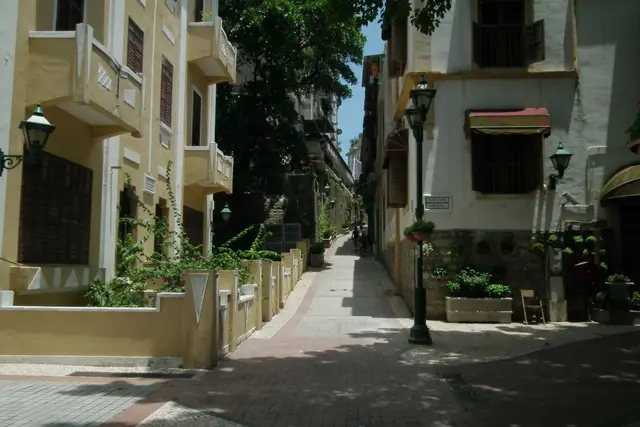
Start at Lilau Square. Travessa de António da Silva leads off it, narrow and gently sloping, and the grey-brick wall of Mandarin’s House runs along one side for longer than a private home has any right to. The entrance is set back from the lane rather than opening straight onto it. That is your first clue to how the whole place works.
Traditional Guangdong houses were built to keep the street out. Here you pass through a gatehouse, turn, and only then see the courtyards. The compound covers roughly 4,000 square metres, which makes it one of the largest family residences in Macau.
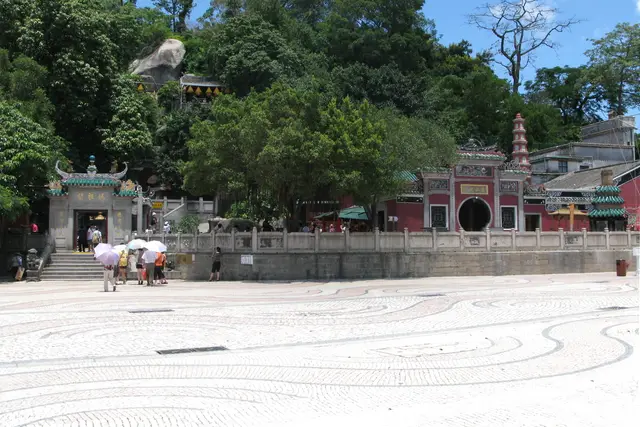
Barra is the part of the peninsula most visitors reach only for A-Ma Temple. A few lanes uphill, this house still draws a fraction of that traffic. It counts as a genuinely quieter find inside a World Heritage zone.
The reformer who wrote here
The house belonged to the family of Zheng Guanying, a merchant, comprador and political thinker of the late Qing dynasty. Building began around 1869, and the family added to it over the following decades. Locally it is known by the family name: Zheng Jia Da Wu in Mandarin, or Casa do Mandarim in Portuguese.
Zheng is remembered for Shengshi Weiyan, usually translated as Words of Warning to a Prosperous Age. It argued that China needed to modernise its commerce, education and government. The book is often credited with shaping the thinking of later figures, Sun Yat-sen among them, and much of it was written in Macau.
Knowing this changes how you walk through the rooms. You are in the study and home of someone whose writing argued for blending Chinese tradition with outside ideas. As you will see, the house itself does exactly that.
Oyster-shell windows and other crossovers
Look up at the window panes. Many are made from thin slices of oyster shell set in wooden lattice, a southern Chinese technique that lets light through as a soft, milky glow. Nobody had to choose between privacy and daylight.
Then look for what does not belong in a “pure” Guangdong house. Mixed in with the Chinese layout are:
- Western-style ceilings and mouldings in some reception rooms
- Indian-influenced decoration around certain window frames
- A moon gate, the round doorway framing the view between courtyards
- Grey brick and dark timber throughout, the standard Lingnan palette
The layout follows the Chinese rule of a series of courtyards and halls. The finishes show a port city where Portuguese, Indian and Chinese builders shared tools and ideas. The government restoration took around eight years, and the house reopened to the public in 2010.
Wednesdays and the 6pm cut-off
The schedule is simple, but one detail catches people out. The house is open 10am to 6pm on Monday, Tuesday, and Thursday through Sunday. Wednesday it is closed. If you are building a Barra day, move it to any other day.
Since the doors close at 6pm, the late afternoon light from A-Ma Temple is not something you can extend into a house visit. Do the house first and the temple and waterfront after. Arriving near opening also leaves time for a guided tour without watching the clock.
Admission details and tour times can change, so check the Macao Cultural Affairs Bureau website or ask at the entrance on the day.
Reaching Lilau Square
Macau has no metro, but the Light Rapid Transit now reaches Barra Station, near A-Ma Temple. From there it is an uphill walk of around ten minutes through the lanes to Lilau Square. Many buses also stop at the A-Ma Temple / Barra terminus.
On foot from Senado Square, allow 20 to 25 minutes. Follow the Historic Centre route south past St. Augustine’s Square, the Dom Pedro V Theatre and St. Lawrence’s Church. The lanes are steep in places and paved with traditional stone.
Taxis know the house as Casa do Mandarim or Lilau Square. Showing either name in writing works better than pronouncing it.
Moving through the courtyards
This is a heritage monument, not a museum with glass cases, and the etiquette follows from that.
- Join a guided tour if one is running. The house is hard to read without someone explaining which wing served which generation. Ask at the entrance about the next tour and which languages are available.
- Stay on the marked paths. Old timber floors and thresholds are fragile, and raised door sills are there to step over, not on.
- Shoot without flash. The oyster-shell panes photograph best in natural light anyway.
- Go slowly in the inner rooms. The halls are set out as rooms rather than galleries, so hanging back by the doorway lets others see in.
Cantonese is the everyday language here. A simple “m goi” (thank you) to the staff goes a long way. Portuguese signage appears alongside Chinese, and English is usually available on interpretive panels.
Lilau and the rest of Barra
Lilau Square is one of the oldest Portuguese residential areas in Macau, laid out around a small fountain under banyan trees. Local saying holds that anyone who drinks from the Lilau spring will never forget Macau, or will return. The original spring now survives only as a decorative fountain, so admire rather than sample.
Within a short walk of the house you can string together:
- Moorish Barracks, the arcaded, Islamic-styled building on Calçada da Barra
- A-Ma Temple, the hillside temple that predates the city and gave Macau its name
- St. Lawrence’s Church, one of the oldest churches in the city
- St. Joseph’s Seminary and Church, with its domed Baroque interior
Together with the house, these make a compact half-day loop of the southern Historic Centre. It needs no transport beyond your feet. Budget one to two hours for Mandarin’s House itself, longer if you join a tour.
Frequently asked questions
What day is Mandarin's House closed?
It is closed on Wednesdays. Every other day of the week it opens from 10am to 6pm.
How do I get to Mandarin's House in Barra?
Take the LRT to Barra Station or a bus to the A-Ma Temple area, then walk uphill about ten minutes to Lilau Square. The house is on Travessa de António da Silva, just off the square. From Senado Square it is a 20 to 25 minute walk via St. Lawrence's Church.
How long should I spend there?
Allow one to two hours. The compound is large, with several courtyards and halls, and a guided tour adds time but explains the layout far better.
Are guided tours available?
Yes, guided tours are offered. Ask at the entrance or check the Macao Cultural Affairs Bureau website for current times and languages.
What else is nearby?
Lilau Square is right outside. The Moorish Barracks, A-Ma Temple, St. Lawrence's Church and St. Joseph's Seminary are all within a short walk, which makes for an easy half-day loop on foot.
Plan your trip to Barra
Macau eSIM & staying connected →
Some links above are affiliate links — if you book through them, Wander Atlas earns a small commission at no extra cost to you. It's how we keep every guide free.