Granite from the Inca city
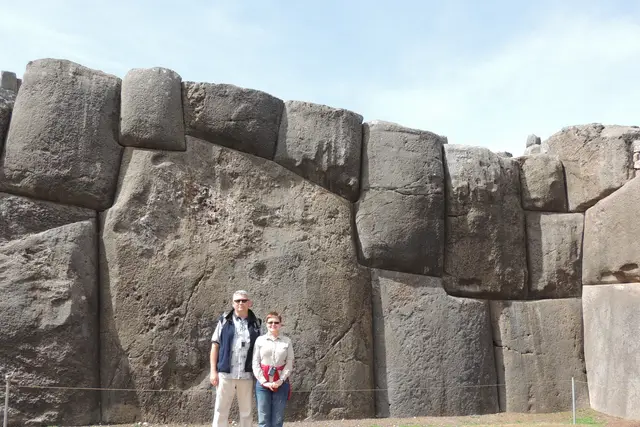
From the Plaza de Armas, the cathedral is a wide, low wall of reddish-brown stone. It sits above a flight of steps on the plaza’s northeast side. Two squat bell towers bracket a carved Renaissance-baroque facade, and the stonework comes from the Inca city that stood here first. Much of that granite was hauled down from Sacsayhuamán, the fortress on the hill above town.
The cathedral went up on the foundations of an Inca palace associated with Viracocha. Construction ran from the mid-16th century to the mid-17th, roughly a hundred years of building. That long timeline shows in the mix of styles: Gothic vaulting, Renaissance proportions and heavy baroque altars all sit under one roof.
Three churches, one front
What looks like one building from the plaza is really a complex of three. The cathedral sits in the middle. To its right is the Iglesia del Triunfo, the first Christian church built in Cusco, on the spot where the Spanish held out during the 1536 Inca siege. To its left is the smaller Iglesia de la Sagrada Familia.
Inside, the spaces open into one another, so you walk from one to the next without going back out onto the plaza. It’s worth knowing before you go, because the side churches hold some of the strongest pieces.
The Last Supper with guinea pig
This is the painting people come looking for. In the cathedral hangs a Last Supper by Marcos Zapata, an 18th-century Quechua painter of the Cusco School. On the platter in front of Christ is a roasted cuy, the guinea pig that is still a festive dish across the Andes. Look closely and you’ll also find Andean fruits and chicha among the more familiar bread and wine.
The Cusco School is the main reason the editorial summary stresses colonial paintings. Indigenous and mestizo artists trained in European techniques painted the canvases that cover the walls here. They added gold-leaf detail and local plants, animals and faces. Things to look for:
- Zapata’s Last Supper and its cuy
- Virgins in triangular, mountain-shaped robes, an image often linked to Pachamama
- Gilded frames and the silver-clad main altar
- The carved cedar choir stalls behind the high altar

The Lord of the Earthquakes
To one side of the nave hangs a darkened crucifix known as the Señor de los Temblores, the Lord of the Earthquakes. Cusqueños credit it with protecting the city during the earthquake of 1650. Centuries of candle smoke have turned the figure nearly black.
Every Holy Monday, the week before Easter, the crucifix is carried out through the Plaza de Armas in one of the city’s biggest processions. Red ñucchu flowers are thrown over it from balconies along the route. If your trip falls in Semana Santa, plan around crowds on the plaza and a packed cathedral.
High in the north tower hangs the María Angola bell, cast in the 17th century and among the largest bells in South America. You’ll hear it on major feast days.
Timing your visit around the Mass windows
The hours are unusual. Google currently shows the cathedral open in two short blocks every day: 6:00–7:00am and 8:00–9:00am. That pattern fits morning Masses rather than a tourist schedule. If you want to see the interior during these windows, you’d be arriving for worship, not a museum visit.
Tourist visiting arrangements for churches in Cusco are often separate from Mass and change through the year and on religious holidays. Check the archdiocese’s official information or ask at the door on the plaza before planning your day around it. Don’t rely on turning up mid-afternoon on the off chance.
Admission for visitors is usually sold separately from the city’s general tourist ticket, and Cusco’s religious-circuit ticket has covered the cathedral along with churches such as San Blas. Current prices are posted at the entrance and on the official site. A proper look at the paintings takes about an hour. Add time if you want to see all three churches.
Stepping in during Mass
Going in during the 6am or 8am slot means walking into a working church, and the behaviour is different. Here’s what to do:
- Come in quietly through the open door and take a pew towards the back, or stand at the side.
- Take hats off. Cover your shoulders and skip shorts, which also helps with the cold stone at that hour.
- Leave the camera alone. Photography inside the cathedral has long been forbidden, and staff enforce it.
- Don’t walk the nave to look at paintings while the service is on. Wait until it ends and the congregation has left.
- Most of the service is in Spanish. If you sit through it, stand and sit when everyone else does.
Cusco sits at about 3,400 metres. An early climb up the cathedral steps on your first morning can leave you short of breath, so take them slowly.
Around the Plaza de Armas
When you leave, you’re already in the middle of Cusco’s sights. Opposite, on the plaza’s southeast side, is the Jesuit church of La Compañía de Jesús. Its towers were built to rival the cathedral’s. The arcaded balconies around the square are good for looking back at the cathedral front.
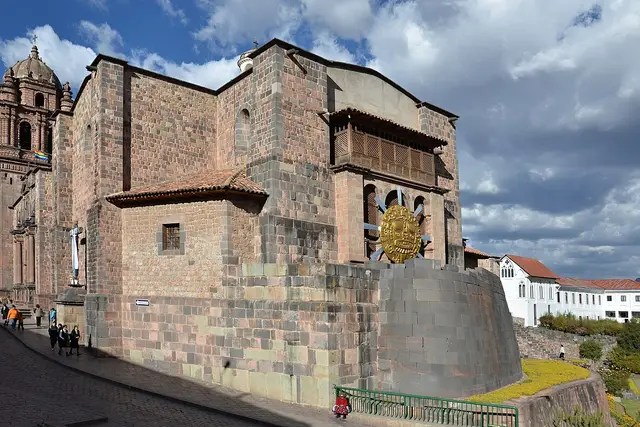
Walk uphill along Calle Hatun Rumiyoq to find the twelve-angled stone set into an Inca wall. Keep going and you reach the San Blas neighbourhood with its church and artisan workshops. Downhill, about ten minutes on foot, is Qorikancha, the Inca sun temple with the Santo Domingo convent built on top of it. Seeing it after the cathedral makes the same story of stone and conquest easy to follow.
Frequently asked questions
Where exactly is Cusco Cathedral?
It's on the northeast side of the Plaza de Armas in central Cusco, at the top of a flight of steps. The Iglesia del Triunfo is to its right and the Iglesia de la Sagrada Familia to its left. You can walk there from anywhere in the historic centre.
What are the opening hours?
Google currently lists two short windows every day, 6:00–7:00am and 8:00–9:00am, which look like Mass times. Visiting arrangements for tourists can be separate and change through the year and on holidays, so check the archdiocese's official information or ask at the entrance before you go.
How long should I spend inside?
About an hour covers the main paintings, the Señor de los Temblores and the choir stalls. Allow more if you want to see the two side churches properly.
Can I take photos inside?
No. Photography inside the cathedral has long been forbidden and staff enforce it. Take your pictures of the facade from the Plaza de Armas or the balconies around it.
What should I see nearby?
La Compañía de Jesús is across the plaza. The twelve-angled stone on Calle Hatun Rumiyoq and the San Blas neighbourhood are a short walk uphill, and Qorikancha is about ten minutes downhill on foot.
Plan your trip to Cusco
Peru eSIM & staying connected →
Some links above are affiliate links — if you book through them, Wander Atlas earns a small commission at no extra cost to you. It's how we keep every guide free.